ERDI & Public Safety Diving

Lifeguard Training vs ERDI Rescue Swimmer: When Surface Skills Must Meet Operational Reality

The Strength of Lifeguard Training

Lifeguard programmes typically focus on:

  • Surface surveillance.
  • Rapid water entry.
  • Approach techniques.
  • Victim tow methods.
  • Basic spinal management.
  • CPR and AED protocols.

These skills are critical.

They create:

  • Confidence in water.
  • Strong rescue swimming technique.
  • Situational scanning awareness.
  • Initial casualty stabilisation ability.

But lifeguard training assumes:

  • Controlled environment.
  • Defined swimming areas.
  • Clear visibility.
  • Limited environmental hazards.

Operational water rarely offers such simplicity.


Where Lifeguard Skills Meet Their Limits

Real-world environments introduce:

  • Currents.
  • Offshore wind.
  • Reduced visibility.
  • Boat traffic.
  • Debris.
  • Night operations.
  • Panic victims.
  • Multiple casualties.

Surface rescue skills alone are insufficient when:

  • The victim submerges.
  • Evidence recovery is required.
  • Structural hazards are present.
  • Team coordination becomes necessary.

Swimming strength does not equal operational readiness.


ERDI Rescue Swimmer I: Structured Operational Foundation

ERDI Rescue Swimmer I builds on lifeguard capability and introduces:

  • Operational team integration.
  • Communication protocols.
  • Search patterns.
  • Victim control under stress.
  • Equipment familiarity.
  • Risk assessment procedures.

It transitions from:

Individual rescuer.

To:

Operational team member.

Discipline replaces improvisation.

Procedure replaces reaction.

Four lifeguards in red and yellow uniforms kneel on a sandy beach next to medical equipment, appearing to assist someone lying on the ground, with an orange rescue boat nearby and the sea in the background.

ERDI Rescue Swimmer II: Advanced Water Operations

Rescue Swimmer II expands capability into:

  • Complex rescue environments.
  • Night operations.
  • Extended search operations.
  • Evidence preservation.
  • Multi-agency coordination.
  • Structured command integration.

Swimmers operate under:

Incident Command Systems.

Defined roles.

Chain-of-command protocols.

Water rescue becomes:

Mission execution.

Not individual heroics.


Surface vs Subsurface Reality

Lifeguards typically operate:

On the surface.

ERDI rescue swimmers must manage:

  • Surface and subsurface environments.
  • Victim retrieval below the surface.
  • Body recovery operations.
  • Underwater hazard recognition.

Transitioning from lifeguard to operational rescue requires:

Comfort below the surface.

Controlled breath management.

Calm under zero visibility.

Surface fitness alone is insufficient.


Risk Management and Decision-Making

Operational rescue introduces:

  • Dynamic hazard analysis.
  • Team positioning strategy.
  • Extraction planning.
  • Equipment staging.
  • Medical evacuation coordination.

Rescue swimmers must assess:

When to enter.

When to wait.

When to deploy additional resources.

Bravery without structure increases risk.

Professional restraint increases survivability.


Victim Psychology and Control

Panic victims are unpredictable.

Rescue swimmers must manage:

  • Defensive approach techniques.
  • Physical resistance.
  • Multiple casualty scenarios.
  • Post-extraction management.

ERDI training emphasises:

Control first.

Stability second.

Extraction third.

Sequence matters.


Environmental Complexity

Rescue operations may involve:

  • Moving water.
  • Rip currents.
  • Flood conditions.
  • Offshore wind patterns.
  • Structural hazards.

Environmental literacy becomes critical.

Water is not uniform.

It is dynamic.

Professional swimmers must read water behaviour before entering.
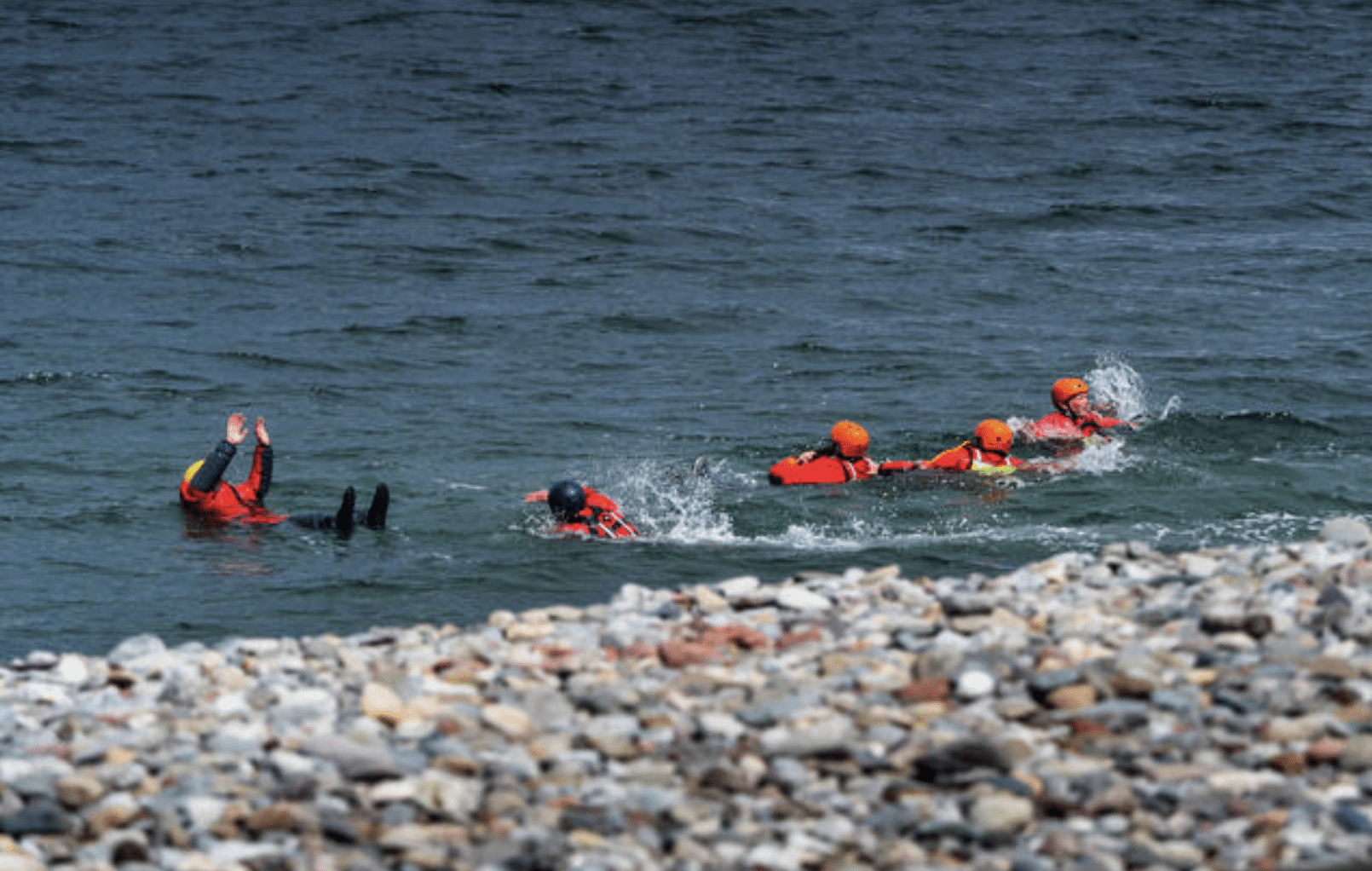
Several people in red wetsuits and helmets are swimming in choppy water near a rocky shore, with one person slightly separated from the group, reaching their arms upwards.

Fitness Is Necessary — But Not Enough

Operational rescue requires:

  • Endurance.
  • Strength.
  • Breath control.
  • Mental resilience.

But fitness must combine with:

Procedure.

Communication.

Role clarity.

Team discipline.

Operational performance is systemic.

Not individual.


Why the Transition Matters

Many lifeguards assume:

Their qualification prepares them for all water rescue.

It does not.

Lifeguard training is foundation.

ERDI Rescue Swimmer training is expansion.

It introduces:

  • Formal structure.
  • Operational accountability.
  • Scenario-based repetition.
  • Interagency integration.

At N9BO℠, we emphasise that strong swimmers are assets — but structured rescue professionals are force multipliers.


Team Integration

ERDI Rescue Swimmers operate within:

  • Incident Command structure.
  • Dive team hierarchy.
  • Medical support coordination.
  • Law enforcement frameworks.

Communication protocols are defined.

Role boundaries are clear.

Authority gradient is managed.

Rescue becomes coordinated.

Not chaotic.


From Pool to Real World

Transitioning from:

Controlled environment.

To:

Operational water.

Requires mindset shift.

Pool environments:

Predictable.

Operational environments:

Unpredictable.

Training must simulate stress.

Comfort must be earned.


Final Perspective

Lifeguard training builds:

Strong foundation.

ERDI Rescue Swimmer builds:

Operational capability.

Surface strength is essential.

But professional rescue requires:

Discipline.

Structure.

Team integration.

Environmental literacy.

Water rescue is not about speed alone.

It is about controlled execution under uncertainty.

Two lifeguards in wetsuits carry another person in a wetsuit across shallow water near the shore, with a rescue board nearby and waves in the background.


Ready to Expand Beyond Traditional Lifeguard Training?


Transition from strong swimmer to operational rescue professional. Contact N9BO℠ to explore ERDI Rescue Swimmer I & II training pathways.


From the N9BO℠ Knowledge Base


Share this

Underwater Evidence Recovery: Best Practices for Dive Teams

The Difference Between Recovery and Evidence Recovery

At first glance, recovering an object underwater may seem straightforward.

Locate the item, secure it, and bring it to the surface.

But when that object becomes evidence, the nature of the operation changes entirely.

The diver is no longer simply retrieving an item.

They are interacting with a potential crime scene.

Every movement, every contact, every decision has consequences beyond the dive itself. Evidence can be:

  • Damaged
  • Contaminated
  • Displaced
  • Rendered unusable in legal proceedings

The objective is no longer just recovery.

It is preservation.

This distinction is what separates general diving operations from forensic underwater work.


The Underwater Crime Scene

Water is a dynamic environment.

Unlike a controlled land-based scene, an underwater site is subject to:

  • Currents
  • Sediment movement
  • Biological activity
  • Limited visibility

Evidence may already be:

  • Partially buried
  • Dispersed
  • Degraded

The diver must operate within this environment without making it worse.

This requires a shift in mindset.

The diver is not simply navigating the environment.

They are interacting with a fragile system where even minor disturbance can alter the outcome of an investigation.


Precision Over Speed

In many public safety operations, time is critical.

There is pressure to:

  • Locate quickly
  • Recover efficiently
  • Conclude operations

However, in evidence recovery, speed is secondary to precision.

Rushing increases the risk of:

  • Disturbing sediment and obscuring visibility
  • Moving or losing small items
  • Damaging delicate evidence

A controlled, methodical approach ensures that:

  • The scene is understood
  • Evidence is identified correctly
  • Recovery is executed without unnecessary disturbance

Professional teams accept that taking more time underwater may save significantly more time—and complications—later.

A fishing weight and hook entangled in fishing line rest on the sea floor among rocks and algae, highlighting marine pollution.

Search Methodology and Scene Integrity

Before any recovery begins, the search itself must be structured.

Random movement through a potential evidence field is unacceptable.

Search patterns must be:

  • Systematic
  • Repeatable
  • Documented

This ensures that:

  • The entire area is covered
  • Findings can be correlated to specific locations
  • The integrity of the scene is maintained

In low-visibility environments, this becomes even more important.

The diver must rely on:

  • Tactile search techniques
  • Line-based navigation
  • Procedural discipline

The search is not just about finding items.

It is about understanding their position within the environment.

Because that position may be critical to the investigation.


Handling Evidence Underwater

Once evidence is located, the challenge shifts to handling.

Underwater handling is inherently difficult:

  • Dexterity is reduced
  • Visibility is limited
  • Equipment restricts movement

This increases the risk of:

  • Dropping items
  • Causing damage
  • Losing context

Divers must be trained to:

  • Approach slowly
  • Stabilise themselves before contact
  • Use controlled movements

In some cases, it is preferable to:

  • Mark the location
  • Document the find
  • Plan recovery with additional resources

Rather than attempting immediate retrieval.

The decision to recover must be deliberate.

Not reactive.


Contamination Control

Water itself is not a sterile environment.

It introduces:

  • Biological material
  • Chemical contaminants
  • Sediment

Divers must ensure that their actions do not introduce additional contamination.

This includes:

  • Avoiding unnecessary contact
  • Using appropriate recovery containers
  • Minimising disturbance

In contaminated water environments, diver safety also becomes a factor.

Protective equipment must be used correctly to:

  • Prevent exposure
  • Maintain operational capability

Contamination control is both:

  • An evidentiary requirement
  • A safety requirement

Documentation and Chain of Custody

Recovery is only one part of the process.

What happens after the item is brought to the surface is equally important.

Evidence must be:

  • Documented
  • Handled correctly
  • Transferred according to protocol

The chain of custody must be maintained.

This ensures that:

  • The evidence can be traced
  • Its integrity is preserved
  • It remains admissible in legal proceedings

Divers play a role in this process.

They must:

  • Communicate clearly with surface teams
  • Provide accurate information about the recovery
  • Ensure proper handling during transfer

A successful recovery that fails in documentation is still a failure.

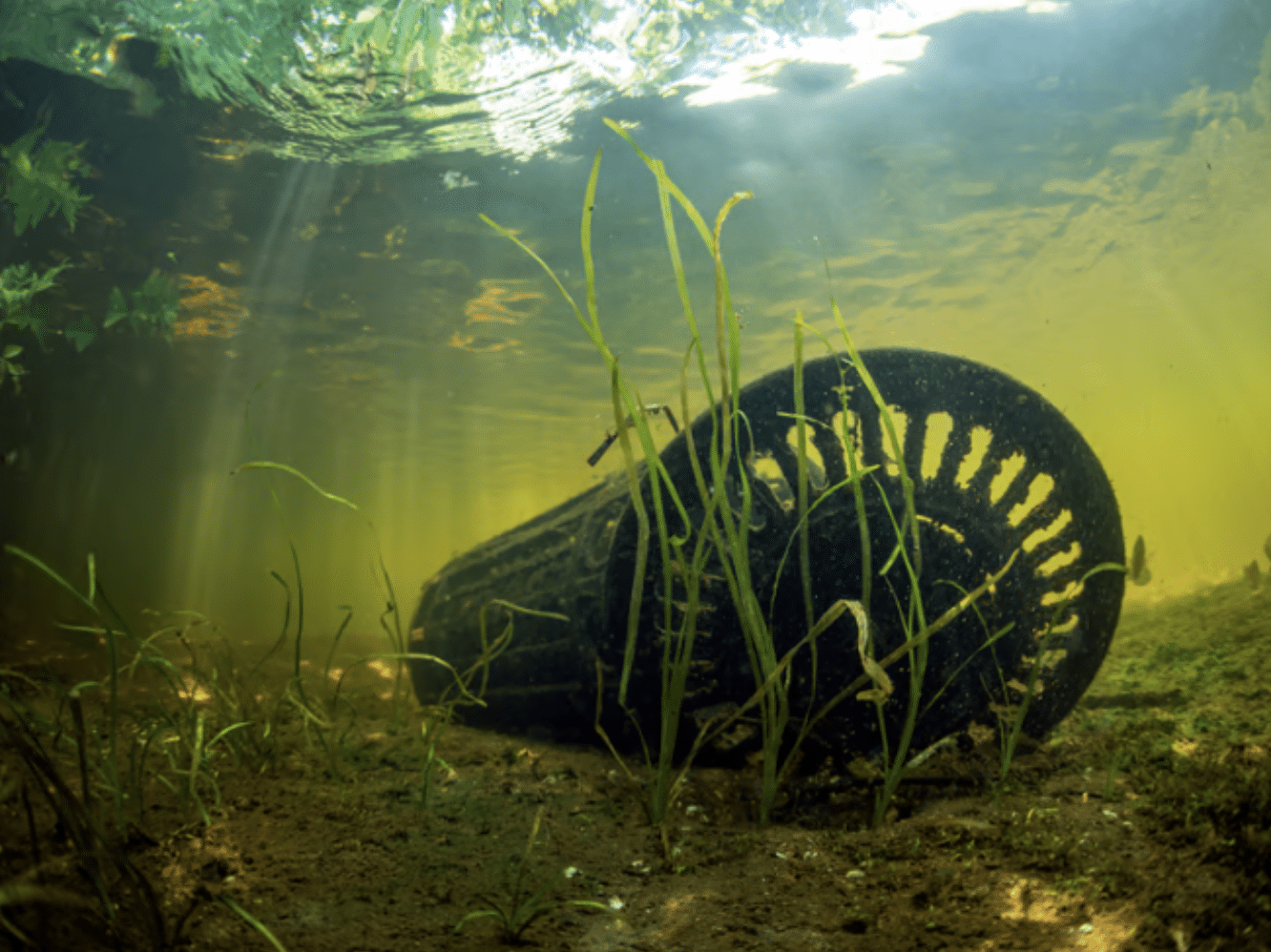
A black cylindrical object with slotted openings lies on the sandy floor of a shallow, sunlit body of water, surrounded by green aquatic plants and algae. Sunbeams filter through the water’s surface.

Team Coordination and Role Clarity

Underwater evidence recovery is not an individual task.

It requires coordination between:

  • Diver
  • Tender
  • Supervisor
  • Surface support

Each role contributes to:

  • Maintaining scene integrity
  • Ensuring safety
  • Supporting the diver

The diver focuses on:

  • Search and recovery

The tender maintains:

  • Line control
  • Communication

The supervisor ensures:

  • Operational oversight
  • Decision-making

This structure allows the operation to function as a system.

Without it, coordination breaks down.

And with it, the complexity of the task becomes manageable.


Training for Real Conditions

Evidence recovery cannot be learned through theory alone.

It requires:

  • Practical training
  • Scenario-based exercises
  • Exposure to realistic conditions

At N9BO℠, training emphasises:

  • Precision
  • Discipline
  • Procedural integrity

Because real-world operations do not occur in controlled environments.

Divers must be prepared to operate:

  • In low visibility
  • Under pressure
  • With limited feedback

Training must reflect this reality.


Final Perspective

Underwater evidence recovery is one of the most demanding disciplines in public safety diving.

It requires:

  • Technical skill
  • Procedural discipline
  • Forensic awareness

The objective is not simply to retrieve.

It is to preserve.

Every action taken underwater has consequences beyond the dive.

Professional teams understand this.

They operate with:

  • Precision
  • Patience
  • Respect for the process

Because in this context, success is not defined by what is brought to the surface.

It is defined by what remains intact.

Aerial view of three red, circular floating structures anchored in clear blue-green water, with small yellow buoys nearby.


Training for Professional Underwater Evidence Recovery?


Contact N9BO℠ to develop ERDI-based forensic diving capabilities built for precision, integrity, and real-world operations.


From the N9BO℠ Knowledge Base


Share this

Night Diving and Black-Water Procedures: Safety Tips for Public Safety Teams

Darkness Changes the Operating Environment

Night diving is often misunderstood as simply “diving with less light.” In reality, it fundamentally alters how divers perceive and interact with their surroundings.

Even in relatively clear water, darkness reduces:

  • Depth perception
  • Spatial awareness
  • Peripheral vision

In public safety diving, where visibility may already be near zero, night operations compound these limitations. The diver is no longer navigating through an environment—they are operating within an absence of visual information.

This has immediate implications.

Tasks that would be straightforward in daylight become:

  • Slower
  • More cognitively demanding
  • More reliant on discipline and procedure

Darkness does not just reduce visibility.

It increases uncertainty.


Black-Water Conditions: When Vision Is Irrelevant

Black-water diving takes this a step further.

In many public safety scenarios—rivers, lakes, flooded environments—visibility is already negligible. At night, the distinction between “low visibility” and “no visibility” disappears entirely.

The diver operates in a space where:

  • Lights may illuminate only particles
  • Reference points are absent
  • Orientation must be maintained without visual cues

This forces a complete reliance on:

  • Tactile feedback
  • Line systems
  • Procedural memory

In these conditions, experience alone is not enough. Without structured training, divers can quickly lose orientation, drift off pattern, or become task-fixated.

The environment removes visual control.

Only discipline replaces it.


Psychological Load in Darkness

One of the most significant challenges in night and black-water diving is psychological.

Darkness introduces:

  • Sensory deprivation
  • Increased perception of isolation
  • Heightened stress response

Even experienced divers can feel disoriented when visual cues disappear completely.

This is not a failure of skill.

It is a natural human response.

The problem arises when this stress begins to affect:

  • Breathing patterns
  • Decision-making
  • Task execution

A diver who begins to feel “lost” in darkness may:

  • Rush movements
  • Overcompensate
  • Lose procedural focus

Training must address this directly.

At N9BO℠, we emphasise exposure to these environments in controlled conditions. Because the first time a diver experiences total darkness should not be during a real operation.

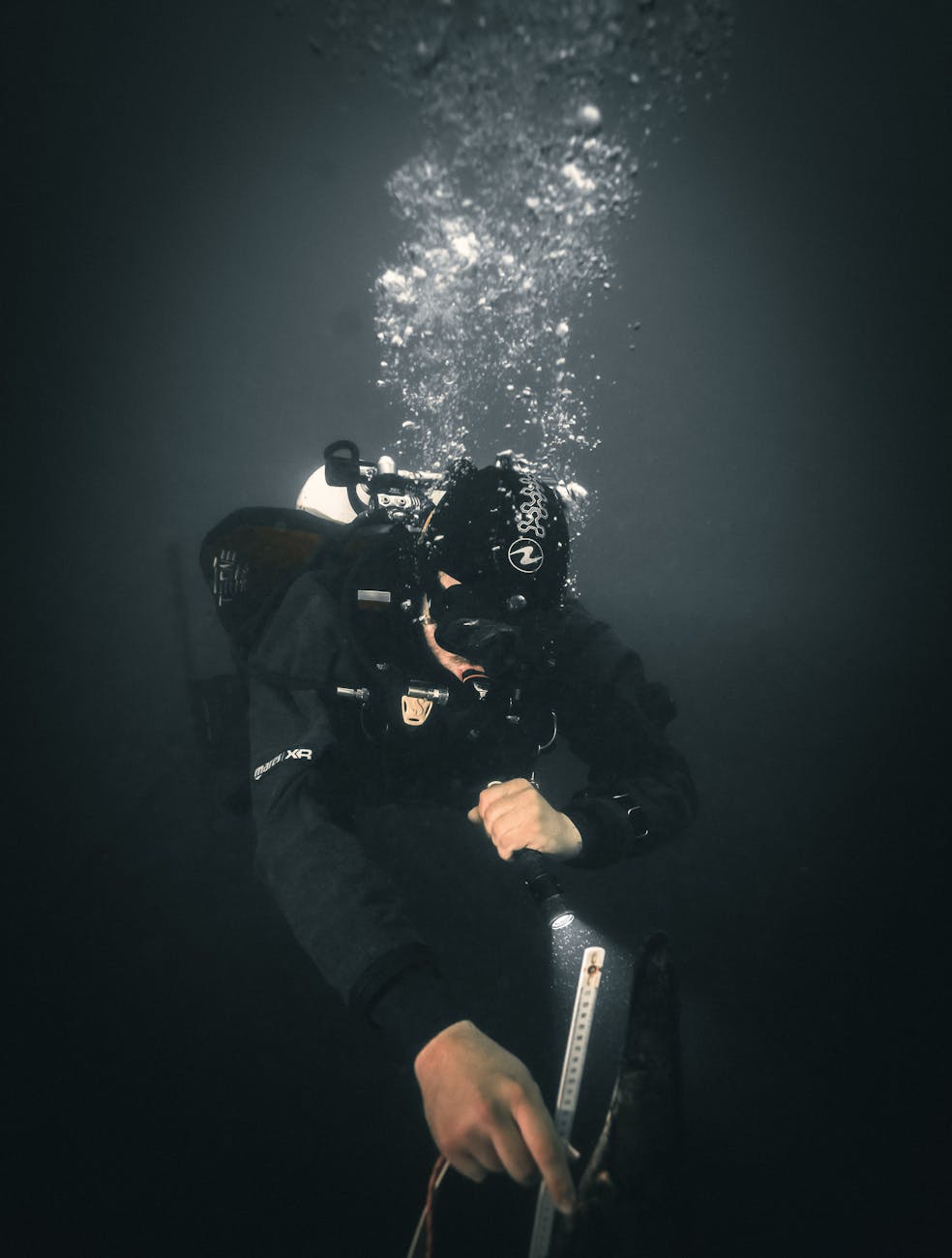
man scuba diving

Lighting: Tool, Not Solution

Lighting systems are essential in night operations—but they are often misunderstood.

A dive light does not restore normal visibility.

In many public safety environments, it can:

  • Reflect off suspended particles
  • Reduce effective visibility
  • Create visual noise

This is especially true in contaminated or silty water.

Lights should be used strategically:

  • To illuminate specific tasks
  • To signal position when appropriate
  • To assist in controlled situations

But they must never be relied upon as the primary means of orientation.

Divers must be trained to operate effectively:

  • With light
  • Without light
  • In conditions where light provides minimal benefit

Because in black-water environments, light is often secondary to procedure.


Tethered Operations and Control

In night and zero-visibility conditions, tethered diving becomes a primary control mechanism.

The line serves multiple purposes:

  • Navigation reference
  • Communication channel
  • Safety link to the surface

The relationship between diver and tender becomes critical.

The tender must:

  • Monitor line tension continuously
  • Interpret signals accurately
  • Maintain awareness of diver movement

The diver must:

  • Maintain consistent line awareness
  • Communicate clearly
  • Avoid unnecessary slack or tension

This system replaces visual coordination.

When executed correctly, it provides:

  • Stability
  • Control
  • Continuous situational awareness

When executed poorly, it introduces confusion and risk.


Movement and Task Execution

In darkness, movement must be deliberate.

There is no visual feedback to correct:

  • Position
  • Direction
  • Body alignment

Divers must rely on:

  • Trim
  • Propulsion control
  • Spatial awareness built through training

Uncontrolled movement leads to:

  • Disorientation
  • Loss of search pattern
  • Increased gas consumption

Task execution must also adapt.

Simple actions become more complex when:

  • They cannot be seen
  • They must be performed by feel
  • They require coordination with the surface

This is where procedural discipline becomes critical.

Every movement must be:

  • Intentional
  • Controlled
  • Aligned with the plan
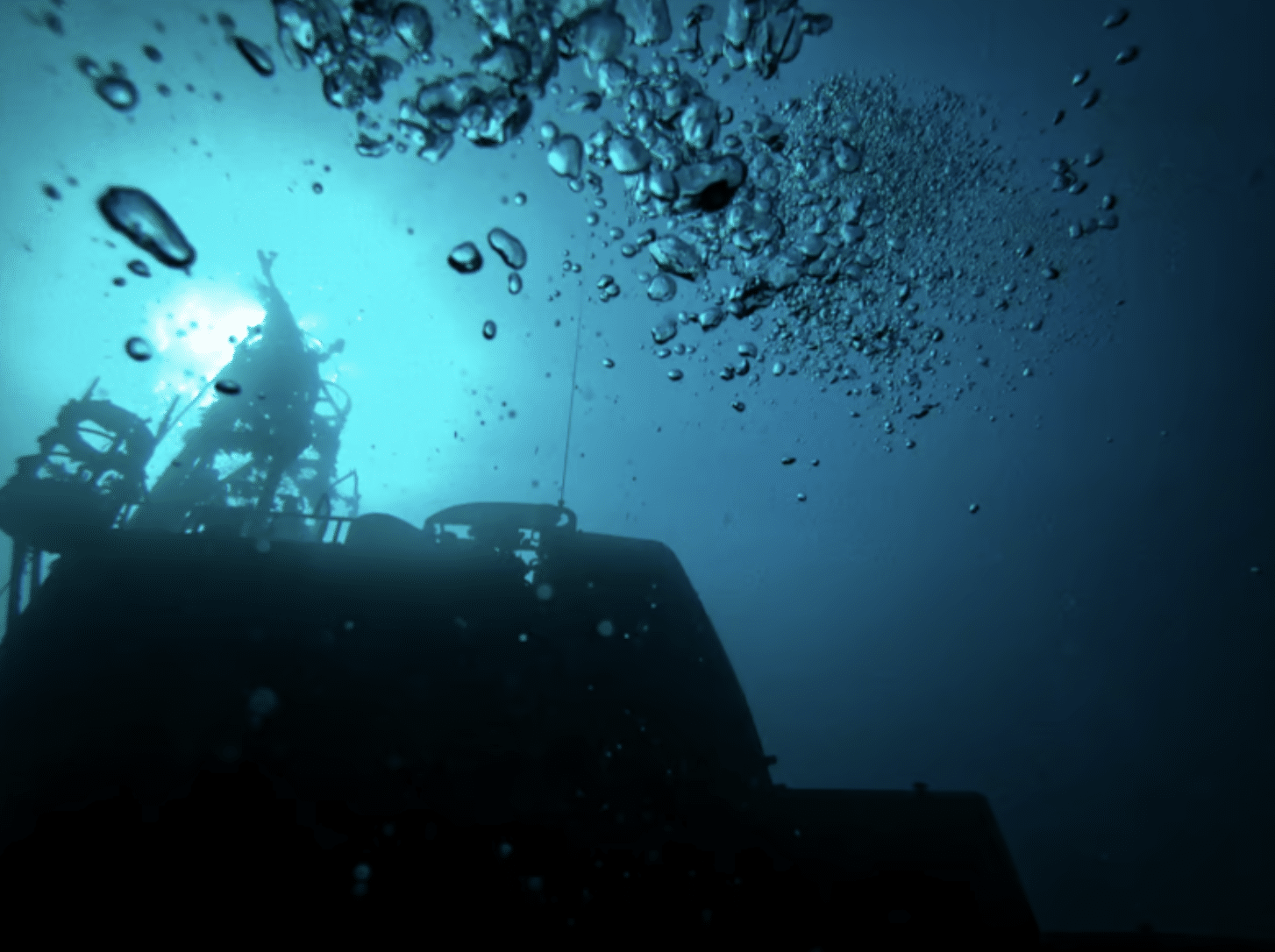
Underwater view of a shipwreck with sunlight filtering from above, bubbles rising towards the surface, and the silhouette of the vessel partially visible in the deep blue water.

Communication: Precision Over Assumption

In night operations, communication errors are more likely.

Visual confirmation is limited or absent.

This means:

  • Line signals must be clear
  • Verbal communication (if available) must be precise
  • Assumptions must be eliminated

A missed or misinterpreted signal can lead to:

  • Incorrect actions
  • Delayed response
  • Escalation of a manageable situation

Teams must train communication until it becomes automatic.

Because in darkness, there is no room for hesitation.


Fatigue and Cognitive Load

Operating in darkness increases cognitive demand.

The diver must:

  • Maintain orientation without visual cues
  • Execute tasks by feel
  • Monitor gas and time
  • Communicate effectively

This creates:

  • Mental fatigue
  • Reduced processing speed
  • Increased likelihood of error over time

Operations must account for this.

This includes:

  • Defined time limits
  • Diver rotation
  • Clear abort criteria

Ignoring fatigue does not increase efficiency.

It increases risk.


Training: Making the Unfamiliar Familiar

Night and black-water diving should never be treated as an advanced add-on skill.

For public safety teams, it is a core operational requirement.

Training must include:

  • Controlled exposure to darkness
  • Scenario-based exercises
  • Stress management

At N9BO℠, we integrate these elements into training because real-world operations do not occur in ideal conditions.

Divers must be prepared to operate:

  • Without visibility
  • Under pressure
  • With full reliance on procedure

The objective is not to make the environment easier.

It is to make the diver more capable within it.


Final Perspective

Night diving and black-water operations remove one of the most fundamental tools a diver has: vision.

In its absence, everything else becomes more important:

  • Procedure
  • Communication
  • Discipline
  • Team coordination

These environments do not forgive improvisation.

They reward preparation.

Teams that train for darkness operate with control.

Those that do not are forced to react within it.

And in public safety diving, reacting is never as effective as being ready.

A silhouette of a scuba diver underwater, swimming towards a bright blue opening in a dark cave or cavern, with bubbles rising above them.


Need to Standardise Your Dive Team Briefings?


Contact N9BO℠ to implement structured ERDI operational protocols and real-world briefing systems for public safety teams.


From the N9BO℠ Knowledge Base


Share this

Checklist: Pre-Dive Briefing for a Low-Visibility Public Safety Operation

Why the Briefing Is the Real Start of the Dive

In recreational diving, the briefing is often treated as a routine step—a quick overview before entering the water. In public safety diving, particularly in low-visibility environments, the briefing is where the operation truly begins.

By the time a diver enters zero visibility, it is too late to clarify roles, reconsider procedures, or correct misunderstandings. There is no visual feedback, no easy communication, and no margin for improvisation. The diver relies entirely on what was established before the dive.

A structured briefing ensures that every member of the team understands:

  • The objective
  • The plan
  • Their role within that plan

Without this alignment, the team is not operating as a system. It is operating as individuals—and in public safety diving, that is where failures begin.


Low Visibility Changes Everything

Low-visibility operations fundamentally alter how diving works.

In clear water, divers can rely on:

  • Visual orientation
  • Immediate situational awareness
  • Direct communication through signals

In zero visibility, these disappear.

The diver must rely on:

  • Tactile feedback
  • Line signals
  • Procedural memory

This means that uncertainty cannot be resolved underwater.

Every decision, every contingency, every signal must be defined in advance. The briefing becomes the only opportunity to ensure that:

  • The diver and tender interpret signals the same way
  • Emergency responses are understood
  • The operational sequence is clear

The absence of visibility increases the importance of preparation exponentially.


Defining the Objective With Precision

The first element of any briefing is the objective.

In public safety diving, objectives are not vague. They must be specific and measurable.

For example, instead of:

“Search the area”

The objective should be:

“Conduct a systematic search of Sector A using a tethered circular pattern to locate a submerged vehicle reported at approximately 4–6 metres depth.”

This level of clarity ensures that:

  • The diver understands what success looks like
  • The team can evaluate progress
  • The operation remains focused

Ambiguity at this stage leads to inefficiency and confusion underwater.


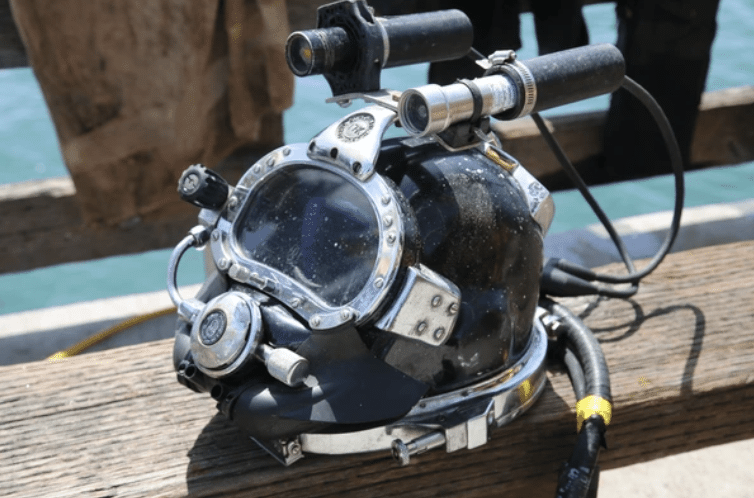
A close-up of a black and silver commercial diving helmet with attached lights and hoses, resting on a wooden surface near water on a sunny day.

Roles and Responsibilities: Eliminating Ambiguity

In low-visibility operations, role clarity is essential.

Each team member must know exactly:

  • What they are responsible for
  • What they are not responsible for

The diver focuses on:

  • Executing the search
  • Maintaining orientation
  • Communicating through the line

The tender is responsible for:

  • Managing the tether
  • Monitoring diver movement
  • Interpreting and sending signals

The supervisor maintains:

  • Overall situational awareness
  • Decision-making authority
  • Safety oversight

If roles are not clearly defined, tasks overlap or are neglected. This creates delays and increases risk.

Professional teams remove ambiguity before the dive begins.


Search Patterns and Operational Method

Low-visibility diving requires systematic search patterns.

These must be agreed upon during the briefing.

The team must define:

  • The type of search (circular, jackstay, grid, etc.)
  • Starting point
  • Direction of movement
  • Coverage expectations

The diver must visualise the pattern before entering the water.

Because once submerged, they will not see the environment.

They will rely entirely on:

  • Muscle memory
  • Line tension
  • Procedural understanding

At N9BO℠, we emphasise that a diver should be able to “see the dive” in their mind before it happens. This mental model is what replaces vision underwater.


Communication: The Lifeline Between Diver and Surface

In low visibility, communication is not optional—it is the lifeline.

If using tethered operations, line signals must be clearly defined and confirmed.

This includes:

  • Standard signals (OK, stop, more line, less line)
  • Emergency signals
  • Recall procedures

Both diver and tender must:

  • Confirm understanding
  • Practise if necessary

Misinterpretation of a signal can lead to:

  • Incorrect actions
  • Delayed response
  • Escalation of a problem

Communication protocols must be simple, clear, and consistent.


Gas Management and Time Limits

Gas planning must be addressed during the briefing.

This includes:

  • Starting pressure
  • Turn pressure
  • Emergency reserves

In public safety diving, the diver may be task-focused, which can lead to reduced awareness of gas consumption.

The team must define:

  • When the diver will be recalled
  • How gas status will be monitored
  • What triggers an abort

Time limits should also be established to manage:

  • Fatigue
  • Thermal exposure
  • Cognitive load

These limits are not suggestions.

They are operational controls.

A commercial diver in a heavy-duty diving suit and helmet prepares to enter the water, assisted by a colleague in a hard hat and yellow safety vest on a metal platform by a boat.

Emergency Procedures: Planning for Failure

Every briefing must include contingency planning.

The team must address:

  • What happens if the diver becomes unresponsive
  • What happens if the line is lost
  • What happens if equipment fails

These scenarios must be:

  • Discussed
  • Understood
  • Agreed upon

Because in low visibility, failure is not always immediately visible.

The team must be prepared to respond without hesitation.

Planning for failure is not pessimistic.

It is professional.


Environmental and Site Hazards

Before the dive, the team must review environmental factors.

This includes:

  • Current
  • Depth
  • Bottom composition
  • Known hazards

In public safety environments, hazards may include:

  • Debris
  • Sharp objects
  • Entanglement risks
  • Contamination

Understanding these factors allows the team to:

  • Adjust procedures
  • Increase awareness
  • Reduce exposure

The environment does not change because of the dive.

The plan must adapt to it.


The Briefing as a Discipline

A proper briefing is not rushed.

It is not informal.

It is a structured process that:

  • Aligns the team
  • Reduces uncertainty
  • Establishes control

Teams that treat briefings as routine tend to:

  • Skip details
  • Assume understanding
  • Miss critical information

Professional teams treat briefings as a discipline.

Because the quality of the briefing directly affects the quality of the dive.


Final Perspective

In low-visibility public safety diving, the most important decisions are made before entering the water.

The briefing defines:

  • The objective
  • The method
  • The response to failure

It creates a shared understanding that allows the team to operate without visual feedback.

Without a structured briefing, even experienced divers are reduced to guesswork.

With it, the team operates as a system.

And in environments where nothing can be seen, that system is what keeps the operation safe—and successful.

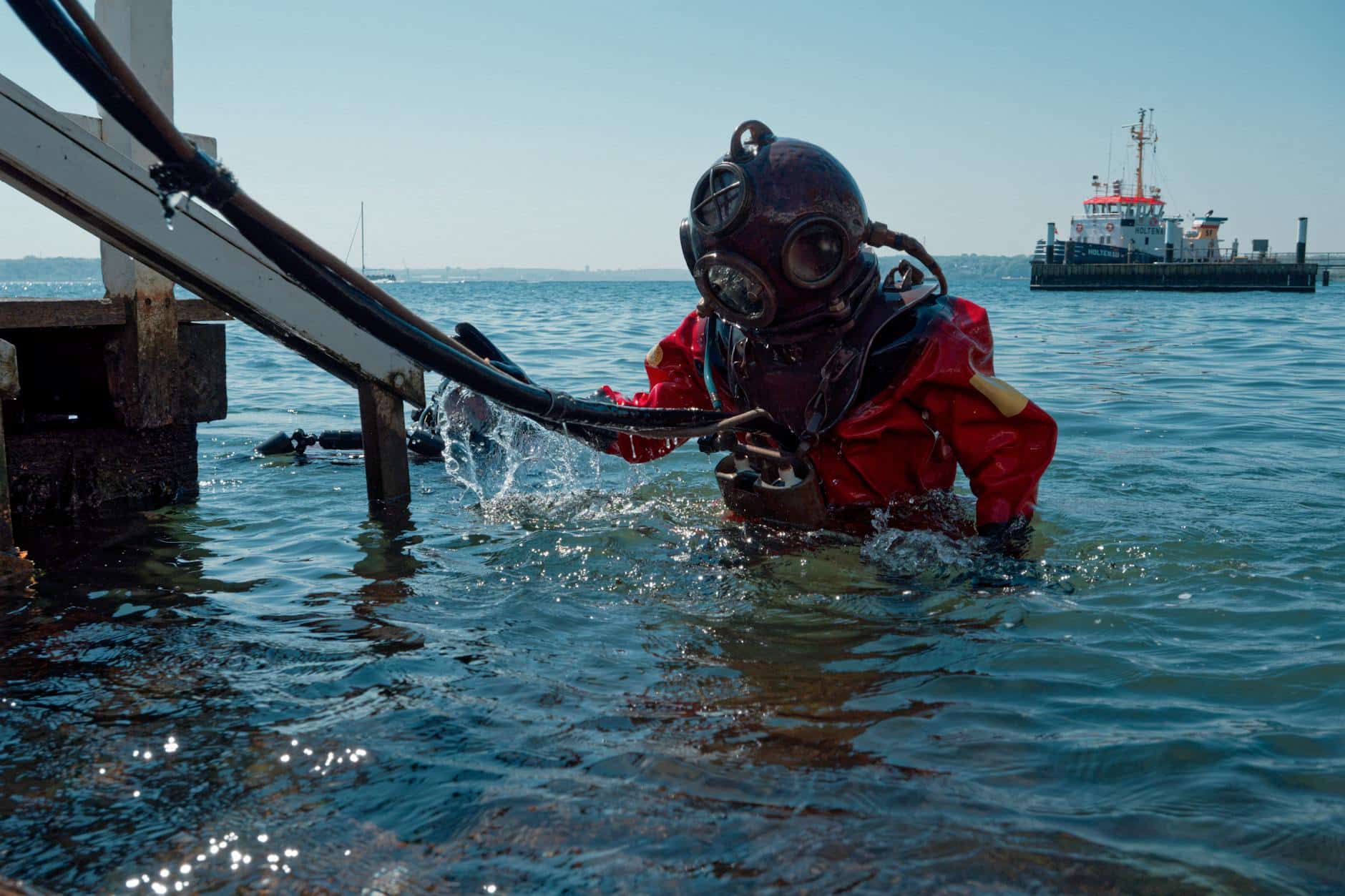
diver in a red standard diving dress with a brass helmet coming out of the sea


Need to Standardise Your Dive Team Briefings?


Contact N9BO℠ to implement structured ERDI operational protocols and real-world briefing systems for public safety teams.


From the N9BO℠ Knowledge Base

Share this

How to Build a Basic Public Safety Dive Team: Equipment, Roles, and Protocols

A Dive Team Is Not Just a Group of Divers

One of the most common misconceptions in public safety operations is that a dive team is simply a collection of certified divers.

It is not.

A public safety dive team is an operational unit designed to function under:

  • Stress
  • Time pressure
  • Adverse environments

This requires more than individual competence.

It requires:

  • Defined roles
  • Coordinated procedures
  • Structured communication

Without these elements, a group of divers becomes disorganised quickly—especially in low-visibility, high-stakes environments.

The distinction is critical.

Because in public safety diving, disorganisation is not inefficient—it is dangerous.


Start With the Mission, Not the Equipment

Many teams begin by purchasing equipment.

This is a mistake.

Equipment should follow:

  • Operational requirements
  • Mission profiles
  • Environmental conditions

A department operating in:

  • Rivers with current
  • Flood environments
  • Urban water systems

will have very different needs compared to:

  • Coastal operations
  • Deep lake recovery

Before selecting equipment, leadership must define:

  • What tasks the team will perform
  • How frequently operations occur
  • What environmental risks exist

Only then can equipment be selected intelligently.

Otherwise, teams often end up with:

  • Incompatible systems
  • Redundant purchases
  • Gear that does not match operational reality

Defining Roles: Structure Before Action

A functional dive team is built around clearly defined roles.

At minimum, these include:

  • Dive Supervisor — responsible for overall operation, decision-making, and safety oversight
  • Primary Diver — executes the task underwater
  • Tender — manages the diver’s line, communications, and situational awareness
  • Standby/Safety Diver — prepared to deploy immediately if something goes wrong

Each role has a defined scope.

There is no ambiguity.

This clarity ensures that:

  • Communication remains structured
  • Tasks are not duplicated or missed
  • Responsibility is understood

In unstructured teams, roles blur.

This leads to:

  • Confusion
  • Delayed responses
  • Increased risk

Professional teams eliminate this ambiguity.

Three men stand in a grassy, wooded area; one is shirtless, putting on a wetsuit while the other two, dressed in dark uniforms, watch. Bags and clothes are spread out on a blanket on the ground.

Equipment: Configured for the Task, Not Preference

Public safety diving equipment is not chosen based on personal preference.

It is selected based on:

  • Function
  • Reliability
  • Compatibility with team procedures

Core equipment often includes:

  • Dry suits for environmental protection
  • Full-face masks for communication and airway security
  • Tether systems for diver control and navigation
  • Redundant gas systems

Each component must integrate into the operational system.

For example:

A full-face mask is not just a comfort upgrade.

It enables:

  • Voice communication
  • Improved coordination
  • Reduced stress in zero visibility

But without proper training, it becomes:

  • A liability
  • A point of failure

Equipment must always be matched with:

  • Training
  • Procedures
  • Maintenance protocols

Protocols: The Backbone of Safe Operations

Protocols are what transform individuals into a team.

They define:

  • How operations are conducted
  • How decisions are made
  • How emergencies are handled

Without protocols, teams rely on:

  • Assumptions
  • Memory
  • Individual judgment

This is unreliable.

Protocols ensure that:

  • Everyone operates from the same framework
  • Actions are predictable
  • Communication is standardised

Key protocols include:

  • Pre-dive briefings
  • Search patterns
  • Emergency procedures
  • Post-dive debriefings

These are not administrative tasks.

They are operational necessities.


Communication: The Invisible System

In public safety diving, communication is often limited or degraded.

Visibility may be zero.

Verbal communication may depend on:

  • Surface communication systems
  • Line signals

This makes communication protocols critical.

A tender must:

  • Monitor the diver continuously
  • Interpret signals accurately
  • Provide feedback

The diver must:

  • Trust the system
  • Communicate clearly
  • Follow established procedures

Breakdowns in communication are one of the most common causes of operational failure.

Not because systems fail.

But because procedures are not followed.

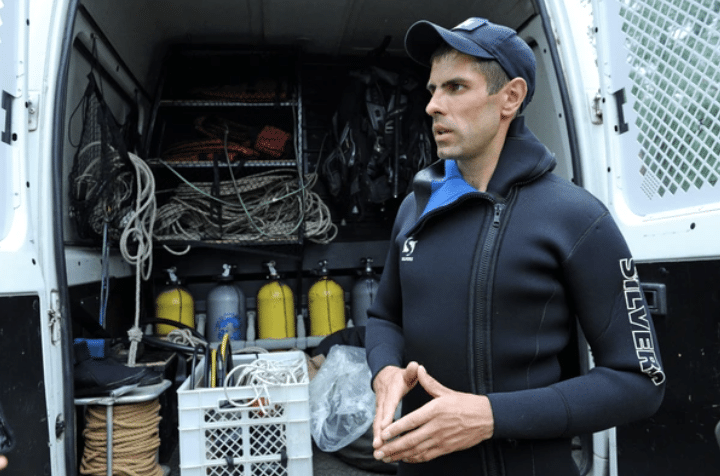
A man in a wetsuit stands beside an open van filled with diving equipment, including oxygen cylinders, ropes, and other gear. He appears to be preparing for or discussing a dive.

Training: Building Capability Over Time

A dive team is not built in a single course.

It is developed over time through:

  • Initial certification
  • Recurrent training
  • Scenario-based exercises

Training must reflect:

  • Real operational conditions
  • Environmental challenges
  • Team dynamics

At N9BO℠, we emphasise training that goes beyond standards.

Because minimum standards create minimum capability.

And minimum capability is insufficient in public safety environments.

Teams must train:

  • Together
  • Regularly
  • Under realistic stress

Only then does performance become reliable.


Leadership: The Deciding Factor

Equipment, roles, and protocols are essential.

But without leadership, they are ineffective.

Leadership ensures:

  • Discipline is maintained
  • Procedures are followed
  • Decisions are made correctly

A strong dive supervisor:

  • Understands operational risk
  • Maintains situational awareness
  • Knows when to continue—and when to stop

Leadership is not authority.

It is responsibility.


Sustainability: Keeping the Team Operational

Building a team is only the first step.

Maintaining it is the challenge.

This includes:

  • Equipment maintenance
  • Skill retention
  • Regular evaluation

Without ongoing effort, teams degrade.

Skills fade.

Procedures are forgotten.

Equipment deteriorates.

Sustainable capability requires:

  • Commitment
  • Structure
  • Continuous improvement

Final Perspective

A public safety dive team is not created by:

  • Buying equipment
  • Sending individuals to courses
  • Reacting to incidents

It is built through:

  • Planning
  • Structure
  • Training
  • Leadership

Departments that approach this deliberately develop reliable capability.

Those that do not create systems that fail under pressure.

Because in public safety diving, success is not accidental.

It is engineered.

Three scuba diving gear sets, including cylinders, masks, and regulators, are arranged upright on a concrete surface near a body of water, with additional diving equipment and greenery visible in the background.


Building or Upgrading Your Dive Team?


Contact N9BO℠ to develop structured ERDI public safety dive teams with the right equipment, roles, and operational protocols.


From the N9BO℠ Knowledge Base


Share this

Public Safety Diving vs. Recreational Diving: Skills and Mindsets Compared

Two Worlds, Same Water

At first glance, diving is diving.

Mask, fins, regulator, buoyancy control—these elements exist in both recreational and public safety environments. But this similarity is superficial.

Recreational diving is designed around:

  • Comfort
  • Enjoyment
  • Controlled exposure

Public safety diving is defined by:

  • Task completion
  • Environmental uncertainty
  • Operational accountability

The difference lies not in the water, but in the purpose.

One dives to experience.

The other dives to achieve.


The Environment: From Clear Water to Zero Visibility

Recreational divers are typically trained and encouraged to dive in conditions that support:

  • Good visibility
  • Predictable currents
  • Minimal hazards

Even when conditions degrade, the expectation is that divers can abort safely.

Public safety divers do not have that luxury.

They operate in:

  • Zero visibility environments
  • Contaminated water
  • Debris-filled areas
  • Confined or entangled spaces

In these conditions, vision is replaced by:

  • Touch
  • Procedure
  • Team coordination

The environment is not chosen.

It is imposed.


The Objective: Exploration vs Mission Completion

A recreational dive has flexible objectives.

If conditions change, the dive can be shortened, modified, or cancelled with minimal consequence.

Public safety diving is different.

Every dive has a defined objective:

  • Recover a victim
  • Locate evidence
  • Inspect a structure
  • Secure a scene

Failure to complete the task may result in:

  • Delayed investigations
  • Compromised evidence
  • Emotional impact on families

The dive is not optional.

The outcome matters.


Mindset Shift: Comfort vs Responsibility

This is where the real transition happens.

Recreational divers are trained to:

  • Stay within limits
  • Maintain comfort
  • Avoid unnecessary risk

Public safety divers must:

  • Operate despite discomfort
  • Manage risk, not avoid it
  • Execute tasks under pressure

The mindset shifts from:

“Am I comfortable?”

to:

“Am I capable of completing this safely and correctly?”

This distinction defines professional diving.

A yellow and black commercial diving helmet with attached lights and communication devices rests on a wooden table.

Skill Application: Technique vs Execution Under Pressure

Recreational training focuses on:

  • Skill acquisition
  • Familiarisation
  • Controlled practice

Skills are often demonstrated in:

  • Clear water
  • Low-stress environments

Public safety diving requires:

  • Skill execution under stress
  • Consistency in degraded conditions
  • Procedural discipline

For example:

A recreational diver may practice mask removal.

A public safety diver must:

  • Maintain orientation
  • Continue task execution
  • Communicate with the team

while managing the same failure.

The skill is the same.

The context is not.


Team Dynamics: Buddy System vs Operational Unit

Recreational diving relies on the buddy system.

This is often informal, based on:

  • Mutual support
  • Shared responsibility

Public safety diving operates as a structured team.

Roles are clearly defined:

  • Diver
  • Tender
  • Supervisor
  • Safety diver

Each role has:

  • Specific responsibilities
  • Communication protocols
  • Operational boundaries

The team functions as a system.

Not as individuals.

A commercial diver in a yellow helmet and wetsuit uses a power tool to work on an underwater metal structure with orange and blue sections, surrounded by bubbles and attached cables.

Procedures vs Flexibility

Recreational diving allows for flexibility.

Divers adapt based on:

  • Experience
  • Preference
  • Conditions

Public safety diving prioritises:

  • Standardisation
  • Procedures
  • Repeatability

Why?

Because consistency reduces error.

Procedures ensure that:

  • Every team member understands the operation
  • Actions are predictable
  • Communication is clear

Flexibility exists—but only within defined frameworks.


Risk Management: Avoidance vs Control

Recreational divers are trained to avoid risk.

If something feels wrong:

  • Abort the dive
  • Surface
  • Reassess

Public safety divers must often operate within risk.

They are trained to:

  • Identify hazards
  • Mitigate exposure
  • Continue operations safely

This does not mean accepting unnecessary danger.

It means understanding that:

  • Risk cannot always be eliminated
  • It must be managed

Equipment: Simplicity vs Configuration for Task

Recreational equipment is streamlined for ease of use.

Public safety equipment is configured for:

  • Communication systems
  • Redundancy
  • Task-specific requirements

This includes:

  • Full-face masks
  • Surface-supplied systems
  • Tethered operations

Equipment becomes part of the operational system.

Not just life support.


Training Philosophy at N9BO℠

At N9BO℠, we emphasise that transitioning from recreational to public safety diving is not about adding certifications.

It is about redefining:

  • Discipline
  • Responsibility
  • Operational mindset

Training focuses on:

  • Realistic scenarios
  • Team integration
  • Procedural execution

Because capability is not built in ideal conditions.

It is built where things go wrong.


Final Perspective

Public safety diving and recreational diving share the same medium.

But they are fundamentally different disciplines.

One prioritises:

  • Experience
  • Enjoyment
  • Personal development

The other demands:

  • Precision
  • Accountability
  • Team performance

Understanding this difference is essential.

Because the moment a diver enters public safety operations, the standard changes.

And so does the responsibility.

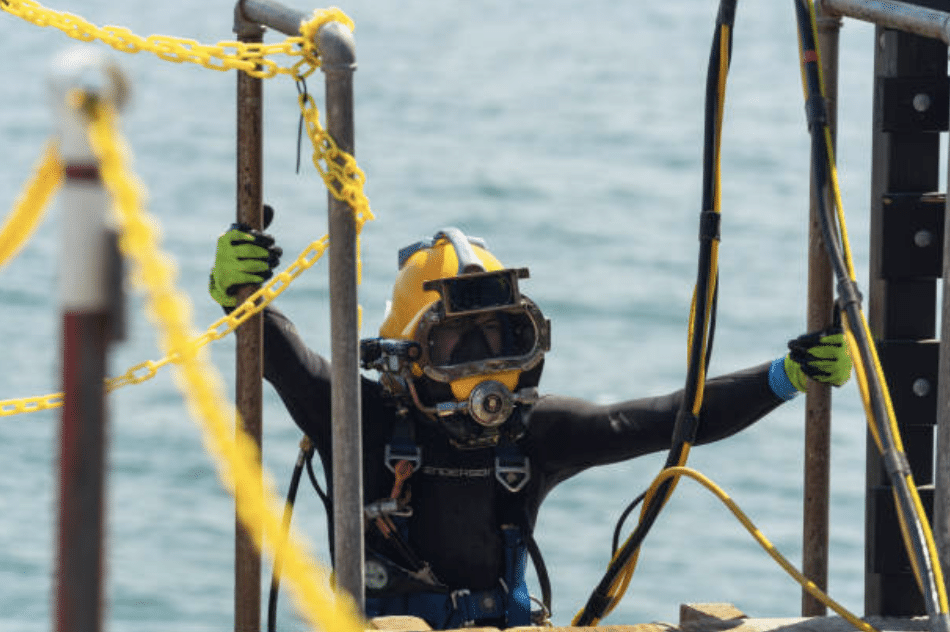
A commercial diver wearing a yellow helmet, black wetsuit, and neon gloves holds onto a metal frame with safety chains near water, preparing for an underwater task.


Ready to Transition from Recreational to Operational Diving?


Contact N9BO℠ to train with structured ERDI programmes built for real-world public safety environments.


From the N9BO℠ Knowledge Base


Share this

5 Ways Proper Dive Training Saves Public Safety Lives (and Budgets)

Training as Risk Reduction, Not Expense

Public safety organisations often evaluate training through a financial lens.

Courses, equipment, and time allocation all represent:

  • Budget commitments
  • Operational downtime
  • Resource allocation

However, this perspective misses the broader picture.

Training is not a cost.

It is risk reduction.

Without structured training, the likelihood of:

  • Operational errors
  • Equipment damage
  • Personnel injury
  • Failed missions

increases significantly.

Each of these carries financial consequences far exceeding the cost of training.


1. Fewer Incidents and Injuries

The most direct impact of training is on personnel safety.

Untrained or undertrained divers are more likely to:

  • Mismanage gas
  • Lose orientation
  • Become entangled
  • Experience stress escalation

These situations can lead to:

  • Injury
  • Emergency response escalation
  • Long-term health consequences

Proper training introduces:

  • Procedures
  • Awareness
  • Failure management

Reducing the probability of incidents.

Fewer incidents mean:

  • Lower medical costs
  • Reduced downtime
  • Improved team longevity

2. More Efficient Operations

Inefficient operations waste time.

In public safety diving, time is critical.

Without training, teams may:

  • Use incorrect search patterns
  • Repeat areas unnecessarily
  • Miscommunicate
  • Lose coordination

This results in:

  • Extended operations
  • Increased fatigue
  • Higher resource consumption

Trained teams operate with:

  • Defined procedures
  • Clear communication
  • Systematic coverage

Efficiency improves outcomes.

And reduces operational costs.

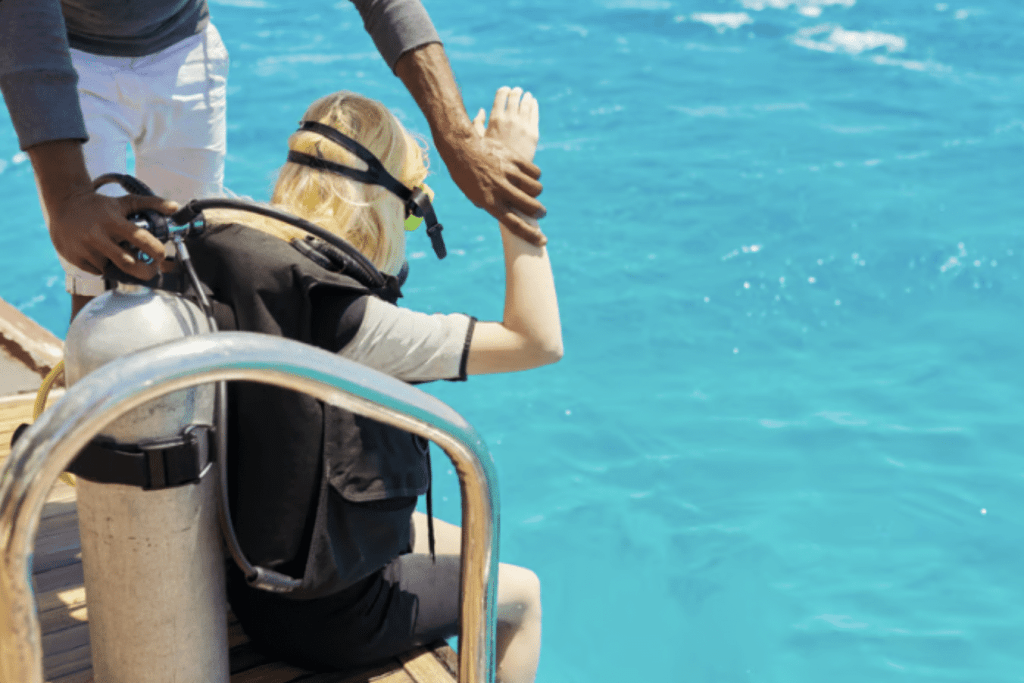
A person wearing scuba gear sits on the edge of a boat, preparing to enter bright blue water, whilst another person steadies and supports them by holding their arm and shoulder.

3. Reduced Equipment Damage and Loss

Public safety diving equipment is expensive.

Dry suits, full-face masks, communication systems, and cylinders all represent significant investment.

Improper use leads to:

  • Premature wear
  • Incorrect configuration
  • Damage during operations

In some cases:

  • Equipment may be lost underwater

Training ensures:

  • Correct handling
  • Proper maintenance
  • Appropriate use

Extending equipment lifespan.

Reducing replacement costs.


4. Lower Legal and Liability Exposure

Public safety operations carry legal responsibility.

If personnel are:

  • Injured due to lack of training
  • Assigned tasks beyond their competence
  • Operating without proper procedures

the organisation is exposed.

Training provides:

  • Documentation
  • Standardisation
  • Recognised certification

This creates:

  • Defensible operational practices
  • Reduced liability

In many cases, proper training is not just recommended.

It is expected.


5. Improved Mission Success Rates

The ultimate objective of public safety diving is:

Mission success.

Whether:

  • Recovering a victim
  • Locating evidence
  • Securing a vehicle

Success depends on:

  • Accuracy
  • Efficiency
  • Coordination

Untrained teams may:

  • Miss targets
  • Delay recovery
  • Compromise evidence

Trained teams:

  • Execute systematic searches
  • Maintain chain of custody
  • Operate with precision

Higher success rates reduce:

  • Repeat operations
  • Extended deployments
  • Additional resource use
Two yellow scuba cylinders with black bottoms are connected by hoses and a harness, with a black and clear diving mask resting on top, all placed on a green, textured ground surface.

The Hidden Cost of “Good Enough”

Many departments operate with a “good enough” mindset.

Basic capability is seen as sufficient.

But in public safety diving, “good enough” leads to:

  • Inconsistency
  • Increased risk
  • Inefficiency

Small inefficiencies accumulate.

They become:

  • Operational delays
  • Financial losses
  • Safety risks

Professional training eliminates variability.

It standardises performance.


Training as Long-Term Investment

The benefits of training are cumulative.

Over time, trained teams:

  • Operate faster
  • Make fewer errors
  • Maintain equipment better
  • Reduce incident rates

This creates long-term savings.

Not just financially, but operationally.

Departments that invest in training build:

  • Sustainable capability
  • Reliable performance
  • Reduced risk exposure

Operational Philosophy at N9BO℠

At N9BO℠, public safety training is approached as:

System development.

We focus on:

  • Procedures
  • Team integration
  • Scenario-based training
  • Real-world application

Because effective training does not just improve individuals.

It improves the entire operation.


Beyond Cost: Protecting People

Ultimately, the most important outcome of training is:

Protection.

Protection of:

  • Divers
  • Team members
  • The public

Financial savings are a result.

But the primary objective is:

Safety.


Final Perspective

Proper dive training is often evaluated as an expense.

In reality, it is one of the most effective ways to:

  • Reduce risk
  • Improve efficiency
  • Protect resources
  • Ensure mission success

In public safety diving, training pays for itself.

Because the cost of being unprepared is always higher.

Two scuba divers surrounded by rising bubbles ascend towards the sunlit surface of the sea, one holding onto a rope, with rays of sunlight piercing through the blue water above them.


Looking to Improve Safety and Efficiency in Your Dive Team?


Contact N9BO℠ to implement structured ERDI training programmes that protect both personnel and operational budgets.


From the N9BO℠ Knowledge Base


Share this

When Does Your Fire/Police Department Need Public Safety Diver Training?

Public Safety Diving Is Not a “Nice to Have” Capability

Many departments delay investment in dive training because incidents appear infrequent.

Water-related operations may seem:

  • Rare
  • Situational
  • Low priority

But when they occur, they are:

  • High consequence
  • Time-sensitive
  • Publicly visible

A single incident involving:

  • A submerged vehicle
  • A missing person
  • Evidence in water

can immediately require a response capability that does not exist.

Public safety diving is not about frequency.

It is about:

Preparedness.


Indicators That Your Department Needs Dive Capability

There are clear operational indicators that a department should develop or formalise dive capability.

These include:

  • Regular proximity to water bodies (rivers, lakes, coastal areas)
  • History of missing persons or drownings
  • Vehicle recovery incidents
  • Flood response requirements
  • Law enforcement evidence searches

Even if incidents are occasional, the impact of being unprepared is significant.

Delays in response can affect:

  • Survival outcomes
  • Evidence integrity
  • Public confidence

The Risk of Ad-Hoc or Untrained Response

In the absence of trained teams, departments may rely on:

  • Improvised solutions
  • External agencies
  • Untrained personnel

This introduces risk.

Untrained divers or responders may:

  • Lack procedural discipline
  • Mismanage equipment
  • Fail to coordinate effectively
  • Expose themselves to unnecessary danger

Public safety diving environments are often:

  • Zero visibility
  • Contaminated
  • Structurally hazardous

Improvisation in these conditions is unacceptable.

A rescue worker in red gear with safety harnesses stands in the foreground while another worker is lifted by a yellow rescue helicopter using a cable against a cloudy sky.

Operational Readiness vs Equipment Ownership

Owning dive equipment does not equal capability.

A department may have:

  • Cylinders
  • Regulators
  • Dry suits

But without:

  • Training
  • Procedures
  • Defined roles

there is no operational readiness.

Capability requires:

  • Structured training
  • Team integration
  • Standard operating procedures
  • Regular drills

Equipment is only one component.


Legal and Liability Considerations

Failure to provide appropriate training introduces liability.

If personnel are:

  • Assigned to water operations
  • Expected to perform recoveries
  • Operating without certification

the organisation assumes risk.

This includes:

  • Injury to personnel
  • Operational failure
  • Legal exposure

Professional training provides:

  • Documentation
  • Standardisation
  • Defensible procedures

This is critical for:

  • Risk management
  • Accountability

Inter-Agency Dependence vs Internal Capability

Many departments rely on external agencies for dive operations.

While this can be effective, it introduces:

  • Delays
  • Coordination challenges
  • Dependency

Developing internal capability allows:

  • Faster response
  • Greater control
  • Integrated operations

The decision is not always binary.

Some departments combine:

  • Internal teams
  • External support

But without internal understanding, coordination becomes difficult.


Training as a System, Not a Course

Public safety diving training is not a one-time event.

It is a system.

This system includes:

  • Initial certification
  • Ongoing training
  • Scenario-based drills
  • Equipment maintenance
  • Procedural updates

Without continuity, capability degrades.

Teams must train:

  • Together
  • Regularly
  • Under realistic conditions
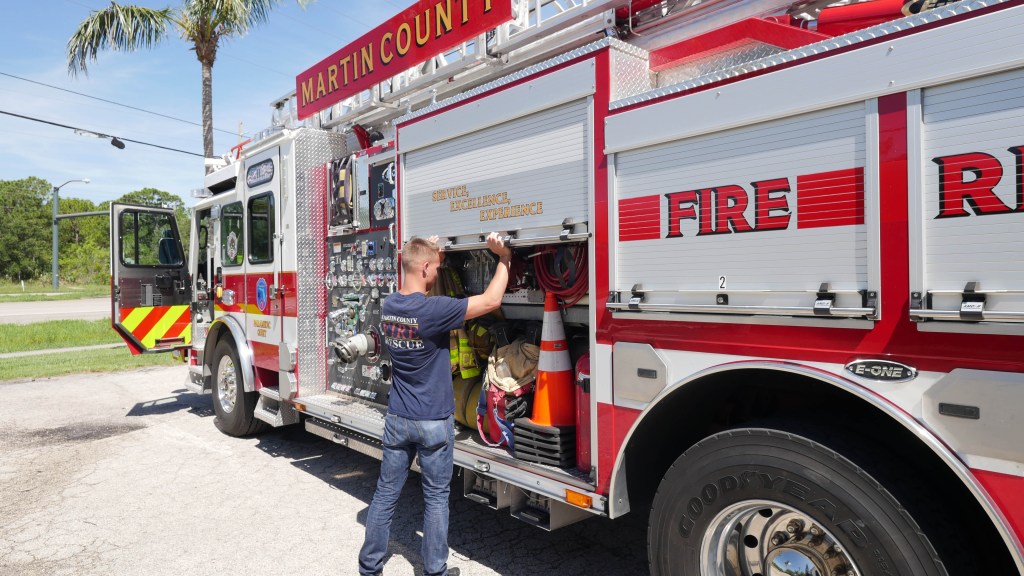
A firefighter in a navy shirt stands beside a Martin County Fire and Rescue lorry, organising equipment such as hoses and orange cones stored in a side compartment.

When Demand Becomes Urgent

Departments often act after a critical incident.

This is too late.

Training takes time.

Team development takes time.

Procedure development takes time.

Waiting until:

  • A major incident occurs
  • Public pressure increases

creates reactive decisions.

Professional organisations plan ahead.


The Role of Leadership

Leadership determines whether dive capability is developed.

Decision-makers must evaluate:

  • Operational risk
  • Community needs
  • Resource allocation

This requires:

  • Understanding of public safety diving
  • Recognition of potential scenarios
  • Commitment to preparedness

Without leadership support, capability cannot be sustained.


Training Standards and Professionalisation

Public safety diving must follow recognised standards.

This ensures:

  • Consistency
  • Safety
  • Interoperability

At N9BO℠, ERDI-based training focuses on:

  • Role definition
  • Team integration
  • Structured procedures
  • Realistic scenarios

The goal is not just to train divers.

It is to build:

Operational teams.


Cost vs Consequence

Training requires investment.

Equipment requires investment.

Time requires investment.

But the cost of not being prepared includes:

  • Delayed response
  • Increased risk
  • Operational failure
  • Reputational damage

Public safety capability is not an expense.

It is:

Risk mitigation.


Final Perspective

The need for public safety diving capability is not defined by how often incidents occur.

It is defined by:

What happens when they do.

Departments that prepare in advance:

  • Respond faster
  • Operate safer
  • Maintain control

Those that do not are forced into:

Reactive decisions.

Because in public safety operations, readiness is not optional.

It is expected.

A scuba diver in a drysuit and mask is being sprayed with water from a hose on a boat, with rocky shoreline and blue water in the background.


Assessing Your Department’s Dive Capability?


Contact N9BO℠ to evaluate your needs and develop structured ERDI public safety dive training programmes.


From the N9BO℠ Knowledge Base

Share this

A Day in the Life: Training a Public Safety Dive Team

The Objective: Building Operational Capability

A public safety dive team is not a group of divers.

It is an operational unit.

The objective of training is not simply to improve individual skills, but to build:

  • Team coordination
  • Procedural discipline
  • Communication clarity
  • Decision-making under pressure

Every training session is designed with a purpose.

Not to simulate perfection, but to reveal weaknesses.

Because weaknesses exposed in training can be corrected.

In operations, they cannot.


The Day Begins With a Structured Briefing

Before anyone enters the water, the team gathers for a detailed briefing.

This includes:

  • Mission objectives
  • Environmental conditions
  • Assigned roles
  • Equipment configuration
  • Emergency procedures
  • Communication protocols

The briefing is not a formality.

It establishes:

  • Clarity
  • Alignment
  • Expectations

Every team member must understand:

  • What is happening
  • Why it is happening
  • What their role is

Ambiguity at this stage leads to confusion later.


Equipment Preparation: No Assumptions

Public safety diving environments are unforgiving.

Equipment preparation is therefore:

  • Systematic
  • Verified
  • Cross-checked

Divers prepare:

  • Full-face masks
  • Communications systems
  • Dry suits
  • Redundant air sources
  • Tether lines

Surface teams prepare:

  • Tending systems
  • Communication lines
  • Time tracking
  • Emergency equipment

Checklists are used.

Not because divers forget.

But because consistency must be guaranteed.


Role Assignment: Everyone Has a Function

A public safety dive team operates through defined roles.

These include:

  • Primary diver
  • Backup diver
  • Tender
  • Dive supervisor
  • Safety officer

Each role has:

  • Responsibilities
  • Boundaries
  • Expectations

There is no overlap without purpose.

There is no improvisation without control.

The diver underwater is only one part of the system.

The surface team is equally critical.

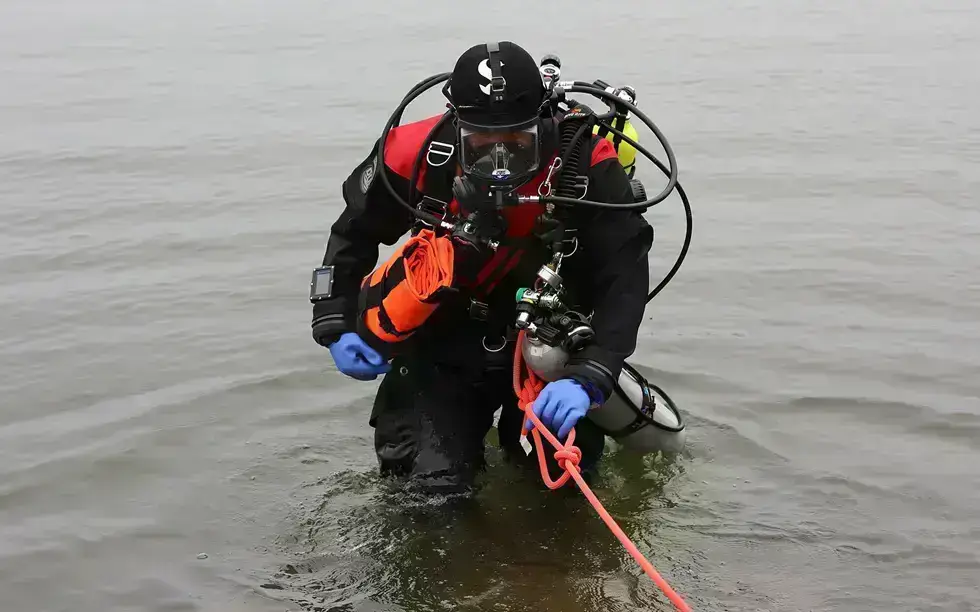
A scuba diver wearing a black and red wetsuit, blue gloves, and full kit emerges from the water holding an orange flotation device attached to a rope.

Entering the Water: Controlled Execution

Entry into the water is not casual.

It is:

  • Controlled
  • Observed
  • Communicated

The diver confirms:

  • Equipment status
  • Communication function
  • Line tension

The tender establishes:

  • Contact
  • Orientation
  • Stability

From the moment the diver submerges, the operation becomes:

System-driven.


Search Operations: Structure Over Speed

Most public safety dives involve search patterns.

These are not improvised.

They are:

  • Planned
  • Executed systematically
  • Monitored from the surface

Common patterns include:

  • Jackstay
  • Circular
  • Arc search

The objective is not to move quickly.

It is to cover the area effectively.

Speed without structure creates gaps.

Gaps reduce success.


Communication: Constant and Clear

Communication between diver and surface is continuous.

The tender monitors:

  • Diver movement
  • Line signals
  • Verbal communication (if available)

The diver reports:

  • Progress
  • Conditions
  • Findings

Silence is not neutral.

It is a warning.

Breakdowns in communication are treated immediately.

Because loss of communication equals loss of control.


Scenario-Based Training: Introducing Stress

Training evolves beyond basic drills.

Scenarios are introduced to simulate:

  • Equipment failure
  • Lost line
  • Diver distress
  • Reduced visibility
  • Task overload

These scenarios are not random.

They are designed to:

  • Increase cognitive load
  • Test decision-making
  • Reveal procedural gaps

The goal is not to create difficulty.

It is to create realism.

Two scuba divers in full kit and drysuits stand waist-deep in the water, each holding onto red safety ropes, with their masks and equipment clearly visible.

The Role of the Instructor

Instructors do not simply observe.

They:

  • Control the scenario
  • Adjust variables
  • Introduce problems
  • Evaluate responses

They are looking for:

  • Consistency
  • Discipline
  • Awareness

Not perfection.

Because perfection is not realistic.

Consistency is.


Debriefing: Where Learning Happens

After the dive, the team gathers again.

The debrief is structured.

It covers:

  • What went well
  • What did not
  • Why errors occurred
  • How to correct them

Feedback is:

  • Direct
  • Specific
  • Actionable

This is where improvement happens.

Without debriefing, training becomes repetition.

With debriefing, it becomes progression.


Physical and Mental Fatigue

A full training day is demanding.

Divers experience:

  • Physical fatigue
  • Cognitive overload
  • Reduced concentration

This is intentional.

Operations do not occur in ideal conditions.

Training must reflect that reality.

Learning to perform while fatigued is part of:

Operational readiness.


Operational Philosophy at N9BO℠

At N9BO℠, public safety dive training is structured around:

Realism.

We emphasise:

  • Role clarity
  • Procedural discipline
  • Team integration
  • Stress exposure
  • Controlled execution

Because public safety diving is not about individual performance.

It is about system performance.


Final Perspective

A day of training a public safety dive team is not about diving.

It is about preparing for environments where:

  • Visibility is zero
  • Conditions are unpredictable
  • Outcomes matter

Every step, from briefing to debriefing, is designed to build:

Reliability.

Because in public safety operations, success is not defined by effort.

It is defined by:

Execution.

A person adjusts a bright orange deep-sea diving helmet with a transparent visor and metal fittings, preparing for an underwater activity outdoors.


Building or Training a Public Safety Dive Team?


Contact N9BO℠ to develop structured, operationally focused ERDI training programmes for your Team.


From the N9BO℠ Knowledge Base


Share this

Myth-Busting: Common Misconceptions About Technical and Public Safety Diving

Myth 1: Technical Diving Is Just “Deeper Diving”

One of the most common misconceptions is that technical diving is simply recreational diving taken to greater depths.

This is incorrect.

Technical diving is defined not by depth, but by:

  • Limited or no direct ascent
  • Decompression obligations
  • Increased complexity
  • Structured procedures

A shallow decompression dive can be technical.

A deep no-decompression dive can still be recreational.

The distinction lies in:

  • Risk exposure
  • Planning requirements
  • Operational discipline

Depth is only one variable.


Myth 2: More Equipment Means More Safety

Technical and public safety divers often carry more equipment, which leads to the assumption that redundancy automatically increases safety.

In reality, more equipment increases:

Complexity.

Each additional component introduces:

  • Failure points
  • Task loading
  • Management requirements

Safety comes from:

  • Understanding the system
  • Managing redundancy correctly
  • Maintaining discipline

Poorly managed equipment makes a diver less safe, not more.


Myth 3: Experience Alone Makes You Competent

Time in the water is often mistaken for competence.

A diver with hundreds of dives may feel confident.

But experience without structure can reinforce:

  • Bad habits
  • Inconsistent procedures
  • Poor decision-making

Competence is built through:

  • Training
  • Feedback
  • Correction
  • Repetition under controlled conditions

Experience supports competence.

It does not replace it.


Myth 4: Public Safety Diving Is Just “Rescue Diving”

Public safety diving is frequently misunderstood as an extension of recreational rescue training.

It is not.

Public safety operations involve:

  • Zero visibility
  • Contaminated water
  • Complex search patterns
  • Evidence preservation
  • Multi-agency coordination

The objective is not exploration.

It is:

  • Recovery
  • Investigation
  • Risk-managed intervention

The environment and mission fundamentally change the approach.

A person wearing a full-face scuba diving mask, diving suit, and breathing apparatus, prepared for underwater exploration or technical diving.

Myth 5: Strong Divers Can “Handle It” Without Structure

There is a belief that skilled or confident divers can adapt to complex situations without strict procedures.

This is one of the most dangerous misconceptions.

Under stress:

  • Cognitive capacity decreases
  • Reaction time slows
  • Errors increase

Structure exists to:

  • Reduce variability
  • Standardise response
  • Improve predictability

Technical and public safety diving rely on procedures because:

Human performance is not consistent under pressure.


Myth 6: Training Is Only for Certification

Many divers view training as a requirement to obtain certification.

Once certified, they assume they are ready.

In reality, training is:

Ongoing.

Certification confirms that a standard was met at a specific moment.

It does not guarantee:

  • Long-term competence
  • Adaptability
  • Performance under stress

Professional divers treat training as continuous.


Myth 7: Problems Are Obvious When They Occur

In recreational diving, many problems are immediately noticeable.

In technical and public safety diving, this is not always the case.

Failures can be:

  • Gradual
  • Silent
  • Misleading

Gas issues, equipment malfunctions, or physiological stress may not be immediately apparent.

This is why monitoring, awareness, and discipline are critical.

Divers must detect problems before they become emergencies.


Myth 8: Confidence Equals Readiness

Confidence is often mistaken for readiness.

A diver who feels prepared may not actually be capable of managing the environment they are entering.

Confidence without competence creates:

Risk.

Professional divers rely on:

  • Objective assessment
  • Measured progression
  • Verified performance

They do not rely on feeling ready.

A scuba diver wearing gear and a red cylinder is partially submerged in a calm, blue body of water, with only their head and equipment visible above the surface.

Myth 9: Training Conditions Reflect Real Conditions

Courses are conducted in controlled environments.

Visibility, conditions, and scenarios are managed.

Real-world environments are not.

Public safety divers may operate in:

  • Black water
  • Strong current
  • Confined spaces
  • Contaminated environments

Technical divers may encounter:

  • Equipment failures
  • Complex decompression profiles
  • Limited exit options

Training prepares for these conditions.

But it cannot replicate them fully.

This is why discipline must extend beyond the course.


Myth 10: “It Won’t Happen to Me”

Perhaps the most dangerous misconception is the belief that incidents happen to others.

This mindset leads to:

  • Complacency
  • Reduced vigilance
  • Deviation from procedure

Technical and public safety diving assume the opposite:

Failure is possible.

Preparation is mandatory.


Reality: Structure, Not Bravery

Both technical and public safety diving are often perceived as extreme.

In reality, they are:

Structured.

They rely on:

  • Planning
  • Procedures
  • Team coordination
  • Risk management

Success is not based on bravery.

It is based on:

Discipline.


Operational Philosophy at N9BO℠

At N9BO℠, training focuses on removing misconceptions.

We emphasise:

  • Standardisation
  • Controlled progression
  • Realistic expectations
  • Performance under stress

Because misunderstanding the nature of diving is one of the fastest ways to create risk.

Clarity creates safety.


Final Perspective

Misconceptions in diving are not harmless.

They influence decisions, behaviour, and risk tolerance.

Correcting them is not about theory.

It is about:

Operational safety.

Technical and public safety diving are not defined by extremes.

They are defined by:

Structure, discipline, and controlled execution.

Understanding this difference is what separates assumption from professionalism.

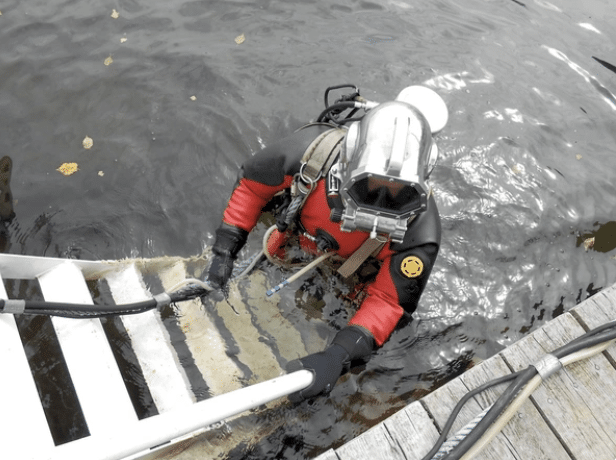
A diver in a red and black drysuit with a helmet climbs a white ladder from the water onto a wooden jetty, holding onto a handrail with cables attached to their suit.


Want to Build Real Diving Competence, Not Assumptions?


Contact N9BO℠ to train beyond misconceptions and develop structured, disciplined diving skills for technical and public safety environments.


From the N9BO℠ Knowledge Base


Share this
Facebook
Instagram
X (Twitter)
TikTok
Youtube
Whatsapp