Two Different Philosophies of Diving
At first glance, technical diving appears to be an extension of recreational diving — deeper dives, more equipment, longer bottom times.
In reality, the two operate under completely different philosophies.
Recreational diving is designed to:
- Simplify
- Minimise risk
- Keep within no-decompression limits
- Allow direct ascent at any time
Technical diving is designed to:
- Manage complexity
- Accept controlled risk
- Operate beyond direct ascent
- Require staged decompression
This is not a linear progression.
It is a shift in how diving is approached entirely.
Access vs Exposure
Recreational diving focuses on access.
It allows divers to:
- Explore safely
- Experience marine environments
- Operate within conservative limits
Technical diving focuses on exposure.
It deliberately places the diver in environments where:
- Direct ascent is not possible
- Decompression obligations exist
- Equipment redundancy is required
This includes:
- Deep diving
- Cave diving
- Wreck penetration
- Complex decompression profiles
The objective changes from access to controlled exposure.
Planning: Simple vs Structured
In recreational diving, planning is straightforward.
A typical plan includes:
- Maximum depth
- Bottom time
- Gas check
- Basic contingency
In technical diving, planning becomes:
Systematic.
It includes:
- Detailed gas calculations
- Decompression schedules
- Multiple contingency plans
- Equipment redundancy
- Team protocols
Nothing is left to assumption.
Every phase of the dive is planned in advance.
Equipment: Convenience vs Redundancy
Recreational equipment is designed for:
- Simplicity
- Ease of use
- Minimal configuration
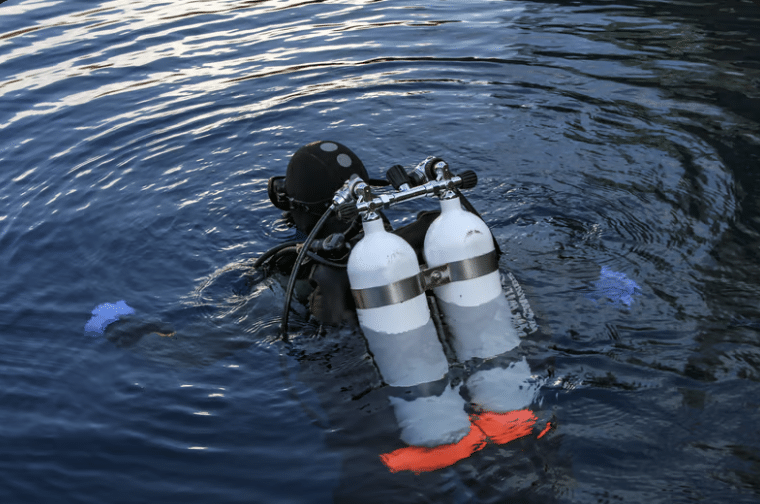
Technical equipment is designed for:
- Redundancy
- Failure management
- Standardisation
This includes:
- Twin cylinders or rebreathers
- Multiple regulators
- Stage/decompression bottles
- Backup systems
The purpose is not comfort.
It is to ensure that any single failure can be managed.
Decision-Making: Flexible vs Defined
Recreational diving allows flexibility.
Divers can:
- Adjust the dive
- Change direction
- End the dive at any time
Technical diving removes flexibility.
Decisions are:
- Predefined
- Procedure-driven
- Based on planning
Deviation introduces risk.
This is why technical diving emphasises:
Discipline over spontaneity.
The Role of the Team
In recreational diving, the buddy system is often informal.
Divers may:
- Separate briefly
- Operate semi-independently
In technical diving, the team is:
Integrated.
Divers operate as a unit.
They must:
- Maintain position
- Monitor each other
- Execute procedures together
The team is not a backup.
It is part of the system.
Gas Management: Awareness vs Precision
Recreational gas management is typically:
- Rule-based
- Conservative
- Flexible
Technical gas management is:
Calculated.
It accounts for:
- Depth
- Time
- Emergency scenarios
- Team requirements
There is no margin for approximation.
Gas becomes a critical variable.
Failure Management
In recreational diving, the expectation is:
Avoid failure.
In technical diving, the expectation is:
Prepare for failure.
Training includes:
- Gas loss scenarios
- Equipment malfunctions
- Lost team member procedures
- Emergency ascents
Failure is not hypothetical.
It is anticipated.
Mental Load and Complexity
Technical diving significantly increases cognitive demand.
Divers must:
- Track multiple variables
- Execute procedures
- Maintain control
- Monitor the team
This creates:
Task loading.
The ability to manage this workload is what defines a competent technical diver.
Training: Exposure vs Transformation
Recreational training introduces skills.
Technical training transforms behaviour.
It focuses on:
- Precision
- Consistency
- Standardisation
- Decision-making
Passing a course is not enough.
Competence must be sustained.
At N9BO℠, this distinction is critical.
Training is not about certification.
It is about changing how divers think and operate.
Mindset: Comfort vs Accountability
Recreational diving prioritises enjoyment and comfort.
Technical diving prioritises:
Accountability.
Divers are responsible for:
- Their own safety
- Their team
- The execution of the plan
There is less tolerance for error.
Because consequences are greater.
Final Perspective
Open water and technical diving are not separated by depth.
They are separated by:
Philosophy.
One simplifies the environment.
The other manages complexity within it.
Transitioning from one to the other requires more than new equipment or deeper dives.
It requires a complete shift in:
- mindset
- discipline
- responsibility
Because technical diving is not just advanced diving.
It is structured, controlled exposure to environments where mistakes are no longer forgiving.

Thinking About Moving Into Technical Diving?
Contact N9BO℠ to understand the transition, prerequisites, and training pathway from recreational to technical diving.
From the N9BO℠ Knowledge Base