Understanding Normal Air First
To understand nitrox, divers first need to understand what standard compressed air contains.
Normal atmospheric air is approximately:
- 21% oxygen
- 78% nitrogen
- 1% trace gases
When divers breathe compressed air underwater, the body absorbs nitrogen because increasing pressure forces inert gas into body tissues.
During ascent, this nitrogen must be released slowly through respiration. If ascent occurs too quickly or nitrogen loading becomes excessive, decompression illness may occur.
Standard recreational diving therefore involves continuous management of nitrogen exposure.
At N9BO℠, we teach nitrox by first understanding the role nitrogen plays in diving physiology.
So What Changes with Nitrox?
Nitrox simply contains more oxygen and less nitrogen than normal air.
For example:
- EAN32 contains 32% oxygen and 68% nitrogen
- EAN36 contains 36% oxygen and 64% nitrogen
By reducing the amount of nitrogen in the breathing gas, the diver absorbs less nitrogen during the dive.
This changes decompression exposure significantly.
The diver is still breathing compressed gas underwater, but the physiological nitrogen load becomes lower compared to diving the same profile on air.
At N9BO℠, we describe nitrox as a gas management tool rather than “special air”.
The Main Benefit: Reduced Nitrogen Exposure
The biggest advantage of nitrox is reduced nitrogen absorption.
Because the diver absorbs less nitrogen:
- No-decompression limits become longer
- Surface intervals may become more efficient
- Repetitive dives generally create less nitrogen loading
This is especially valuable during:
- Multiple dives per day
- Liveaboard operations
- Dive travel schedules
- Training programmes involving repetitive dives
For many recreational divers, nitrox provides additional conservatism rather than simply longer dive time.
Divers often report feeling less fatigued after repetitive diving, although this remains partly subjective and varies between individuals.
At N9BO℠, we emphasise nitrox as a safety and efficiency tool rather than a way to aggressively extend dives.

Nitrox Does Not Mean “Unlimited Diving”
One of the most common misconceptions is that nitrox removes decompression limits entirely.
It does not.
Although nitrogen exposure decreases, oxygen exposure increases. Oxygen becomes the new limiting factor.
As depth increases, oxygen partial pressure rises. Excessive oxygen exposure can lead to central nervous system (CNS) oxygen toxicity, which may cause convulsions underwater.
For this reason, nitrox mixtures have maximum operating depths (MODs) that must never be exceeded.
For example:
- EAN32 typically has a recreational MOD of approximately 33 metres
- EAN36 has a shallower MOD of approximately 28 metres
The higher the oxygen percentage, the shallower the safe operating depth becomes.
At N9BO℠, we teach that nitrox changes dive limitations—it does not remove them.
The Relationship Between Depth and Oxygen
The key principle in nitrox diving is oxygen partial pressure.
As a diver descends, ambient pressure increases. This means the oxygen being breathed becomes progressively more concentrated physiologically, even though the gas mixture itself remains unchanged.
This is why oxygen exposure must be monitored carefully during nitrox diving.
Divers therefore learn to calculate:
- Maximum Operating Depth (MOD)
- Oxygen exposure limits
- Oxygen partial pressure (PO₂)
Understanding these calculations is fundamental to safe nitrox use.
At N9BO℠, we emphasise that nitrox diving is based on pressure management and gas awareness.
Nitrox and Dive Computers
Modern dive computers make nitrox diving far easier than in the past.
The diver enters:
- Oxygen percentage
- Maximum PO₂ limit
The computer then adjusts decompression calculations automatically.
However, divers must still understand the underlying theory rather than relying blindly on electronics.
A computer can process numbers, but the diver remains responsible for:
- Gas verification
- Correct settings
- Depth awareness
- Exposure management
At N9BO℠, we teach divers to understand the gas first and trust technology second.

Gas Analysis and Cylinder Identification
One of the defining procedures in nitrox diving is analysing the breathing gas before the dive.
Divers must personally verify:
- Oxygen percentage
- Maximum operating depth
- Correct cylinder labelling
This is critical because incorrect gas assumptions can create serious safety risks.
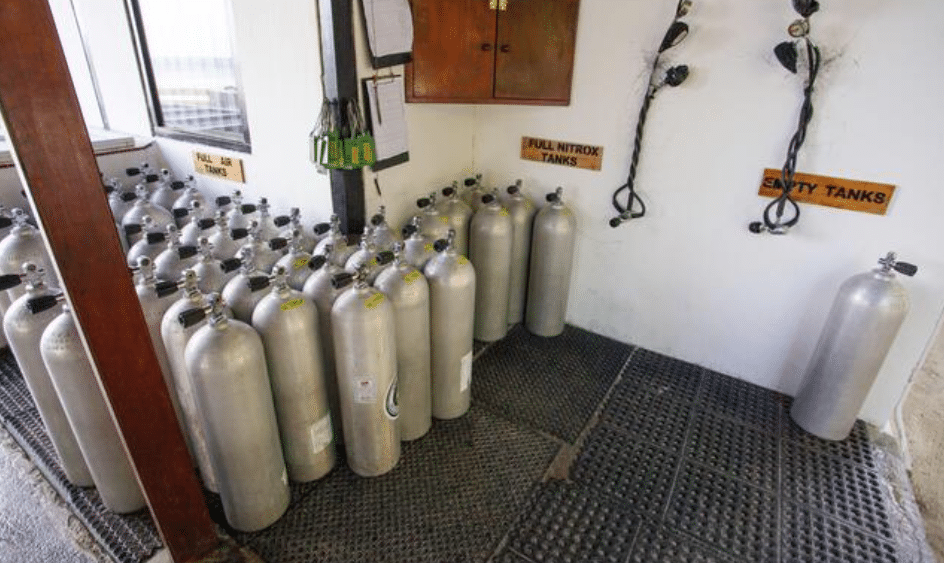
Nitrox cylinders are therefore marked clearly, and divers learn how to:
- Use oxygen analysers
- Record gas percentages
- Confirm MOD calculations
This process introduces divers to a more disciplined and technical approach to gas management.
At N9BO℠, we reinforce that divers are responsible for verifying the gas they breathe.
Who Uses Nitrox?
Nitrox is now widely used across both recreational and technical diving.
It is especially popular among:
- Frequent recreational divers
- Liveaboard divers
- Dive professionals
- Technical divers using decompression gases
For recreational diving, nitrox is often used conservatively to reduce nitrogen exposure during repetitive dives.
In technical diving, enriched oxygen mixtures may also be used strategically during decompression.
The gas itself is therefore extremely versatile, but the planning and procedures become more advanced as diving complexity increases.
At N9BO℠, we position nitrox as one of the most useful and practical advancements in modern diving.
Why Nitrox Changes Diver Mindset
Learning nitrox often changes how divers think about breathing gas and dive planning.
Many recreational divers initially view air as a fixed and unquestioned part of diving. Nitrox introduces the concept that breathing gas can be selected and planned based on operational requirements.
This creates greater awareness of:
- Gas composition
- Physiological exposure
- Dive planning discipline
- Operational limits
For many divers, nitrox becomes the first step toward more technical and analytical diving approaches.
At N9BO℠, we view nitrox training as both practical gas education and mindset development.
Operational Mindset
Nitrox reinforces a fundamental principle of diving: gas selection affects physiology, safety, and operational capability.
By reducing nitrogen exposure, nitrox can increase conservatism and improve efficiency during repetitive diving. However, the increased oxygen percentage introduces new considerations that require proper training and disciplined procedures.
The strongest nitrox divers are not the ones pushing limits. They are the divers who understand:
- Gas composition
- Oxygen exposure
- Depth limitations
- Conservative planning
At N9BO℠, we approach nitrox as controlled gas management rather than enhanced recreational performance.
The gas itself is simple. Understanding how to use it responsibly is what matters.

Dive Smarter with Enriched Air Nitrox
Contact N9BO℠ to begin your nitrox training and learn how enriched air can improve dive planning, efficiency, and safety through disciplined gas management.
From the N9BO℠ Knowledge Base