Darkness Changes the Operating Environment
Night diving is often misunderstood as simply “diving with less light.” In reality, it fundamentally alters how divers perceive and interact with their surroundings.
Even in relatively clear water, darkness reduces:
- Depth perception
- Spatial awareness
- Peripheral vision
In public safety diving, where visibility may already be near zero, night operations compound these limitations. The diver is no longer navigating through an environment—they are operating within an absence of visual information.
This has immediate implications.
Tasks that would be straightforward in daylight become:
- Slower
- More cognitively demanding
- More reliant on discipline and procedure
Darkness does not just reduce visibility.
It increases uncertainty.
Black-Water Conditions: When Vision Is Irrelevant
Black-water diving takes this a step further.
In many public safety scenarios—rivers, lakes, flooded environments—visibility is already negligible. At night, the distinction between “low visibility” and “no visibility” disappears entirely.
The diver operates in a space where:
- Lights may illuminate only particles
- Reference points are absent
- Orientation must be maintained without visual cues
This forces a complete reliance on:
- Tactile feedback
- Line systems
- Procedural memory
In these conditions, experience alone is not enough. Without structured training, divers can quickly lose orientation, drift off pattern, or become task-fixated.
The environment removes visual control.
Only discipline replaces it.
Psychological Load in Darkness
One of the most significant challenges in night and black-water diving is psychological.
Darkness introduces:
- Sensory deprivation
- Increased perception of isolation
- Heightened stress response
Even experienced divers can feel disoriented when visual cues disappear completely.
This is not a failure of skill.
It is a natural human response.
The problem arises when this stress begins to affect:
- Breathing patterns
- Decision-making
- Task execution
A diver who begins to feel “lost” in darkness may:
- Rush movements
- Overcompensate
- Lose procedural focus
Training must address this directly.
At N9BO℠, we emphasise exposure to these environments in controlled conditions. Because the first time a diver experiences total darkness should not be during a real operation.
Lighting: Tool, Not Solution
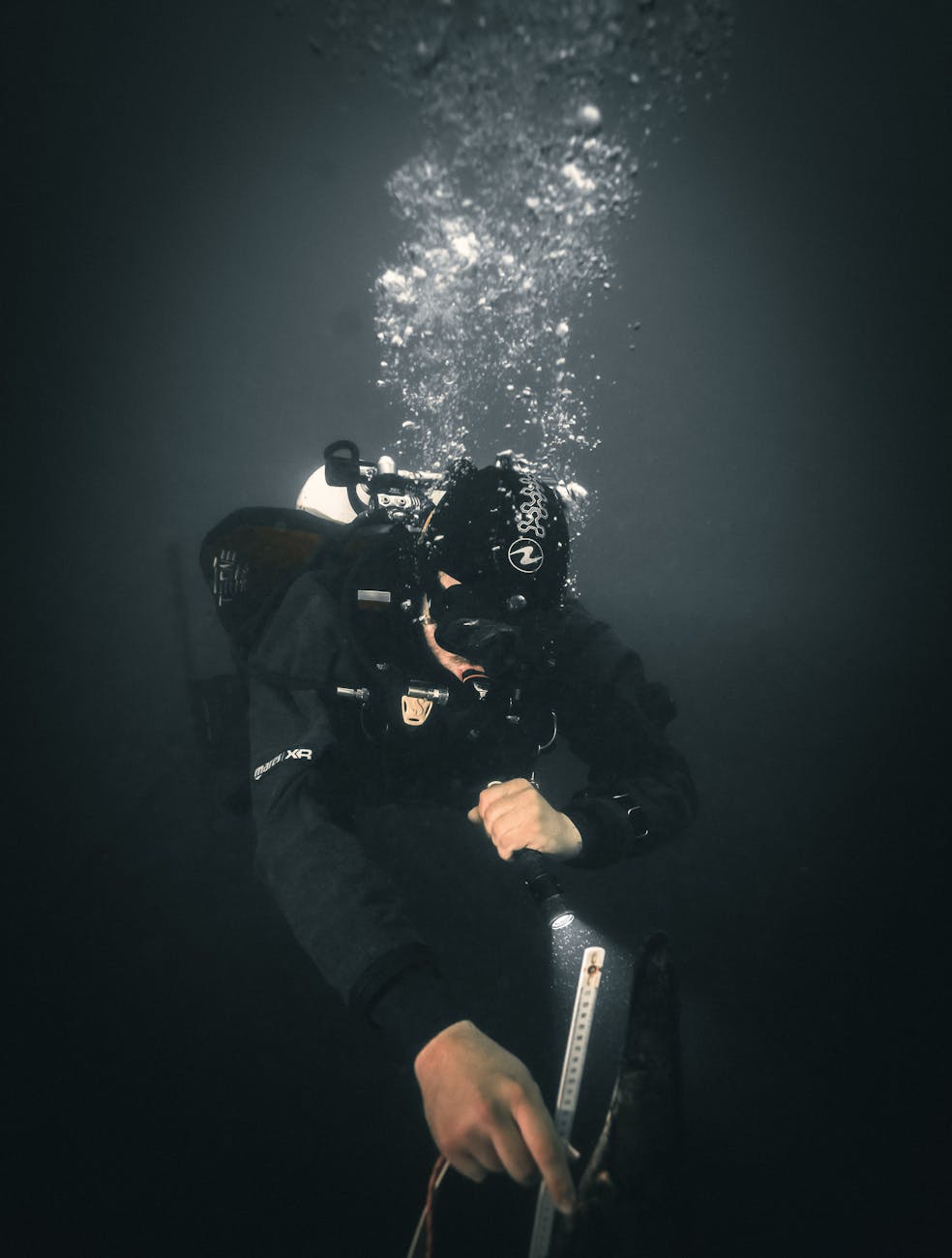
Lighting systems are essential in night operations—but they are often misunderstood.
A dive light does not restore normal visibility.
In many public safety environments, it can:
- Reflect off suspended particles
- Reduce effective visibility
- Create visual noise
This is especially true in contaminated or silty water.
Lights should be used strategically:
- To illuminate specific tasks
- To signal position when appropriate
- To assist in controlled situations
But they must never be relied upon as the primary means of orientation.
Divers must be trained to operate effectively:
- With light
- Without light
- In conditions where light provides minimal benefit
Because in black-water environments, light is often secondary to procedure.
Tethered Operations and Control
In night and zero-visibility conditions, tethered diving becomes a primary control mechanism.
The line serves multiple purposes:
- Navigation reference
- Communication channel
- Safety link to the surface
The relationship between diver and tender becomes critical.
The tender must:
- Monitor line tension continuously
- Interpret signals accurately
- Maintain awareness of diver movement
The diver must:
- Maintain consistent line awareness
- Communicate clearly
- Avoid unnecessary slack or tension
This system replaces visual coordination.
When executed correctly, it provides:
- Stability
- Control
- Continuous situational awareness
When executed poorly, it introduces confusion and risk.
Movement and Task Execution
In darkness, movement must be deliberate.
There is no visual feedback to correct:
- Position
- Direction
- Body alignment
Divers must rely on:
- Trim
- Propulsion control
- Spatial awareness built through training
Uncontrolled movement leads to:
- Disorientation
- Loss of search pattern
- Increased gas consumption
Task execution must also adapt.
Simple actions become more complex when:
- They cannot be seen
- They must be performed by feel
- They require coordination with the surface
This is where procedural discipline becomes critical.
Every movement must be:
- Intentional
- Controlled
- Aligned with the plan
Communication: Precision Over Assumption
In night operations, communication errors are more likely.
Visual confirmation is limited or absent.
This means:
- Line signals must be clear
- Verbal communication (if available) must be precise
- Assumptions must be eliminated
A missed or misinterpreted signal can lead to:
- Incorrect actions
- Delayed response
- Escalation of a manageable situation
Teams must train communication until it becomes automatic.
Because in darkness, there is no room for hesitation.
Fatigue and Cognitive Load
Operating in darkness increases cognitive demand.
The diver must:
- Maintain orientation without visual cues
- Execute tasks by feel
- Monitor gas and time
- Communicate effectively
This creates:
- Mental fatigue
- Reduced processing speed
- Increased likelihood of error over time
Operations must account for this.
This includes:
- Defined time limits
- Diver rotation
- Clear abort criteria
Ignoring fatigue does not increase efficiency.
It increases risk.
Training: Making the Unfamiliar Familiar
Night and black-water diving should never be treated as an advanced add-on skill.
For public safety teams, it is a core operational requirement.
Training must include:
- Controlled exposure to darkness
- Scenario-based exercises
- Stress management
At N9BO℠, we integrate these elements into training because real-world operations do not occur in ideal conditions.
Divers must be prepared to operate:
- Without visibility
- Under pressure
- With full reliance on procedure
The objective is not to make the environment easier.
It is to make the diver more capable within it.
Final Perspective
Night diving and black-water operations remove one of the most fundamental tools a diver has: vision.
In its absence, everything else becomes more important:
- Procedure
- Communication
- Discipline
- Team coordination
These environments do not forgive improvisation.
They reward preparation.
Teams that train for darkness operate with control.
Those that do not are forced to react within it.
And in public safety diving, reacting is never as effective as being ready.

Need to Standardise Your Dive Team Briefings?
Contact N9BO℠ to implement structured ERDI operational protocols and real-world briefing systems for public safety teams.
From the N9BO℠ Knowledge Base