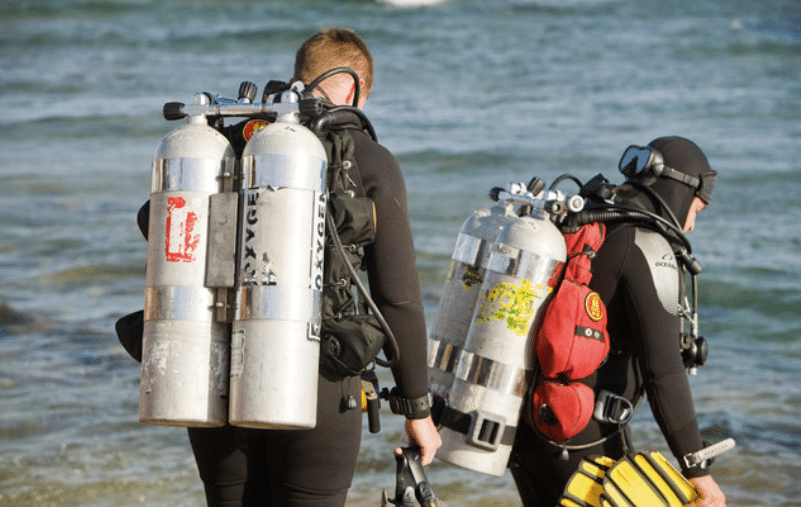
Long Before Scuba, Humans Went Underwater
Diving began not as sport, but as survival.
Ancient civilisations practiced breath-hold diving for:
- Food gathering
- Pearl and sponge harvesting
- Salvage and recovery
These early divers relied on lung capacity, conditioning, and intimate knowledge of water conditions.
Early Artificial Breathing Attempts
As needs expanded, so did innovation.
Ancient diving bells and surface-supplied air systems appeared, allowing longer bottom times but introducing new dangers—chief among them pressure-related injury.
The Industrial Age and Pressurised Work
The 18th and 19th centuries saw the rise of:
- Caissons
- Pressurised tunnels
- Hard-hat diving
Workers suffered “the bends” without understanding its cause. Diving advanced faster than physiology—until science intervened.
The Birth of Diving Physiology
Scientists like Paul Bert identified nitrogen absorption and oxygen toxicity.
This knowledge transformed diving from guesswork into a measurable, modelled activity. Safety became teachable.

Military and Commercial Drivers
Military needs accelerated diving technology:
- Salvage and mine clearance
- Submarine escape
- Underwater demolition
Commercial diving followed with construction, inspection, and offshore support.
Recreational Scuba Changes Everything
The Aqua-Lung made diving portable and accessible.
Training agencies emerged to standardise skills, equipment, and safety procedures—bringing structure to mass participation.
The Rise of Technical Diving
As curiosity pushed beyond recreational limits, technical diving emerged.
Mixed gases, decompression procedures, and overhead environments demanded:
- Advanced planning
- Redundancy
- Systems thinking
Diving once again became specialised.

Closed-Circuit Rebreathers (CCR)
CCR technology reduced gas consumption and bubble signature.
Used by military and explorers, CCRs reintroduced complexity—and required a new level of discipline and training.
Public Safety and Professional Specialisation
Public safety diving, scientific research, cave exploration, and offshore operations each developed distinct methodologies.
Modern diving is not one activity—but a family of specialised disciplines.
Instructor Perspective: Why History Matters
Instructors often see divers question rules without context.
At N9BO℠, diving history is taught to show why standards exist—not as tradition, but as accumulated lessons paid for in lives.
Patterns Repeat When History Is Ignored
Many modern incidents mirror early mistakes:
- Overconfidence
- Technology misuse
- Physiology neglect
History remains operationally relevant.
The Bottom Line
Diving evolved through necessity, failure, and learning.
Modern divers benefit from centuries of accumulated knowledge—but only if they respect it. At N9BO℠, history is not nostalgia; it is a safety tool that informs how divers train, plan, and operate today.

Curious About Modern Diving Systems and Training?
Understanding the evolution of diving helps contextualise modern equipment and safety standards. Contact us to discuss training pathways built on proven principles and modern techniques.
From the N9BO℠ Knowledge Base