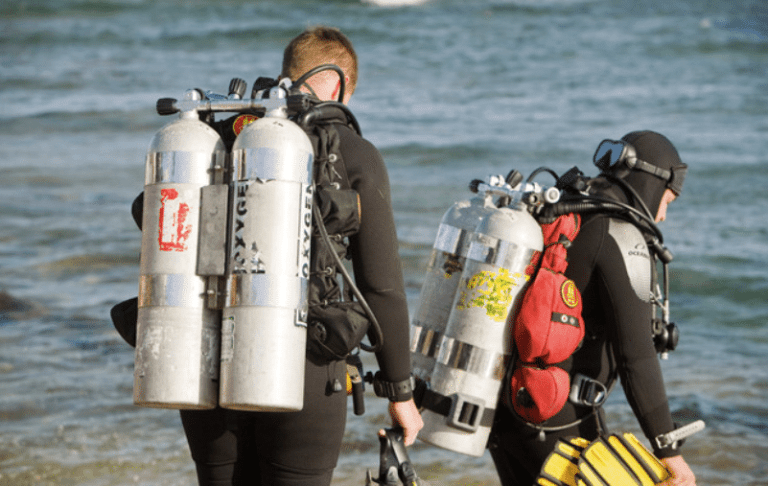
Why Twin Tanks Exist
At first glance, twin cylinders appear to be:
- Double the gas.
- Double the weight.
- Double the complexity.
But in technical diving, they represent:
- Controlled redundancy.
- Failure isolation capability.
- Balanced gas distribution.
- Increased mission margin.
Twin tanks are not about depth for ego.
They are about depth with control.
What Is a Manifold?
A manifold is:
- A metal connection between two cylinders.
- Composed of two posts and a central isolator valve.
- Designed to allow gas flow between both tanks.
In normal operation:
- Both cylinders equalise.
- Gas flows freely between them.
- The diver breathes from a shared supply.
But the real power lies in:
The ability to isolate.
The Isolator Valve: The Core of the System
The manifold includes:
- Left post valve.
- Right post valve.
- Central isolator valve.
In a failure scenario:
- The diver can close one post.
- Or close the isolator.
- Protect remaining gas supply.
Example:
If a right regulator free-flows:
- Close right post.
- Gas from left cylinder remains available.
Without a manifold:
- A catastrophic failure could empty the entire system.
The manifold transforms twin cylinders into:
A controlled, fail-manageable life support system.
Redundancy vs Capacity
Important distinction:
Twin tanks are not just about more gas.
They provide:
- Redundant regulators.
- Redundant valve systems.
- Redundant first stages.
- Isolation capability.
Gas capacity increases, yes.
But the primary advantage is:
Controlled failure response.
In overhead environments:
- There is no direct ascent.
- There is no immediate bailout.
- There is no surface option.
Failure management must be internal.

Gas Balance and Symmetry
Manifolded twins allow:
- Equal pressure in both cylinders.
- Balanced breathing.
- Stable trim.
- Predictable gas management.
Compared to independent twins:
Manifolded systems reduce:
- Asymmetrical gas depletion.
- Complex gas tracking.
- Confusion under stress.
The diver monitors:
One pressure reading.
But has structured failure control.
Valve Drills: Why Skill Matters
Owning manifolded twins does not make a diver safer.
Skill does.
Technical divers practice:
- Reaching back.
- Identifying the correct post.
- Closing valves precisely.
- Maintaining buoyancy while shutting down.
Valve drills must be:
- Controlled.
- Deliberate.
- Practised regularly.
Speed is not the metric.
Precision is.
A poorly executed valve shutdown can:
- Increase task loading.
- Disrupt buoyancy.
- Escalate stress.
Why Not Just Use Single Tank with Pony?
Single tank with pony provides:
- Separate gas source.
- Simpler setup.
- Limited redundancy.
But:
- Pony volume may be insufficient.
- Switching regulators under stress increases complexity.
- Gas planning becomes more layered.
Manifolded twins integrate redundancy directly into primary configuration.
This simplifies:
- Gas tracking.
- Regulator switching.
- Failure response.
In decompression or cave diving:
Integrated systems matter.
Overhead and Decompression Context
In environments where:
- Direct ascent is impossible.
- Decompression stops are mandatory.
- Long penetrations occur.
The manifold provides:
- Margin.
- Control.
- Structured redundancy.
If a regulator fails at 60 meters:
You cannot ascend immediately.
You must:
- Solve the problem.
- Protect gas.
- Continue safely to exit.
Manifold systems were designed for exactly this reality.

When Manifolds Become Dangerous
Improper training leads to:
- Inability to reach valves.
- Incorrect shutdown sequence.
- Over-reliance on equipment.
- False confidence.
Manifolds increase safety only when:
The diver is trained to use them.
At N9BO℠, we emphasise configuration discipline and shutdown competency because equipment without procedural mastery creates risk, not protection.
The Psychological Benefit
Knowing you can isolate a failure:
- Reduces panic.
- Improves cognitive bandwidth.
- Enhances decision clarity.
Redundancy builds calm.
Calm improves performance.
Performance protects margin.
Manifold as Philosophy
The manifold reflects a deeper principle:
Assume something will fail.
Design systems to contain failure.
Train to manage failure.
Do not rely on optimism.
Technical diving evolved around this mindset.
Twin tanks are not aesthetic.
They are architectural.
When Are Twins Appropriate?
Twin tanks are appropriate when:
- Entering decompression diving.
- Entering overhead environments.
- Extending bottom time significantly.
- Operating in complex profiles.
They are not necessary for:
- Basic recreational dives.
- Shallow non-decompression exposures.
- Divers without proper training.
Configuration must match mission.
Not ambition.
Final Perspective
The manifold is:
- A redundancy bridge.
- A failure firewall.
- A technical standard.
- A behavioural commitment.
It is not about carrying more gas.
It is about protecting what you carry.
Twin tanks with manifold represent:
A shift from reactive diving to engineered safety.

Ready to Transition to Twinsets Safely?
Manifold systems require structured training and disciplined practice. Contact N9BO℠ to explore technical diving pathways built on redundancy and control.
From the N9BO℠ Knowledge Base