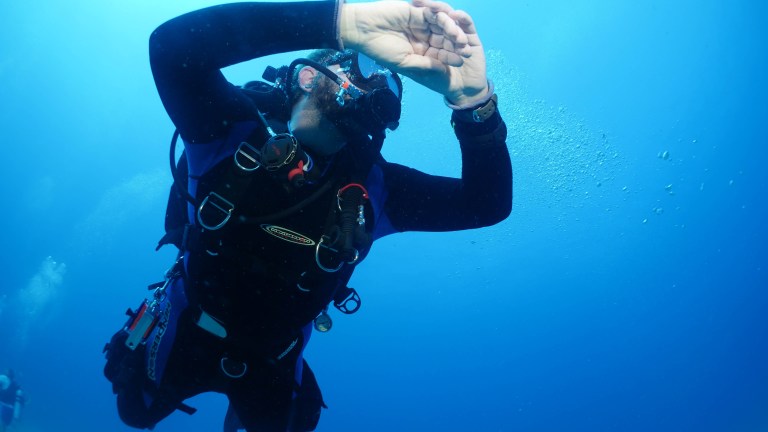
The Illusion of “Good Enough” Buoyancy
Many divers enter technical training confident in their buoyancy control. After all, they can hover, maintain safety stops, and hold position during recreational dives. Yet within the first days of technical training, that confidence is often shaken.
This is not because technical instructors impose unrealistic expectations, but because technical environments expose buoyancy control under conditions recreational diving never does. Increased equipment mass, task loading, failure drills, and decompression obligations all place demands on control that recreational dives rarely reveal.
In recreational diving, buoyancy errors are often inconsequential. A one-metre deviation during a safety stop may go unnoticed. In technical diving, the same deviation can affect decompression accuracy, gas consumption, and team coordination. This is why technical diving training treats buoyancy as a foundational safety system, not a comfort skill.
Buoyancy Under Task Load: Where Control Breaks Down
The most revealing moment for buoyancy control is not when a diver is motionless, but when they are occupied. Valve drills, gas switches, reel work, navigation, or simulated failures divide attention. When buoyancy is not automatic, it becomes the first thing to degrade.
This phenomenon is well understood in human performance science: when cognitive load increases, less automated tasks suffer. TDI technical diving courses deliberately introduce task loading to expose this effect in a controlled environment, allowing instructors to identify whether buoyancy is truly ingrained or merely situational.
Divers who rely on constant visual reference, frequent inflator adjustments, or exaggerated fin movement often discover that these compensatory habits fail under stress. Technical training removes these crutches early—sometimes uncomfortably so.

Trim as a Functional Requirement, Not a Visual Preference
Trim is often dismissed as an aesthetic concern, associated with photographs rather than function. In reality, trim directly influences almost every aspect of technical diving performance.
A diver who is head-up or foot-heavy experiences increased drag, higher gas consumption, and reduced stability. More importantly, poor trim interferes with task execution: valves are harder to reach, fin kicks become inefficient, and maintaining position relative to teammates becomes inconsistent.
In overhead or low-visibility environments, trim errors have environmental consequences as well. Silt disturbance can eliminate visibility, turning manageable situations into high-risk ones. Advanced technical diving progression treats trim as an environmental and operational control mechanism, not a stylistic choice.
Buoyancy, Trim, and Decompression Accuracy
Once mandatory decompression is introduced, buoyancy control becomes directly linked to physiological safety. Decompression schedules are calculated based on depth and time assumptions. Deviations—particularly repeated oscillations—alter inert gas loading in ways dive computers may not fully capture.
This is why PADI Tec training programmes and TDI technical diving courses emphasise depth stability during stops. It is not about “looking good,” but about reducing unnecessary physiological stress.
Divers who struggle to hold precise depths during simulated stops often experience increased anxiety, further degrading control. This feedback loop is one of the most common early barriers to progression.
The Compounding Effect of Equipment
Technical equipment increases both capability and complexity. Twin cylinders, stage bottles, and redundant systems add mass and inertia. Poor buoyancy habits that were manageable with a single cylinder become amplified.
Equipment also changes how divers interact with their buoyancy systems. Gas shifts during ascent, suit inflation dynamics, and cylinder buoyancy characteristics must all be managed deliberately. Technical diving training teaches divers to anticipate these changes rather than react to them.
Candidates who treat buoyancy as something “the equipment will handle” quickly discover the opposite: technical equipment demands better buoyancy skill, not less.

Psychological Pressure and Control Degradation
Stress plays a subtle but significant role in buoyancy and trim failures. Divers under evaluation often experience performance anxiety, leading to shallow breathing, rapid adjustments, or rushed movements. These behaviours destabilise buoyancy further.
Technical training environments are intentionally structured to normalise evaluation. Advanced technical diving progression encourages divers to slow down, breathe deliberately, and accept imperfection while maintaining control.
This psychological component is often overlooked in informal practice, yet it is critical for consistent performance in real operations.
Why These Failures Are Predictable—and Preventable
The fact that buoyancy and trim issues are so common does not indicate poor candidates; it reflects a predictable mismatch between recreational experience and technical demand. Recreational training simply does not require buoyancy to function under the same constraints.
The good news is that these failures are also highly correctable. Divers who dedicate time to refining buoyancy and trim before entering technical courses often progress faster, retain more information, and experience less stress during training.
At N9BO℠, early technical training is structured to diagnose and address these issues methodically, ensuring that candidates build competence rather than merely surviving the course.
Control as a Professional Standard
Ultimately, buoyancy and trim are not personal preferences. They are professional standards in technical diving. Divers who achieve stable, repeatable control-free mental capacity for planning, communication, and decision-making—the skills that truly define technical competence.
Technical diving does not demand perfection. It demands consistency.

Importantly, buoyancy and trim are not aesthetic concerns; they are safety mechanisms. Stable divers think more clearly, communicate better, and consume less gas.
At N9BO℠, buoyancy and trim are treated as professional competencies, not stylistic preferences, forming the backbone of Advanced technical diving progression.

Struggling With Buoyancy and Trim?
We can help you identify and correct the underlying issues that limit progression in technical diving.
From the N9BO℠ Knowledge Base