Buoyancy Is Not a Mechanical Skill Alone
Many divers learn buoyancy as a mechanical task: add gas, vent gas, hold depth. While this description is technically accurate, it misses the deeper implication.
Buoyancy determines how much attention a diver has available. Technical diving training treats buoyancy as a cognitive enabler—not just a physical competency.
The Hidden Cost of Poor Buoyancy
Divers with unstable buoyancy are constantly correcting. These micro-adjustments consume attention continuously.
Each correction may seem minor, but collectively they:
- Increase task loading
- Reduce situational awareness
- Delay decision-making
- Increase stress
Advanced technical diving progression teaches that poor buoyancy quietly taxes the brain.
Buoyancy and Cognitive Bandwidth
Cognitive bandwidth is finite. When buoyancy requires constant attention, there is less capacity for:
- Monitoring teammates
- Interpreting environmental change
- Anticipating problems
Stable buoyancy frees the mind. Technical diving training explicitly links buoyancy mastery to mental clarity.

Depth Control Under Stress
Stress amplifies buoyancy instability. Rapid breathing, tension, and rushed movements disrupt depth control.
This creates a feedback loop: instability increases stress, which further degrades buoyancy. Advanced technical diving progression teaches divers to stabilise depth first to stabilise thinking.
Why Buoyancy Fails in Emergencies
Many emergency skills are practised in isolation, without buoyancy demand. Under stress, divers may complete the action but lose depth control.
Professional training integrates buoyancy into every skill. Technical diving training requires that emergency responses maintain stable depth—not sacrifice it.
Buoyancy and Team Predictability
Teams rely on predictable vertical positioning. Inconsistent depth control disrupts spacing, communication, and coordinated movement.
Advanced technical diving progression treats buoyancy as a team discipline, not an individual accomplishment.
Instructor Perspective: Teaching Buoyancy as Thinking Space
Instructors often observe that once buoyancy stabilises, everything else improves—communication, awareness, and calmness.
At N9BO℠, buoyancy is framed early as a way to buy thinking time, not just control depth.

Why Experience Alone Does Not Guarantee Buoyancy
Some experienced divers still struggle with buoyancy because habits were never corrected. Familiarity does not fix inefficiency.
Technical diving training uses feedback, repetition, and stress exposure to reset buoyancy fundamentals.
Buoyancy in Complex Environments
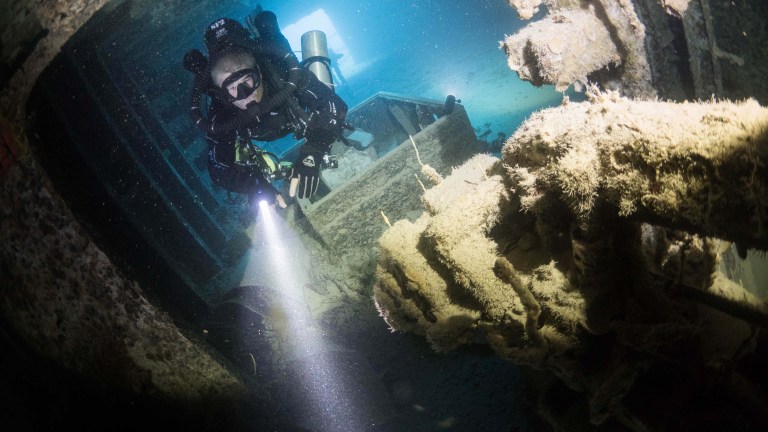
In caves, wrecks, or decompression scenarios, vertical instability has consequences—silt disturbance, collision, decompression error.
Advanced technical diving progression reinforces buoyancy precision because complexity punishes instability.
Professional Parallels
In aviation, stable flight frees pilots to manage systems and decisions. In diving, stable buoyancy does the same.
Control creates capacity.
The Bottom Line
Buoyancy is not about depth.
It is about thinking.
In technical diving, precise buoyancy control frees cognitive bandwidth for awareness, communication, and decision-making. The most capable divers are those whose depth never competes with their thoughts.
At N9BO℠, buoyancy is trained as mental freedom.
Want More Control and Less Mental Load Underwater?
Stable buoyancy reduces workload and allows better awareness and decision-making. Contact us to discuss improving buoyancy and control in demanding dives.
From the N9BO℠ Knowledge Base