Why Decompression Is So Widely Misunderstood
Few topics in diving generate as much confusion as decompression. Recreational divers are typically taught to follow their dive computer, respect no-decompression limits, and perform a safety stop. For many, decompression remains something abstract—handled by electronics, rarely questioned, and poorly understood.
This approach works within recreational limits because the margins are intentionally wide. However, once divers enter environments where mandatory decompression is required, ignorance becomes a liability. Technical diving demands not blind trust, but informed confidence. This is why decompression theory occupies a central place in technical diving training.
Understanding decompression does not mean becoming a mathematician. It means understanding what models attempt to represent, where they are reliable, and where they are not.
What Decompression Models Actually Are
At its core, decompression theory attempts to describe how inert gases—primarily nitrogen and helium—are absorbed and released by the body under pressure. Because the human body is biologically complex, decompression models rely on mathematical approximations rather than direct measurement.
These models divide the body into hypothetical “tissue compartments,” each with assumed gas uptake and release rates. No model perfectly represents reality; instead, they aim to be conservative predictors of acceptable risk.
This is a critical distinction taught in TDI technical diving courses and PADI Tec training programmes: decompression models do not guarantee safety. They estimate probability.
Why “Following the Computer” Is Not Enough
Dive computers are powerful tools, but they are not decision-makers. They apply a chosen model to the data they receive—depth, time, and sometimes ascent rate. What they cannot fully account for are:
- Individual physiological variability
- Hydration status
- Thermal stress
- Workload and exertion
- Previous dive history beyond basic tracking
A diver who treats the computer as an infallible authority misunderstands its role. Advanced technical diving progression teaches divers to use computers as instruments, not oracles.
Understanding decompression theory allows divers to recognise when a profile is aggressive, when conservatism is warranted, and when a computer’s output should be questioned.
Gas Choice and Its Decompression Implications
One of the most practical applications of decompression theory is gas selection. Helium reduces narcosis and gas density, but it also changes decompression dynamics. Oxygen accelerates off-gassing but introduces toxicity considerations.
Without an understanding of how different gases behave, divers may make suboptimal choices that increase stress rather than reduce it. This is why technical diving training integrates decompression theory with gas planning, rather than treating them as separate subjects.
Divers learn that decompression is not just about how long you stop, but how efficiently gas exchange occurs during ascent.
Ascent Rate, Micro-Stops, and Stability
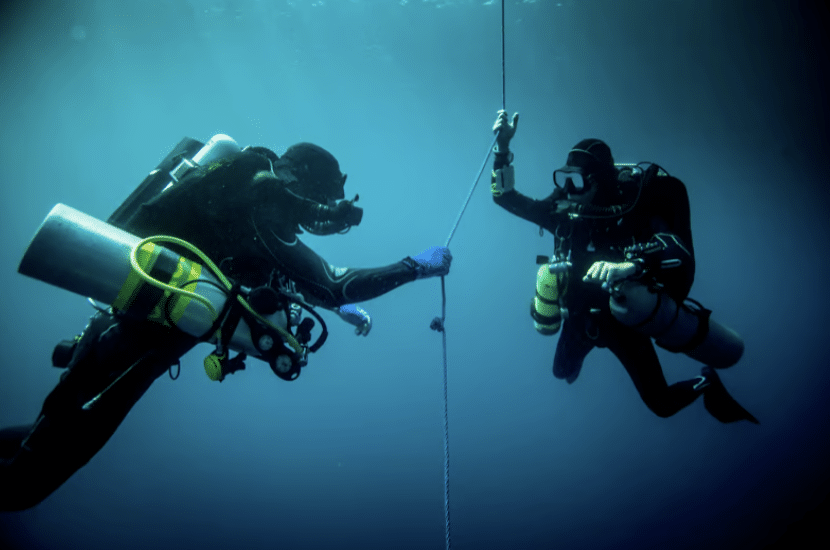
Modern decompression thinking places increasing emphasis on ascent behaviour rather than just stop depth. Rapid ascents, even if corrected later, can increase bubble formation. Conversely, smooth, controlled ascents reduce stress on the body.
Technical training emphasises:
- Consistent ascent rates
- Stable stop depths
- Minimal vertical oscillation
These behaviours are often more important than the exact stop schedule. Advanced technical diving progression reinforces that how you ascend matters as much as where you stop.
Individual Variability and Conservative Planning
No two divers decompress identically. Age, fitness, body composition, and genetics all influence decompression response. This variability is one reason decompression sickness can occur even when divers follow accepted procedures.
Understanding this uncertainty leads to conservative planning. Divers who grasp decompression theory tend to:
- Add buffer time
- Avoid marginal profiles
- Respect surface intervals
- Adjust behaviour based on fatigue and conditions
These habits are not mandated by standards; they emerge from understanding. This distinction is emphasised throughout TDI technical diving courses.
Long-Term Exposure and Career Longevity
For divers who engage in frequent or professional-level technical diving, decompression is not a single-event concern—it is cumulative. Repeated exposure to marginal profiles can lead to long-term health consequences even without acute incidents.
This reality is particularly relevant for instructors, expedition divers, and public safety personnel. Advanced technical diving progression therefore frames decompression management as a career-preservation strategy, not merely a dive-planning exercise.
At N9BO℠, decompression education emphasises sustainability: diving in a way that preserves both short-term safety and long-term wellbeing.
What You Actually Need to Understand
Divers do not need to memorise equations or compare competing algorithms obsessively. What they do need is:
- An understanding of model assumptions
- Awareness of factors that increase risk
- The ability to plan conservatively
- The discipline to ascend slowly and deliberately
This level of understanding transforms decompression from a mystery into a manageable, respected process.
Decompression as Risk Management, Not Clearance
Perhaps the most important conceptual shift is viewing decompression not as something to “get through,” but as something that actively protects the diver. Stops are not obstacles; they are safety buffers.
This mindset change is one of the defining features of technical diving training. Divers who internalise it approach dives with patience, humility, and professionalism.
Decompression is not about earning the right to surface.
It is about ensuring you can surface safely—every time.
Effective decompression planning is not about gaming algorithms but about building margin. Factors such as hydration, workload, and temperature influence outcomes and must be considered holistically.
At N9BO℠, decompression is taught as a practical risk-management tool, forming a cornerstone of Advanced technical diving progression.
Want to Truly Understand Decompression?
If decompression theory feels abstract or confusing, we can help translate it into practical understanding for real-world diving.
From the N9BO℠ Knowledge Base