Fin Buoyancy: The Overlooked Variable
Most divers choose fins based on:
- Comfort.
- Blade stiffness.
- Aesthetic preference.
- Instructor recommendation.
Few consider:
Fin buoyancy characteristics.
Fins may be:
- Negatively buoyant (sink in water).
- Neutral.
- Slightly positively buoyant (float).
That buoyancy interacts with:
- Exposure suit type.
- Cylinder configuration.
- Weight placement.
- Body posture.
Trim begins at the feet.
Why Trim Matters
Horizontal trim is essential for:
- Reduced drag.
- Efficient propulsion.
- Gas conservation.
- Environmental protection.
- Controlled decompression.
If fins are too buoyant:
- Feet rise.
- Diver becomes head-down.
- Depth control becomes unstable.
If fins are too negative:
- Feet sink excessively.
- Diver struggles to maintain level posture.
- Increased fin effort required.
Fin buoyancy influences stability.
Stability influences safety.
Dry Suit Divers: The Classic Example
Dry suit divers often experience:
- Air migration toward feet.
- Increased leg buoyancy.
- Tendency for feet to rise.
In such configurations:
Negatively buoyant fins can:
- Counterbalance air in legs.
- Improve horizontal stability.
- Reduce inversion risk.
Many technical divers in dry suits prefer:
Heavier rubber fins.
Not because they look serious.
But because they stabilise trim.
Wetsuit Divers: Different Dynamics
Wetsuits compress at depth.
Leg buoyancy reduces during descent.
Positive fins in wetsuits may:
- Exaggerate feet-up posture.
- Require compensatory hip adjustment.
Negative fins in wetsuits:
- May over-weight lower body.
- Increase ankle strain.
- Reduce efficiency for lighter divers.
Configuration must be individualised.
There is no universal solution.

Technical vs Recreational Context
Technical divers prioritise:
- Precision trim.
- Back kick control.
- Frog kick efficiency.
- Stable decompression posture.
Fin buoyancy becomes critical.
Recreational divers in:
- Warm water.
- Minimal exposure.
- Single cylinder setups.
May prioritise comfort over precision.
But even then:
Trim influences gas consumption.
Gas influences margin.
Margin influences safety.
Fin Weight and Energy Expenditure
Heavier fins:
- Increase ankle workload.
- Increase muscular fatigue.
- Demand stronger propulsion.
Lighter fins:
- Reduce effort.
- Improve long surface swims.
- May reduce power in strong currents.
Choosing overly heavy fins without need:
Increases fatigue.
Fatigue reduces performance.
Performance degradation increases risk.
Back Kick, Helicopter Turns, and Control
Advanced propulsion techniques require:
- Fin responsiveness.
- Predictable balance.
- Controlled ankle movement.
Negatively buoyant fins often:
- Provide stable pivot point.
- Improve control in frog kick.
- Support reverse propulsion precision.
However:
Technique matters more than mass.
Equipment supports skill.
It does not replace it.
Environmental Considerations
In overhead environments:
- Fine silt requires stable trim.
- Poor visibility demands precision.
- Small fin misalignment can disturb bottom.
Fin buoyancy affects:
Foot positioning.
Blade angle.
Sediment disturbance.
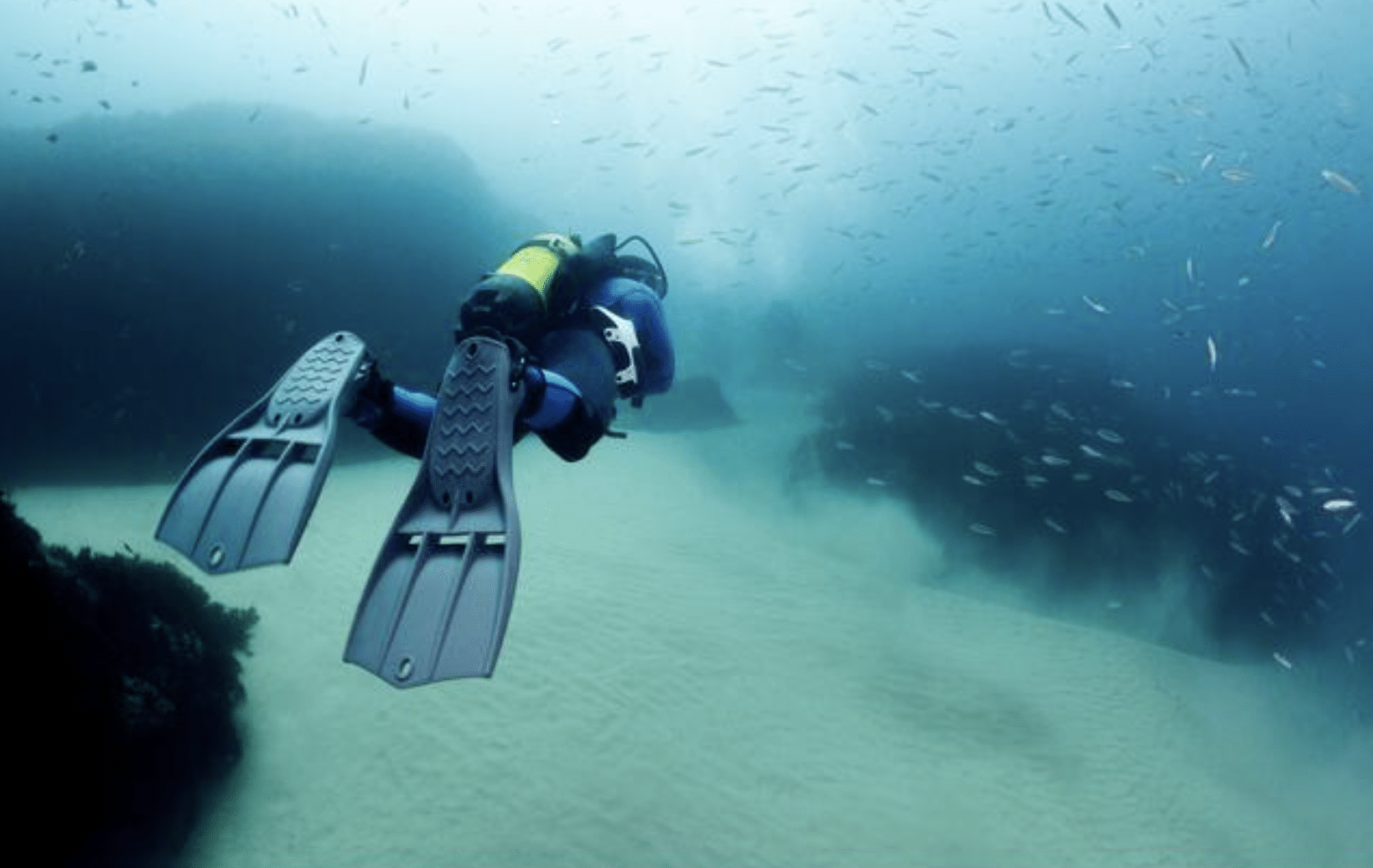
Precision diving requires predictable fin behaviour.
Testing and Configuration Discipline
Divers should evaluate fins by:
- Floating test in confined water.
- Observing leg position in neutral hover.
- Testing frog and back kicks.
- Monitoring fatigue over long dives.
Do not assume:
What works for one diver works for another.
Configuration is contextual.
Common Misconceptions
“Heavy fins are more professional.”
Not necessarily.
“Light fins are only for beginners.”
Incorrect.
“Fin buoyancy does not matter.”
It absolutely does.
Professional divers assess:
Balance.
Function.
Integration.
Not trends.
Integration With Full Configuration
Fin buoyancy must be evaluated alongside:
- Cylinder position.
- Backplate weight.
- Weight belt distribution.
- Exposure suit type.
- Boot buoyancy.
- Stage bottle placement.
Small changes affect system equilibrium.
Trim is systemic.
Not isolated.
At N9BO℠, we emphasise configuration analysis as part of professional development. Equipment selection is deliberate — because underwater stability is not accidental.
The Psychological Component
Balanced trim reduces:
- Anxiety.
- Task loading.
- Depth fluctuation.
- Gas spikes.
Confidence increases when:
The body remains stable effortlessly.
Good configuration reduces cognitive load.
Cognitive margin protects decision quality.
When to Reconsider Your Fins
Consider reassessing fin choice if:
- You struggle with horizontal trim.
- Your feet constantly rise or sink.
- You fatigue quickly in currents.
- You experience ankle strain.
- You transition between wetsuit and dry suit environments.
Configuration evolves.
Professionals adapt.
Final Perspective
Fins are not just propulsion tools.
They are trim regulators.
Energy modifiers.
Stability influencers.
Choosing negative or positive buoyant fins is not about aesthetics.
It is about:
Balance.
Efficiency.
Control.
Small equipment decisions create large performance outcomes.

Unsure If Your Fin Configuration Supports Your Diving?
Trim and propulsion depend on proper equipment balance. Contact N9BO℠ to evaluate your configuration and optimise performance.
From the N9BO℠ Knowledge Base