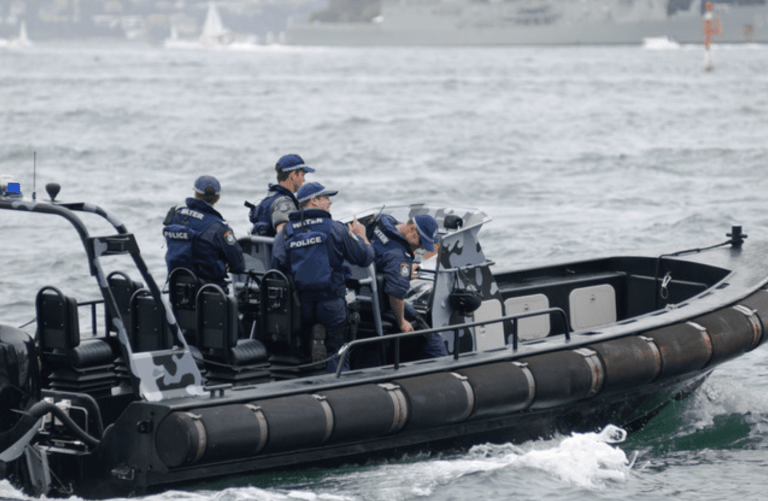
Why Small Boat Operations Matter in Public Safety
Public safety dive teams rarely deploy from large, stable platforms.
More often, they operate from:
- Rigid inflatable boats (RIBs).
- Aluminium rescue vessels.
- Patrol craft.
- Small coastal boats.
- River rescue platforms.
These vessels operate in:
- Currents.
- Swell.
- Offshore wind.
- Congested waterways.
- Low-visibility conditions.
Operating safely from small boats is not intuitive.
It is procedural.
The Risk Profile of Small Craft
Small boats introduce specific hazards:
- Reduced freeboard.
- Weight sensitivity.
- Trim instability.
- Propeller exposure.
- Limited deck space.
- Rapid weather vulnerability.
Under operational stress, these risks multiply.
Divers gearing up on a moving vessel:
Increase load shift.
Affect balance.
Create trip hazards.
Small Boat Ops training emphasises:
Movement discipline.
Every step must be intentional.
Pre-Departure Planning
Professional operations begin before launch.
Planning includes:
- Weather forecast analysis.
- Tide and current evaluation.
- Fuel calculation.
- Equipment load management.
- Crew role assignment.
- Communication protocols.
- Emergency contingency review.
Improvisation at sea is dangerous.
Preparation reduces decision fatigue.

Crew Roles and Structure
Small boat operations require:
- Coxswain (vessel operator).
- Dive supervisor.
- Tender or deck support.
- Rescue swimmer readiness.
Clear roles reduce confusion.
Authority gradients must be:
Understood.
Respected.
Structured.
Boat operations integrate with:
Incident Command Systems (ICS).
Communication clarity protects margin.
Boat Handling Fundamentals
ERDI Small Boat Ops covers:
- Safe approach techniques.
- Maintaining station in current.
- Victim approach strategies.
- Diver pick-up procedures.
- Propeller awareness.
- Engine neutral discipline.
Poor boat handling:
Creates secondary emergencies.
Professional seamanship reduces risk before divers even enter water.
Launching and Recovery of Divers
Deploying divers from small craft requires:
- Controlled entry sequencing.
- Weight distribution awareness.
- Stable positioning.
- Engine management.
Recovery requires:
- Ladder positioning.
- Engine neutral verification.
- Physical support coordination.
- Controlled re-boarding.
Mismanaged recovery leads to:
Injury.
Propeller hazard.
Boat instability.
Structured recovery procedures protect team members.
Search Pattern Integration
Small boats are frequently used to:
- Establish search grids.
- Deploy sonar.
- Drop markers.
- Support divers during circular or jackstay searches.
Precise boat positioning improves:
Search efficiency.
Evidence preservation.
Operational speed.
Boat drift misalignment compromises underwater search accuracy.
Surface discipline influences subsurface performance.
Emergency Scenarios
ERDI Small Boat Ops training addresses:
- Man overboard.
- Engine failure.
- Sudden weather change.
- Fuel miscalculation.
- Communication loss.
- Capsize prevention.
Divers must understand:
That boats are not static platforms.
They are dynamic risk environments.
Preparedness reduces panic.

Night and Low-Visibility Operations
Reduced visibility adds:
- Navigational risk.
- Collision risk.
- Communication challenges.
- Depth perception limitations.
Proper lighting discipline is critical.
Improper lighting can:
Blind operators.
Reduce situational awareness.
Create shadow hazards.
Night operations require structured planning.
Integration with Dive Operations
Small boat ops is not separate from diving.
It is part of:
Mission execution.
Dive team members must understand:
Boat trim.
Load impact.
Movement timing.
Emergency communication flow.
At N9BO℠, we emphasise that small boat proficiency is a core operational skill — not an optional add-on. Divers who understand seamanship reduce risk above and below the surface.
Maritime Culture and Professionalism
Seamanship is built on:
Respect for environment.
Predictable behaviour.
Conservative judgement.
Clear communication.
Professional small boat operators:
- Anticipate change.
- Avoid complacency.
- Maintain margin.
- Prioritise safety over speed.
Maritime discipline is non-negotiable.
Why This Course Matters in Asia
In Southeast Asia and regional coastal environments:
- Weather shifts rapidly.
- Maritime traffic is dense.
- Coastal currents are strong.
- Infrastructure may be limited.
Public safety teams must be self-sufficient.
Small Boat Ops competence:
Expands operational reach safely.
Final Perspective
Small boats amplify:
Environmental forces.
Human error.
Operational complexity.
Professional training transforms:
Risk into manageable systems.
The ERDI Small Boat Operations course builds:
Seamanship discipline.
Command integration.
Diver deployment safety.
Environmental awareness.
Because the dive begins long before the descent.
It begins on deck.

Ready to Strengthen Your Maritime Operational Capability?
Develop disciplined small boat operations aligned with ERDI public safety standards. Contact N9BO℠ to schedule structured Small Boat Ops training.
From the N9BO℠ Knowledge Base