Why Full Face Masks Exist in Public Safety Diving
In recreational diving, equipment is largely designed for comfort and simplicity. Public safety diving operates under very different constraints. Divers may work in contaminated water, zero visibility environments, cold conditions, or locations where communication with the surface is critical. The full face mask was developed to address these operational challenges.
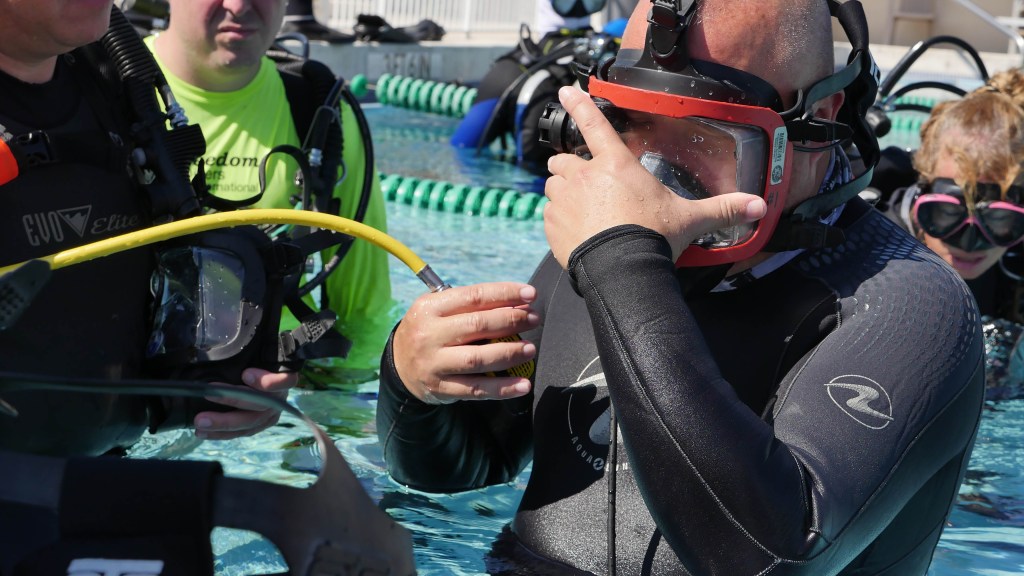
An FFM seals around the entire face rather than just the eyes and nose, allowing the diver to breathe through both nose and mouth while maintaining a protected breathing environment. This reduces jaw fatigue, improves thermal protection, and allows integration with underwater communication systems. For law enforcement, recovery teams, and emergency response divers, these advantages are not luxuries — they are operational necessities.
At N9BO℠, FFM training begins with understanding that the equipment is not simply an upgrade. It is a different system requiring different habits and procedures.
Communication Changes Everything
One of the most significant advantages of full face mask diving is communication. In ERDI operations, divers often remain in constant contact with tenders and supervisors on the surface. Instructions, updates, and safety information can be transmitted in real time, reducing uncertainty and improving coordination.
This fundamentally changes underwater operations. Instead of relying solely on hand signals or line pulls, teams operate more like coordinated units. Search patterns can be adjusted immediately, hazards communicated instantly, and diver workload reduced through clear direction from the surface.
However, communication introduces a new layer of discipline. Divers must learn to speak clearly, manage breathing while communicating, and avoid cognitive overload. Surface teams must also be trained to communicate efficiently. Poor communication can create confusion rather than clarity. ERDI training addresses this by integrating communication procedures into operational scenarios rather than treating them as an accessory skill.
Protection in Contaminated and Harsh Environments
Public safety divers frequently operate in environments unsuitable for traditional open-face equipment. Contaminated water, fuel residues, biological hazards, and low temperatures all increase exposure risk. A full face mask provides an additional barrier between the diver and the environment, reducing direct contact with potentially harmful water.
This protective function is one of the main reasons FFMs are standard equipment in many emergency response agencies. Combined with drysuits and proper decontamination procedures, they form part of a complete exposure protection system.
At N9BO℠, this aspect is taught within the broader context of risk management. Equipment alone does not eliminate risk; it reduces exposure when used correctly within established procedures.

New Failure Modes Require New Training
While FFMs provide clear advantages, they also introduce new risks. Mask flooding, regulator free-flow, communication failure, or incorrect strap adjustment can quickly escalate if the diver is not properly trained. Unlike a standard regulator, removal of a full face mask requires deliberate procedure and backup planning.
ERDI training emphasises bailout procedures, emergency mask removal, and transition drills. Divers must become comfortable managing failures calmly and methodically. The objective is not simply to use the equipment, but to understand how it behaves when things go wrong.
This reflects a core principle at N9BO℠: professional equipment demands professional discipline. The more capable the system, the more important training becomes.
Operational Efficiency and Reduced Diver Stress
When properly used, full face masks can significantly reduce diver workload. Breathing becomes more natural, communication reduces uncertainty, and the diver can focus more effectively on the task at hand. In search and recovery operations, inspections, or evidence recovery, this increased efficiency translates directly into safer and more controlled operations.
However, this benefit only appears when training is thorough. Without structured familiarisation, the mask can feel restrictive or unfamiliar. Proper training removes this barrier and allows the diver to use the equipment confidently.
At N9BO℠, FFM training integrates equipment handling with real operational scenarios, ensuring divers understand not only how to wear the mask, but how to work effectively with it.
A Professional Tool, Not a Comfort Upgrade
The full face mask represents a transition from recreational diving equipment to operational life-support systems. It enables communication, improves protection, and enhances control — but only when supported by disciplined procedures and team coordination.
For this reason, ERDI Full Face Mask training is not about equipment familiarity alone. It is about operational mindset. Divers learn to think in terms of systems, redundancy, and communication rather than individual comfort.
In professional diving, the goal is always the same: reduce uncertainty, increase control, and maintain safety margins even when environments become unpredictable. The full face mask, properly understood and trained, becomes a powerful tool in achieving that objective.
Interested in ERDI Full Face Mask Training?
Full face mask diving requires specialised procedures and operational training. Contact N9BO℠ to learn more about ERDI Full Face Mask programmes and public safety diving pathways.
From the N9BO℠ Knowledge Base