Understanding the Octopus as a Dynamic Organism
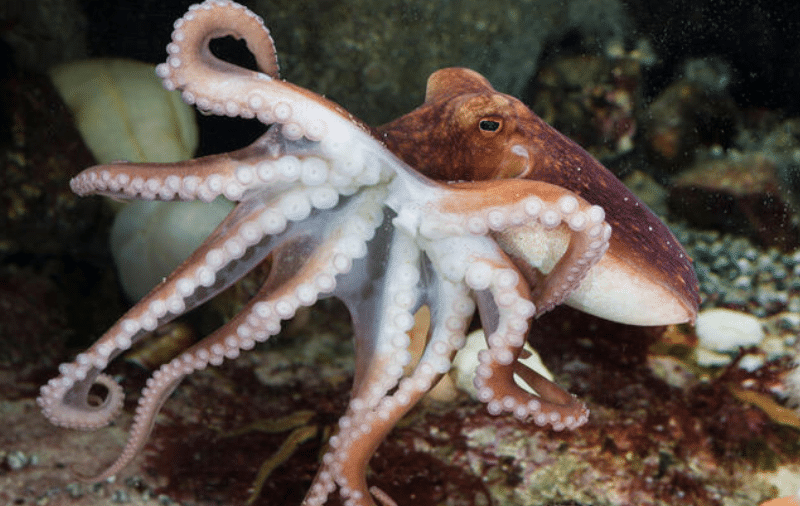
Octopuses are not passive reef inhabitants. They are active, adaptive predators capable of altering their behaviour, appearance, and positioning in response to their surroundings. Unlike many marine species that rely on fixed defensive strategies, octopuses operate through constant assessment and adjustment.
Their physiology supports this adaptability. With no rigid skeleton, they can change shape, compress into confined spaces, and move efficiently across varied terrain. This flexibility allows them to exploit environments that are inaccessible to other species.
At N9BO℠, we emphasise that the octopus is not simply a subject of observation—it is an example of real-time environmental adaptation.
Camouflage and Environmental Awareness
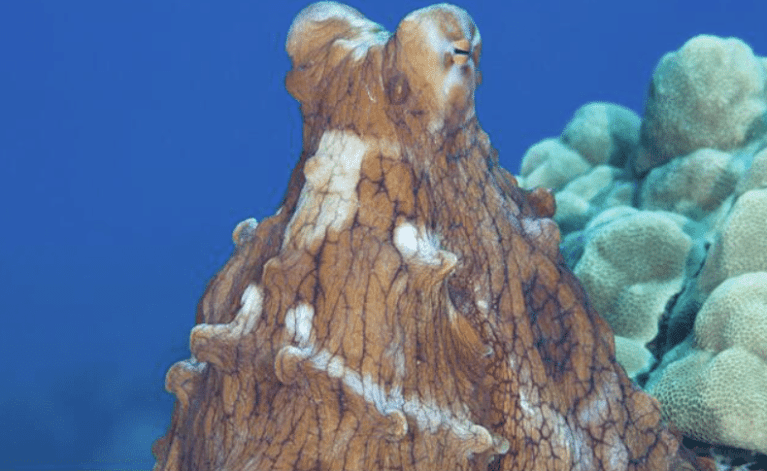
One of the most well-known capabilities of octopuses is camouflage. However, this is not limited to colour change. Octopuses adjust texture, posture, and movement to match their surroundings with high accuracy.
This behaviour is driven by continuous environmental assessment. The octopus does not rely on a fixed pattern; it actively interprets its environment and adapts accordingly.
Key characteristics of this capability include:
- Rapid colour change to match substrate
- Texture modification to replicate coral, rock, or sand
- Positioning that aligns with environmental structure
This level of awareness highlights the importance of observation. The octopus reacts to subtle changes, including the presence and behaviour of divers.
At N9BO℠, we use this as a reference point: effective operation requires continuous environmental assessment, not static awareness.
Behavioural Adaptation and Threat Response
Octopuses demonstrate a range of responses depending on perceived threat level. These responses are not random—they are selected based on context.
Typical responses include:
- Remaining motionless to avoid detection
- Retreating into shelter or confined spaces
- Using ink as a defensive measure
- Rapid escape through jet propulsion
The choice of response reflects assessment of risk and available options. This adaptability reduces exposure and increases survival.
For divers, this reinforces a key principle: response must be proportional to the situation. Overreaction wastes energy and creates additional risk, while underreaction increases exposure.
At N9BO℠, we emphasise adaptive response as a core operational capability.
Problem-Solving and Decision-Making
Octopuses are known for their problem-solving ability. They can navigate obstacles, open containers, and manipulate objects to achieve specific outcomes. This indicates a high level of cognitive function relative to other marine species.
This behaviour is not instinct alone—it involves learning, memory, and decision-making.
For divers, the relevance lies in the ability to:
- Assess multiple options
- Select effective solutions under constraint
- Adjust behaviour based on outcome
Operational environments often present similar challenges. Conditions change, information is incomplete, and decisions must be made quickly.
At N9BO℠, we highlight that effective decision-making is based on assessment, not assumption—mirroring the behaviour observed in adaptive species.
Energy Efficiency and Movement Control
Octopuses do not expend energy unnecessarily. Their movement is controlled, deliberate, and efficient. They avoid unnecessary exposure and conserve energy for when it is required.
This is particularly evident in:
- Slow, controlled crawling when undetected
- Use of cover and terrain to reduce visibility
- Rapid movement only when required
For divers, this reinforces the importance of efficient movement. Excessive finning, poor trim, and unnecessary repositioning increase energy consumption and reduce control.
Energy efficiency is not only a performance factor—it directly affects gas consumption and overall dive safety.
At N9BO℠, we integrate movement control into training, recognising its impact on both safety and environmental interaction.
Interaction with Divers
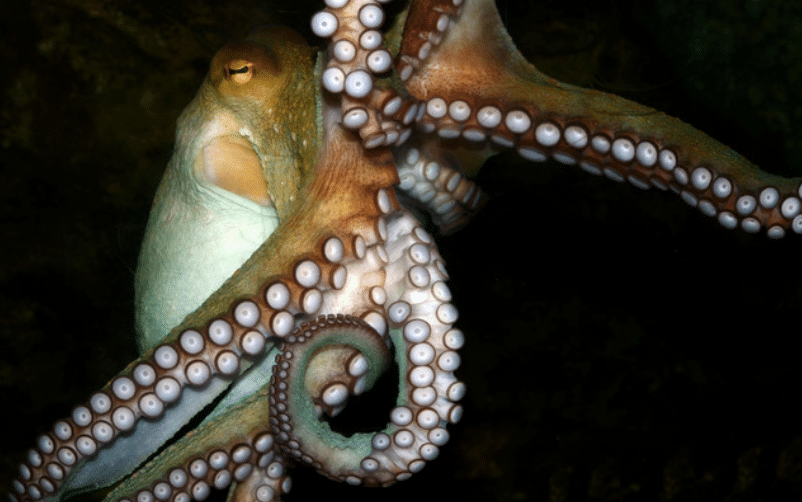
Octopuses respond directly to diver behaviour. Calm, controlled divers may be observed or tolerated, while erratic movement or close approach triggers defensive responses.
Indicators of stress or disturbance include:
- Rapid colour change
- Retreat into shelter
- Defensive posture or ink release
These responses provide immediate feedback. Divers who understand these indicators can adjust behaviour to reduce impact.
Approaching too closely or attempting interaction increases stress and disrupts natural behaviour. As with other marine life, observation should not interfere with activity.
At N9BO℠, we treat wildlife interaction as a controlled activity, where diver behaviour directly influences outcomes.
Environmental Integration and Use of Terrain
Octopuses use their environment actively. They select positions that provide cover, visibility, and access to resources. This includes utilising rock formations, coral structures, and even artificial objects.
This behaviour reflects an understanding of terrain and its advantages.
For divers, environmental integration is equally important. Effective positioning within the environment improves:
- Situational awareness
- Stability and control
- Access to exit routes
Poor positioning reduces options and increases exposure.
At N9BO℠, we emphasise the use of environment as a tool, not just a setting.
Adaptation as a Survival Strategy
The defining characteristic of the octopus is adaptability. It does not rely on a single strategy but adjusts continuously based on conditions.
This includes:
- Changing behaviour based on threat level
- Modifying appearance and movement
- Selecting optimal positioning
- Conserving energy until required
For divers operating in variable environments, this approach is directly applicable. Fixed responses are less effective than adaptive ones.
At N9BO℠, we train personnel to remain flexible, adjusting behaviour as conditions evolve rather than relying on rigid patterns.
Operational Mindset
Octopus behaviour demonstrates that survival in complex environments depends on awareness, adaptability, and control. These are not abstract concepts—they are observable, practical behaviours.
Divers who operate with fixed assumptions, poor awareness, or inefficient movement increase their risk. Those who adapt, observe, and respond effectively maintain control.
At N9BO℠, we use real-world examples to reinforce operational principles. The octopus is one such example—demonstrating how continuous assessment and adaptation lead to effective outcomes.
In dynamic environments, the ability to adapt is not an advantage. It is a requirement.

Operate with Awareness and Adaptability
Contact N9BO℠ to integrate advanced situational awareness and adaptive behaviour into your dive training, ensuring your teams operate effectively in complex environments.
From the N9BO℠ Knowledge Base