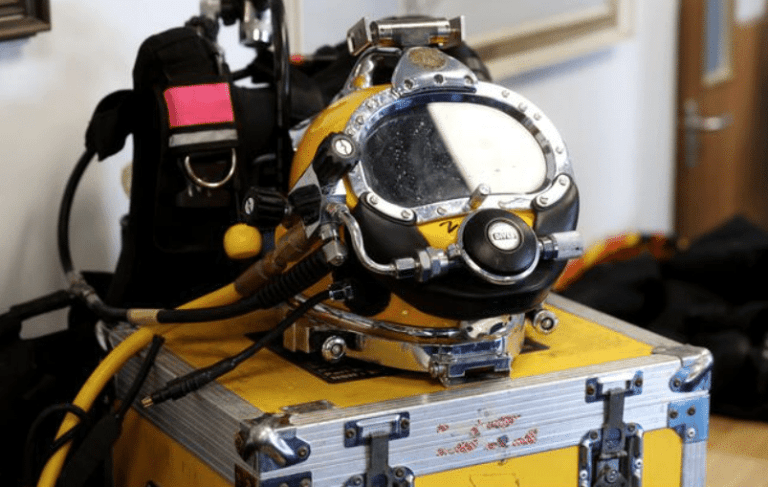
What Is a Kirby Morgan Helmet?
A Kirby Morgan helmet is:
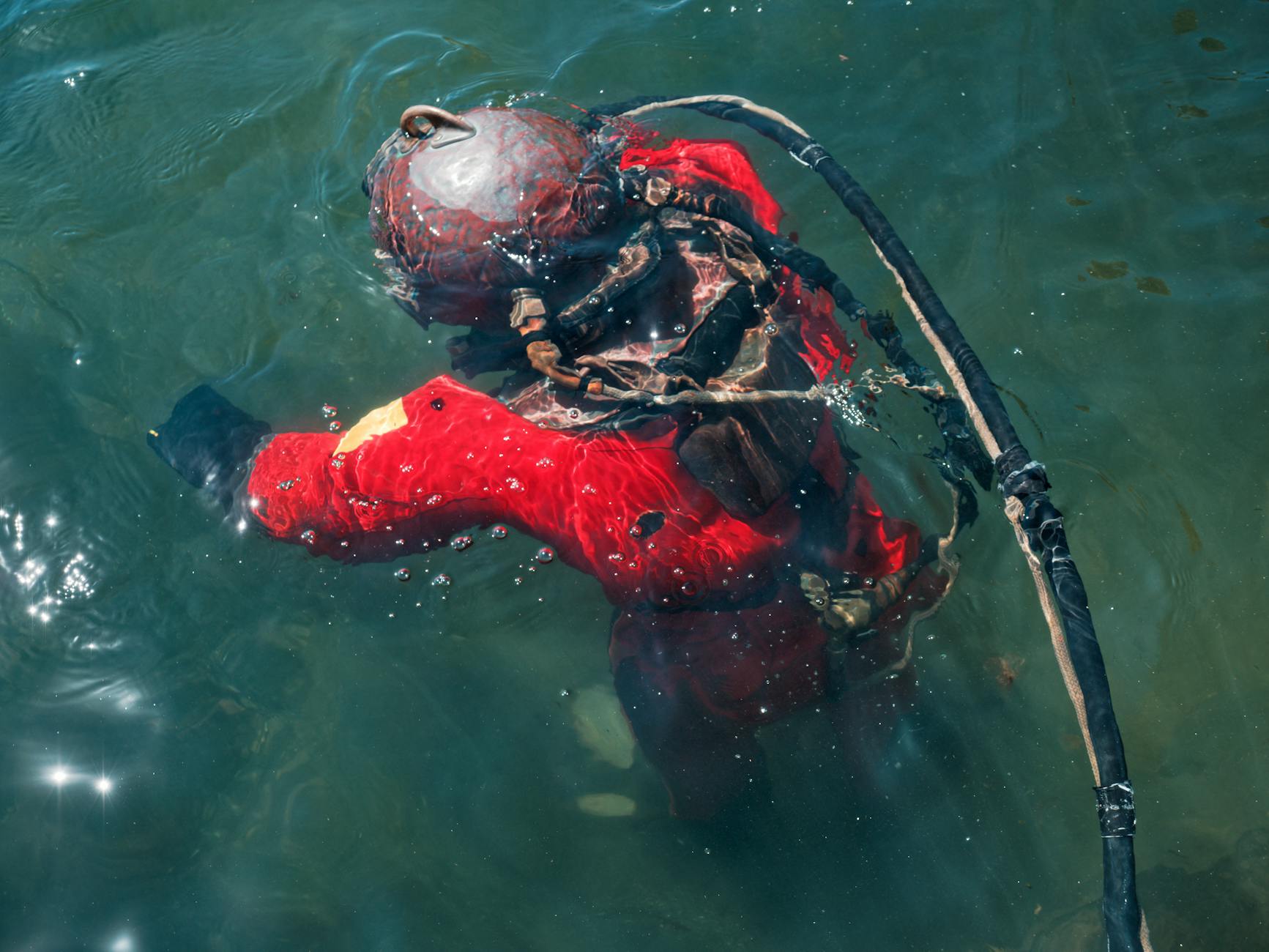
- A surface-supplied diving helmet.
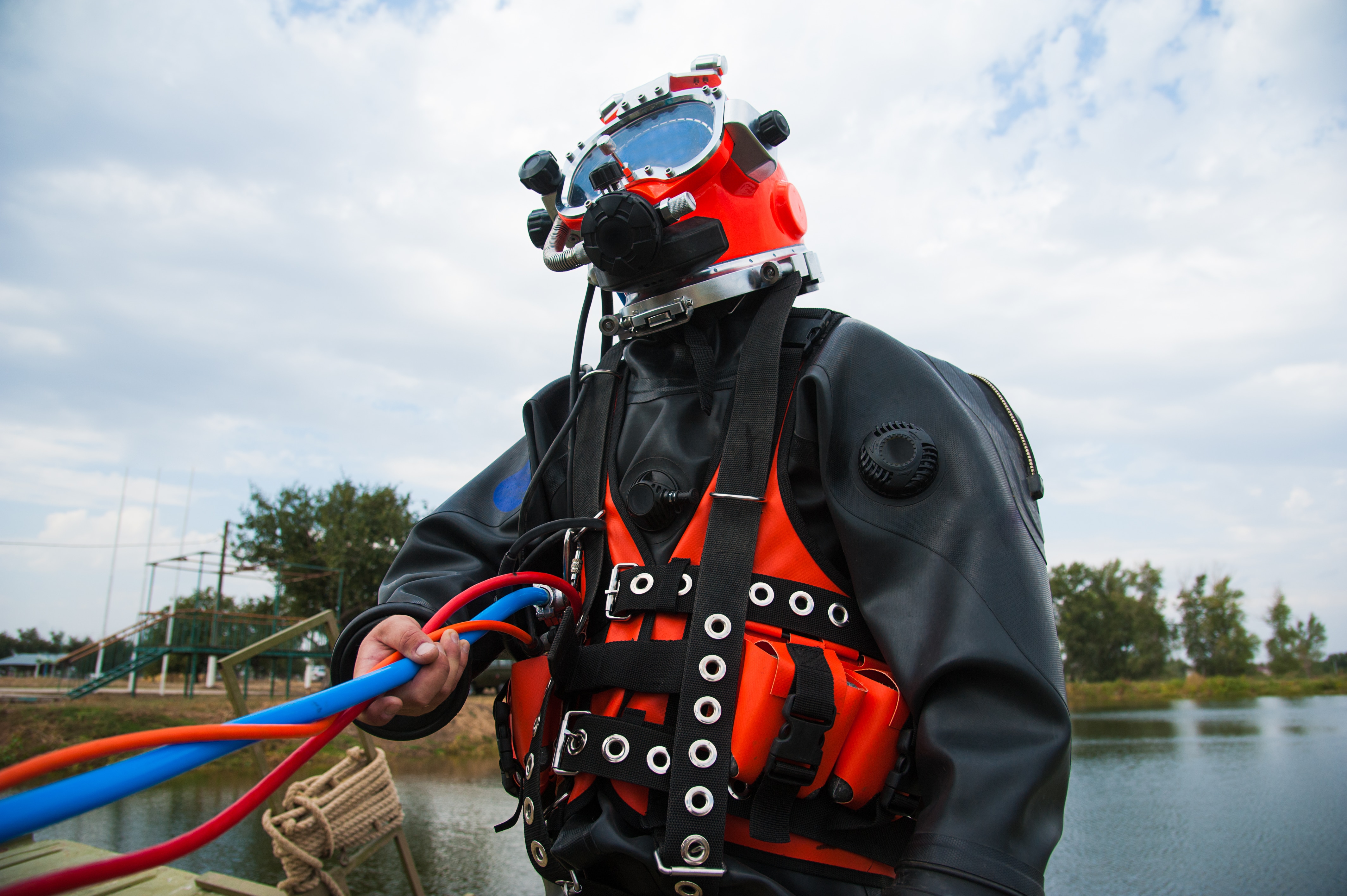
- Connected via umbilical to the surface.
- Integrated with breathing gas supply.
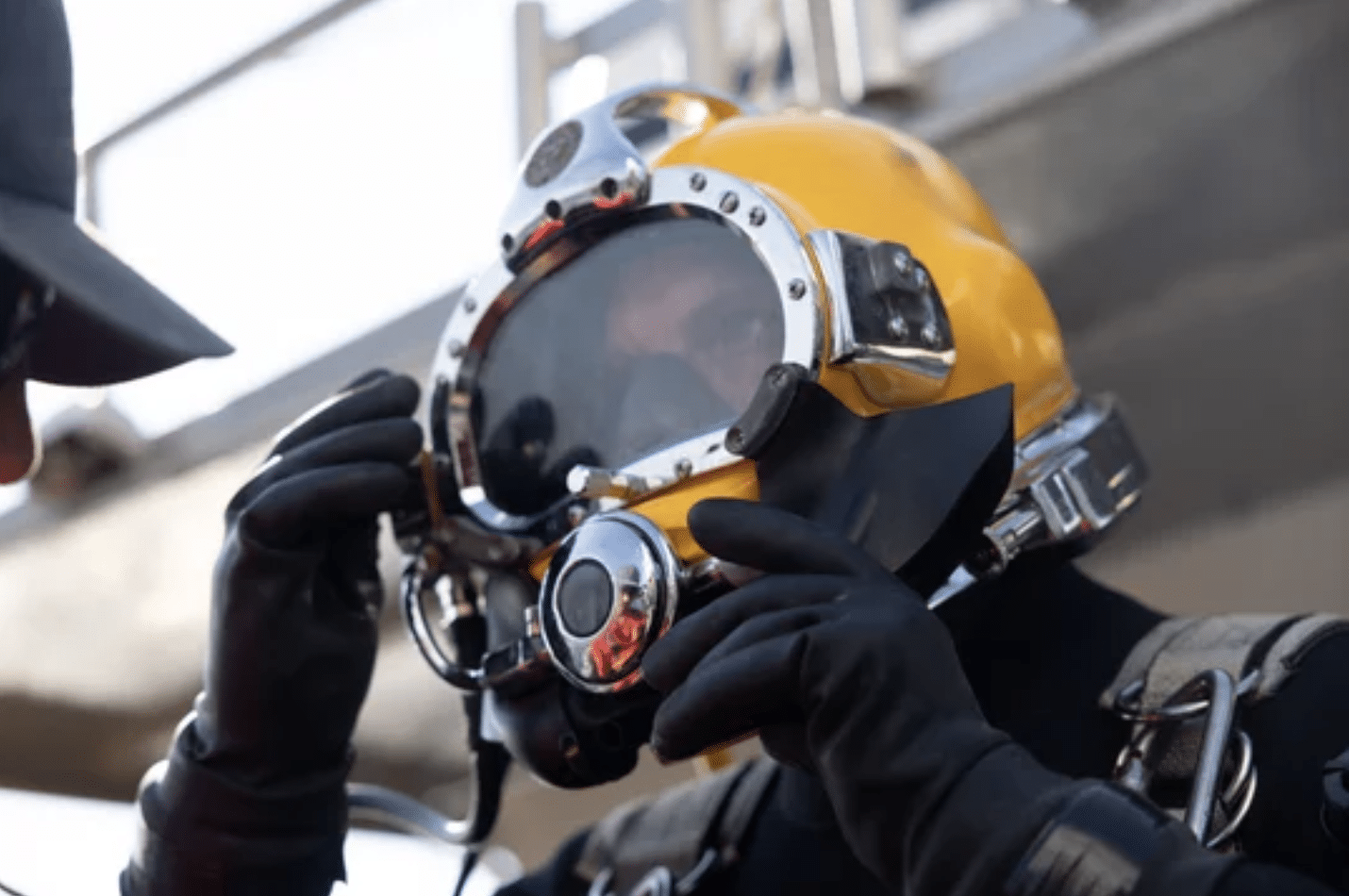
- Equipped with hard-shell head protection.
- Fitted with communications systems.
Unlike scuba, where the diver carries gas:
Surface-supplied divers receive breathing gas from the surface.
The helmet becomes part of a complete life-support system.
Surface-Supplied Diving: A Different Philosophy
Surface-supplied systems include:
- Umbilical hose (breathing gas, communications, strength member).
- Surface control station.
- Standby diver support.
- Tender supervision.
- Continuous voice communication.
This system creates:
- Direct oversight.
- Immediate communication.
- Surface intervention capability.
It shifts diving from independent activity to supervised operation.
Structure defines safety.
Why Helmets Instead of Full Face Masks?
Kirby Morgan helmets provide:
- Full head protection.
- Jaw and neck coverage.
- Rigid shell integrity.
- Stable faceplate positioning.
- Secure neck dam or yoke system.
In hazardous environments, this matters.
Commercial environments may include:
- Heavy tools.
- Debris.
- Strong currents.
- Contaminated water.
- Structural hazards.
Helmets protect more than breathing.
They protect the diver.
Integrated Communication Systems
One defining feature of Kirby Morgan helmets is:
Hard-wired surface communication.
Divers can:
- Speak continuously with surface team.
- Receive instructions instantly.
- Report environmental changes.
- Call for assistance without hand signals.
In commercial or public safety operations:
Communication is mission-critical.
Silence increases risk.
Voice reduces ambiguity.
Gas Delivery and Redundancy
Surface-supplied divers typically use:
- Primary gas supply from the surface.
- Emergency bailout cylinder worn by the diver.
This creates:
- Surface-managed gas monitoring.
- Immediate intervention capability.
- Backup redundancy if umbilical fails.
Unlike scuba, gas is centrally managed.
Surface control enhances accountability.
Applications of Kirby Morgan Systems
Kirby Morgan helmets are used in:
- Commercial construction.
- Offshore oil & gas.
- Salvage operations.
- Underwater welding.
- Public safety diving.
- Military diving.
- Hazardous water recovery.
These environments require:
- Stability.
- Communication.
- Head protection.
- Continuous oversight.
Helmets support task-focused work.
Operational Discipline
Helmet diving requires:
- Surface supervisor.
- Tender management.
- Pre-dive checklist protocol.
- Umbilical management.
- Emergency drills.
The diver is part of a system.
Autonomy is reduced.
Structure increases.
At N9BO℠, we emphasise that surface-supplied diving represents operational discipline — not recreational flexibility.
It reflects professional infrastructure.
Maintenance and Certification
Kirby Morgan helmets require:
- Annual inspection.
- Proper servicing.
- Manufacturer-approved parts.
- Documentation logs.
- Oxygen compatibility awareness (when applicable).
Improper maintenance compromises:
- Seal integrity.
- Communication reliability.
- Pressure stability.
Professional operators respect equipment lifecycle.
Helmet systems are engineered tools.
Human Factors and Helmet Diving
Helmet diving changes:
- Head movement.
- Buoyancy distribution.
- Thermal protection.
- Psychological comfort.
Divers must adapt to:
- Increased weight.
- Surface supervision.
- Structured communication.
Training ensures familiarity before exposure increases.
Comfort must follow competence.
Public Safety and Contaminated Water Context
In public safety diving:
- Contaminated water exposure is common.
- Biohazards may exist.
- Limited visibility is normal.
Helmets allow:
- Full-face protection.
- Reduced water exposure.
- Controlled breathing system.
Protection supports mission completion.
Equipment must match risk.
Why Kirby Morgan Represents Professional Culture
Kirby Morgan helmets are not symbolic of prestige.
They represent:
- Structured supervision.
- Industrial reliability.
- Team coordination.
- Operational discipline.
They are tools designed for environments where failure carries significant consequence.
Surface-supplied systems reduce uncertainty.
Infrastructure protects margin.
Engineering Meets Operational Discipline
Helmet diving integrates:
- Mechanical engineering.
- Human physiology.
- Team communication.
- Structured oversight.
Every element must align.
Operational diving requires more than equipment.
It requires system thinking.
Kirby Morgan systems embody that philosophy.
Interested in Professional Surface-Supplied Diving Training?
Contact us for training in structured systems and disciplined supervision tailored to commercial and public safety environments.
From the N9BO℠ Knowledge Base