The Appeal of Personal Preference
Divers are naturally drawn to personal preference. Equipment choices, hose routing, accessory placement, and procedural habits all feel like expressions of comfort and identity. In recreational diving, these preferences are often harmless. The environment is forgiving, and divers operate largely independently.
Technical diving is different.
As complexity increases, individual preference becomes a liability. Technical environments demand predictability, not personal expression. This is why technical diving training places such strong emphasis on standardisation—not because there is only one “correct” way, but because consistency reduces uncertainty when things go wrong.
What Standardisation Actually Means
Standardisation is often misunderstood as rigid conformity. In reality, it means that critical systems behave in expected, repeatable ways. This includes:
- Consistent equipment configuration
- Predictable hose routing
- Uniform failure responses
- Shared communication protocols
Standardisation does not eliminate choice; it limits variation where variation increases risk. TDI technical diving courses introduce standardisation to ensure that any team member can anticipate another’s actions during an emergency.
Why Emergencies Punish Individuality
Under stress, humans revert to habit. In a failure scenario, there is no time to analyse a teammate’s unique setup or remember customised procedures. If equipment or responses differ significantly, teammates must pause to interpret—precisely when time and clarity are most limited.
This hesitation is rarely dramatic. It manifests as:
- Delayed assistance
- Incorrect valve manipulation
- Confused gas-sharing responses
Advanced technical diving progression recognises that standardisation is a time-saving safety mechanism, not an ideological position.

Standardisation and Cognitive Load
One of the greatest benefits of standardisation is reduced cognitive load. When systems are predictable, divers do not waste mental bandwidth interpreting novelty. This frees attention for problem-solving and situational awareness.
Technical training deliberately limits variables during early progression. Divers may find this restrictive, but the intent is to build automaticity. Once core systems are ingrained, adaptation becomes safer and more deliberate.
The Team Perspective
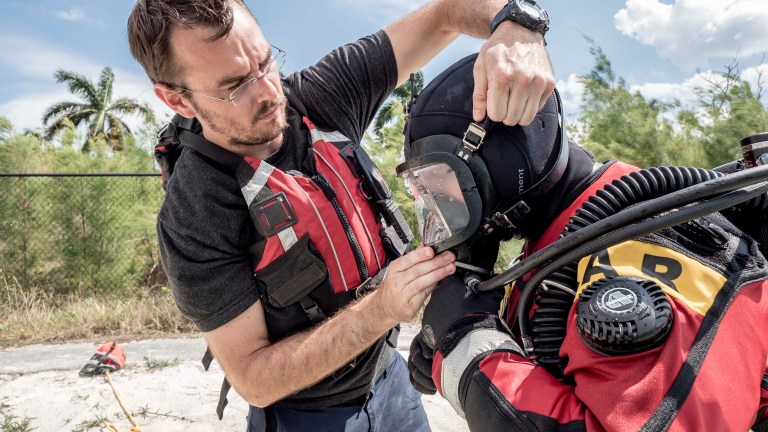
Technical diving is a team activity, even when divers carry redundant systems. Teams rely on mutual understanding. Standardisation allows divers to:
- Anticipate teammate actions
- Intervene quickly during failures
- Share gas without confusion
- Maintain formation and spacing
Without standardisation, teams function as collections of individuals rather than integrated systems. Technical diving training treats team cohesion as a primary safety objective.
Where Personal Preference Still Belongs
Not all variation is dangerous. Personal preference is appropriate where it does not affect team response or failure management. Examples may include:
- Exposure protection choice
- Fin models (within performance limits)
- Mask type
The distinction lies in whether a preference alters how a diver interacts with life-support systems. Advanced technical diving progression teaches divers to separate comfort choices from critical-system design.
How “Doing It Your Way” Becomes a Red Flag
In professional technical environments, resistance to standardisation is often viewed as a warning sign. It may indicate:
- Overconfidence
- Inflexibility
- Poor team orientation
Instructors pay close attention to how candidates respond to standardisation requirements. A diver who cannot adapt their preferences for the sake of the team may struggle in complex operations.

Standardisation Across Agencies and Disciplines
While different agencies have variations, the underlying principle is consistent across professional diving disciplines: predictability saves lives. Public safety, military, commercial, and technical diving all rely on standardised systems for the same reason.
At N9BO℠, standardisation is framed not as obedience, but as professional responsibility. Divers are encouraged to understand why systems are standardised, not merely to comply.
Adaptation Comes After Mastery
True expertise is not expressed through constant customisation. It is expressed through the ability to adapt deliberately and safely when conditions require it.
Divers who master standard systems first are far better equipped to modify them intelligently later. Technical diving training therefore prioritises mastery before modification.
The Professional Reality
In complex environments, uniqueness does not impress. Reliability does.
Teams trust divers whose equipment, procedures, and responses are predictable. This trust is earned through disciplined standardisation, not personal flair.
At N9BO℠, divers are taught that individuality belongs in personality—not in emergency procedures.
The Bottom Line
Personal preference feels empowering.
Standardisation keeps teams alive.
Technical diving is not about expressing how you dive—it is about ensuring that everyone knows exactly what will happen when something goes wrong.

Relying Too Much on Personal Habits?
Standardisation exists to reduce ambiguity and error under pressure. Contact us to discuss why consistent procedures matter in professional and technical diving.
From the N9BO℠ Knowledge Base