A Pioneer in Recreational CCR
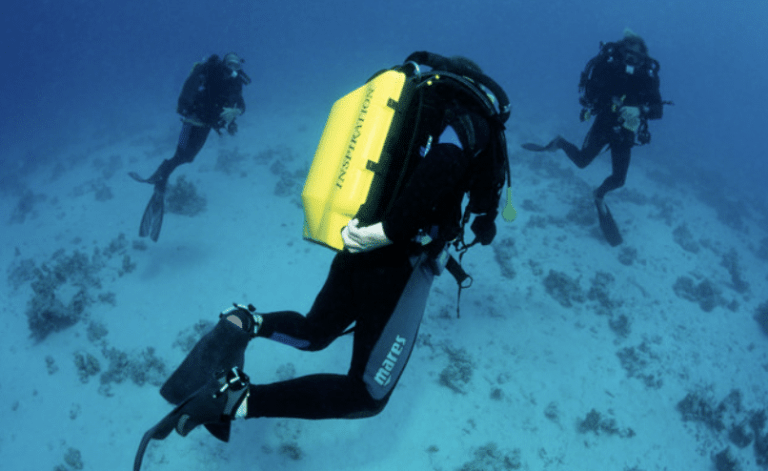
The Buddy Inspiration was among the first rebreathers widely available to non-military divers.
Its introduction marked a turning point:
Closed-circuit systems moved from specialised military platforms into the civilian technical diving community.
This transition demanded:
- Simplified electronics.
- User-friendly displays.
- Modular maintenance design.
- Structured training programmes.
The Inspiration helped shape modern CCR education.
But technology alone does not create safety.
Discipline does.
How the Buddy Inspiration Works
The Inspiration is an electronic closed-circuit rebreather (eCCR).
Its core components include:
- Oxygen sensors (typically three).
- Electronic controller.
- Heads-up display (HUD).
- Manual oxygen addition valves.
- Carbon dioxide scrubber.
- Counterlungs.
- Bailout system.
The system maintains a preset oxygen partial pressure (PO₂).
It injects oxygen automatically to maintain setpoint.
The diver monitors.
The diver verifies.
The diver intervenes if needed.
Automation supports — it does not replace awareness.
Electronic Control: Benefit and Responsibility
Electronic control reduces workload compared to fully manual CCR systems.
However, reliance on electronics introduces:
- Sensor drift risk.
- Display failure potential.
- Calibration dependency.
- Battery management requirements.
Divers must understand:
- How to interpret sensor disagreement.
- How to recognise false-high readings.
- How to switch to manual control.
- When to bailout.
Trust, but verify.
Blind faith is dangerous in life support systems.
CO₂ Scrubber and Work of Breathing
Like all CCR systems, the Buddy Inspiration depends on:
- Proper scrubber packing.
- Correct absorbent duration tracking.
- Adequate flow path.
Poor packing can cause:
- Channeling.
- Reduced CO₂ removal.
- Hypercapnia risk.
Hypercapnia is particularly dangerous because:
- It increases breathing rate.
- It impairs judgement.
- It accelerates panic.
CCR divers must treat scrubber preparation as critical ritual.
Preparation defines survivability.
Gas Efficiency and Decompression Flexibility
The Inspiration allows divers to:
- Optimise oxygen fraction.
- Extend bottom times.
- Reduce gas logistics burden.
- Maintain consistent PO₂ during decompression.
However:
Longer dives increase fatigue.
Extended exposure increases task loading.
Decompression obligations accumulate.
CCR expands capability.
It also demands conservative planning.
Capability must be matched with restraint.
Bailout Discipline
Every CCR diver must carry:
- Independent bailout gas.
- Sufficient volume for ascent and decompression.
- Clearly labelled regulators.
The Inspiration includes bailout integration options.
But bailout must be:
- Planned.
- Verified.
- Drilled repeatedly.
Transitioning to open circuit under stress must feel procedural.
Panic increases gas consumption.
Rehearsal protects composure.
Human Factors in Inspiration Diving
CCR diving introduces:
- Cognitive monitoring load.
- Instrument cross-checking.
- Subtle failure recognition.
- Continuous physiological awareness.
The Inspiration reduces some workload through automation.
But it increases responsibility for interpretation.
At N9BO℠, CCR training integrates structured stress exposure and scenario drills, reinforcing that electronic convenience does not reduce the need for disciplined mindset.
Modern systems require modern discipline.

Maintenance and Sensor Management
Oxygen sensors:
- Age over time.
- Drift unpredictably.
- Require calibration.
Battery systems must be:
- Monitored.
- Replaced on schedule.
- Verified pre-dive.
O-rings and seals must be:
- Inspected.
- Lubricated appropriately.
- Replaced as required.
Maintenance discipline is life-support discipline.
Neglect accumulates risk silently.
The Inspiration in Technical Context
The Buddy Inspiration is used in:
- Deep Trimix dives.
- Cave penetration.
- Expedition projects.
- Cold-water environments.
Its reputation is built on:
- Reliability.
- Field serviceability.
- Upgrade compatibility.
Yet no rebreather removes consequence.
Operational conservatism must remain primary.
Evolution of CCR Culture
The Inspiration contributed to:
- Standardised CCR training curricula.
- Increased civilian CCR adoption.
- Broader technical diving progression.
It helped normalise:
- Setpoint diving.
- Sensor voting logic.
- Bailout integration philosophy.
But as CCR adoption grew, so did the need for disciplined education.
Technology spreads faster than mindset.
Training must keep pace.
Engineering and Ethics
Owning a CCR system is not equal to mastering it.
Competence requires:
- Repetition.
- Honest self-assessment.
- Conservative dive planning.
- Regular skill refresh.
The Inspiration is a powerful tool.
Tools amplify user behaviour.
Structured behaviour produces safe outcomes.
Unstructured behaviour magnifies risk.
Modern CCR Responsibility
The Buddy Inspiration remains a respected platform.
But modern CCR divers must remember:
- Electronics assist.
- Redundancy protects.
- Discipline sustains.
- Complacency kills quietly.
CCR diving is not about silence.
It is about awareness.
Awareness must remain continuous.
Ready to Train on the Buddy Inspiration Rebreather?
Electronic CCR systems require structured training and disciplined oversight. Contact N9BO℠ to explore professional CCR progression pathways.
From the N9BO℠ Knowledge Base