Purpose of the Extended Range Course
The TDI Extended Range course is designed to train divers to safely conduct dives beyond traditional technical limits without the use of helium. It allows divers to plan and execute dives to a maximum depth of 55 metres / 180 feet using air as the primary breathing gas, supported by decompression gases such as nitrox or oxygen.
This makes it a unique course within the technical pathway. It extends exposure while maintaining reliance on air, which introduces both accessibility and additional risk.
The objective is not simply to go deeper. It is to manage the consequences of depth—particularly narcosis and gas density—while maintaining control throughout the dive.
At N9BO℠, we position Extended Range as a course in managing limitation, not just extending capability.
Deep Air Diving and Its Constraints
Extended Range is fundamentally a deep air course. Unlike Trimix-based training, helium is not used to reduce narcosis or gas density.
This introduces a critical factor: the diver must operate under increased narcotic effect while maintaining full control of procedures and awareness. Nitrogen narcosis becomes a constant operational consideration, not an occasional effect.
At these depths, decision-making, reaction time, and situational awareness can degrade. The diver must recognise this and compensate through discipline, structure, and strict adherence to the plan.
This is what defines the course. It is not simply about reaching depth, but about maintaining performance under physiological constraint.
At N9BO℠, we emphasise that deep air diving is not forgiving. It requires precision to counter reduced cognitive capacity.
Integration of Decompression and Depth
Extended Range builds directly on Advanced Nitrox and Decompression Procedures. It combines depth with decompression obligation, creating a significantly more complex operational environment.
Dives at this level require staged decompression using additional gases, and the diver must manage both depth exposure and decompression requirements simultaneously.
This creates a compounded risk profile. The diver is exposed to:
- Increased inert gas loading
- Extended decompression obligations
- Reduced margin for error
Execution must therefore be exact. The ascent profile, gas switches, and stop durations must all align precisely with the plan.
At N9BO℠, we treat Extended Range as the point where complexity becomes layered, not sequential.

Gas Management Under Increased Demand
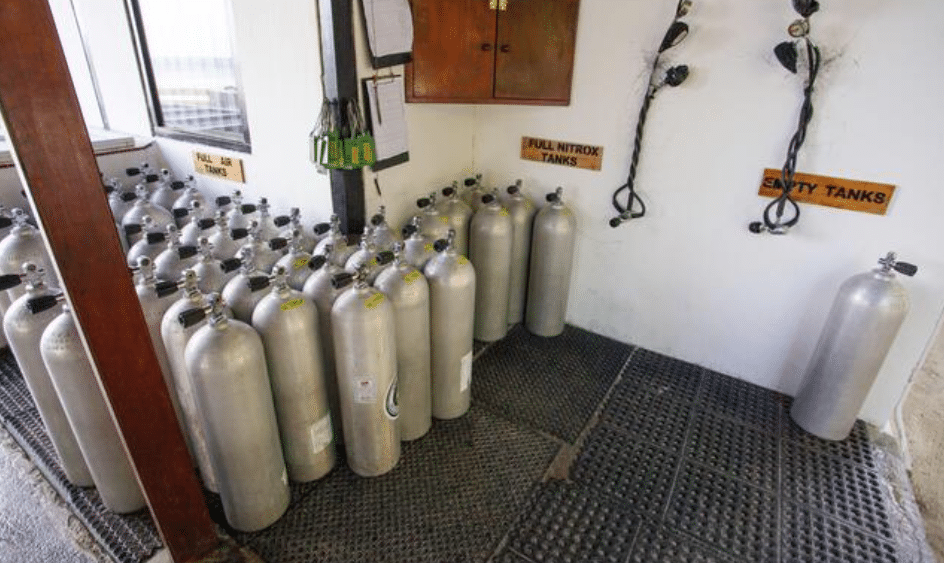
Gas management becomes more critical at depth. Consumption increases, reserves must account for longer decompression, and contingency planning must be robust.
Divers must plan for:
- Bottom gas sufficient for depth and duration
- Decompression gas to accelerate off-gassing
- Emergency scenarios including gas loss
At this level, gas is not simply monitored—it is actively managed as a primary operational parameter.
Any miscalculation or deviation can have immediate consequences, particularly when direct ascent is not an option.
At N9BO℠, we emphasise that gas planning is the backbone of Extended Range diving.
Equipment Configuration and Redundancy
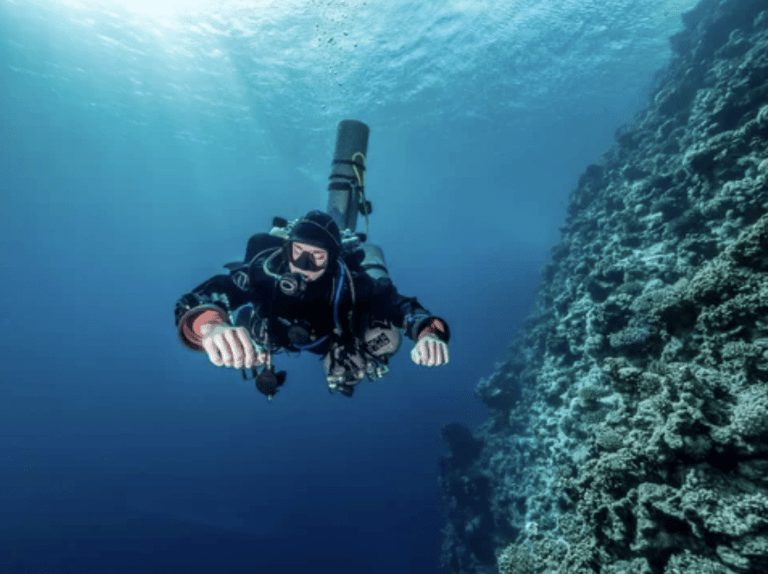
The equipment used in Extended Range must support both depth and decompression. This typically includes doubles or sidemount systems, along with multiple stage cylinders.
Configuration must allow:
- Clear identification of gases
- Efficient and controlled gas switching
- Redundancy in critical systems
Failures must be manageable in-water. At this level, the diver cannot rely on rapid ascent as a solution.
Equipment must therefore be configured not only for function, but for failure management.
At N9BO℠, we treat equipment as part of a survival system, not simply a toolset.
Task Load and Cognitive Management
Extended Range significantly increases task load. The diver must manage depth, gas, decompression, positioning, and team coordination simultaneously.
This is compounded by narcosis. The diver is operating with reduced cognitive efficiency while managing increased complexity.
Control is maintained through structure. Procedures must be followed exactly, and tasks must be prioritised correctly.
Loss of awareness at this level has immediate consequences. There is no margin for distraction or improvisation.
At N9BO℠, we train divers to operate within structured systems that compensate for cognitive limitations.

Team Coordination at Depth
At Extended Range level, diving is inherently team-based. Individual actions directly affect the safety of others, particularly during decompression.
Procedures must be standardised. Gas switches, ascent rates, and decompression stops must be synchronised.
Communication, even when limited, must remain clear and consistent. Each diver must understand the plan and execute it without deviation.
Coordination reduces variability and ensures that all divers remain within safe parameters.
At N9BO℠, we emphasise that Extended Range diving is not an individual activity. It is a controlled team operation.
Position Within the Technical Pathway
The Extended Range course sits at the upper limit of air-based diving. It represents the maximum depth at which air can be used as a primary gas within structured technical limits.
Beyond this point, the introduction of helium becomes necessary to manage narcosis and gas density effectively.
This makes Extended Range both a progression and a boundary. It demonstrates what is possible with air, while also highlighting its limitations.
At N9BO℠, we use Extended Range to reinforce why gas selection matters as depth increases.
Operational Mindset
The TDI Extended Range course is defined by constraint. Depth is increased, but margin is reduced. The diver must operate within tighter limits while managing greater exposure.
Success depends on discipline, precision, and continuous awareness. There is no tolerance for deviation, and no reliance on improvisation.
At N9BO℠, we approach Extended Range as a test of control. It requires the diver to manage physiological, technical, and operational challenges simultaneously.
In technical diving, the ability to go deeper is not the objective. The ability to maintain control at depth is what defines capability.

Train for Depth with Discipline
Contact N9BO℠ to integrate TDI Extended Range training into your development pathway, building the control, planning discipline, and operational capability required for deep technical diving.
From the N9BO℠ Knowledge Base