Equipment Is a Tool, Not a Statement
Technical diving communities often frame the CCR vs OC debate emotionally. Rebreather diving is sometimes perceived as advanced or superior, while open circuit is viewed as traditional.
This perspective is operationally flawed.
Both systems are life-support platforms designed to manage depth, time, and decompression. The appropriate choice depends on the mission’s demands.
Professional divers ask:
- What depth and duration are required?
- Is gas logistics constrained?
- Is noise or bubble suppression important?
- What are bailout requirements?
- How complex is the environment?
Equipment follows objective.
Where Rebreathers Offer Advantage
CCR systems provide significant benefits in certain mission profiles.
Gas Efficiency
Because exhaled gas is recycled and oxygen is metabolically replaced, CCR allows dramatically extended runtime with minimal gas consumption. This is especially advantageous for deep, long-duration technical dives.
Optimised PPO₂
Maintaining a stable, elevated partial pressure of oxygen throughout the dive reduces decompression obligation compared to fixed-gas open circuit profiles.
Reduced Bubble Signature
In cave exploration, scientific research, or certain operational contexts, minimal bubble production reduces disturbance and improves environmental integrity.
However, these advantages come with complexity.
CCR introduces:
- Sensor dependency
- Electronics monitoring
- Loop management
- Strict bailout planning
Efficiency increases. Simplicity decreases.

Where Open Circuit Remains Superior
Open circuit systems are mechanically straightforward. The diver breathes from compressed cylinders; exhaled gas is released into the water.
Advantages include:
Immediate Transparency
Cylinder pressure is directly visible. Gas depletion is predictable and tangible.
Simplified Failure Modes
If a regulator fails, shutdown procedures are straightforward. No oxygen injection systems or electronics are involved.
Reduced Cognitive Load
OC requires less system monitoring. This can reduce task loading in high-complexity environments.
In environments where logistical gas support is available and runtime demands are moderate, open circuit remains highly effective.
Reliability through simplicity is a powerful safety factor.
Bailout Planning Defines CCR Viability
One of the most critical differences lies in failure response.
In CCR, bailout is a primary consideration from the beginning of planning. The diver must carry sufficient open circuit gas to manage worst-case ascent scenarios.
In deep or decompression-heavy dives, bailout gas can become substantial.
This affects:
- Equipment load
- Mobility
- Team coordination
- Gas logistics
In certain missions, the bailout burden may negate CCR efficiency advantages.
Mission planning must evaluate whether bailout feasibility supports CCR deployment.
Environmental Constraints
Environment plays a decisive role.
Overhead Environments
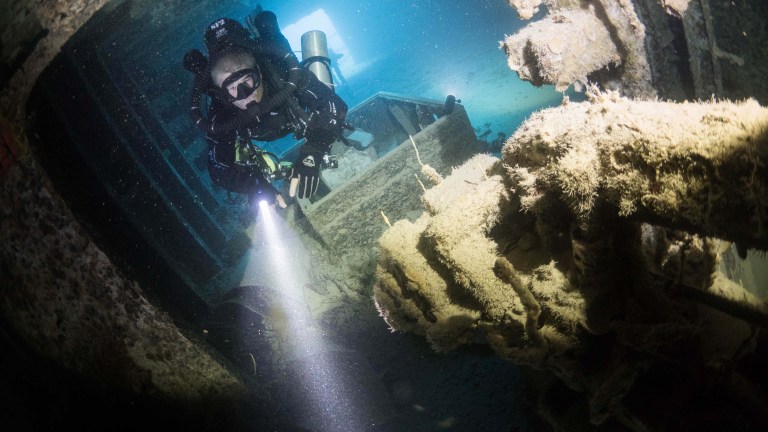
Caves and wrecks introduce restricted movement and complex exit strategies. Both CCR and OC can be used, but failure response must align with environmental constraints.
CCR failure in restriction requires immediate bailout and stable gas supply. OC failure requires shutdown precision.
Cold Water
Rebreathers reduce gas flow rates and can mitigate regulator freeze risk. However, electronics must be protected from environmental stress.
Remote Locations
In expedition contexts with limited gas fills available, CCR’s efficiency can be strategically advantageous.
The environment does not favour one system universally. It rewards appropriate choice.
Human Factors and Discipline
Rebreathers demand constant system awareness. Sensor checks, PPO₂ monitoring, and loop volume management increase cognitive workload.
Open circuit reduces system monitoring but still requires gas discipline and decompression control.
The diver’s training and experience level are decisive.
A diver uncomfortable with electronic monitoring may perform better and safer on open circuit. A disciplined CCR diver comfortable with structured procedure may execute long-duration missions more efficiently.
At N9BO℠, we emphasise that equipment should match competence. Technology cannot compensate for insufficient discipline.
Team Compatibility and Standardisation
In technical teams, mixed configurations can complicate emergency planning.
Gas sharing procedures differ between CCR and OC divers. Decompression schedules may vary. Bailout contingencies require alignment.
Operational coherence improves when team members train and plan within compatible systems.
Mission objectives must account for team structure.
Mission Dictates Equipment
The question is not “Which system is better?”
The question is:
“What does this dive require?”
- Extended deep exploration? CCR may offer efficiency.
- Moderate depth with complex navigation? OC may offer simplicity.
- Remote logistics? CCR reduces fill dependency.
- High-failure-risk environment? OC transparency may reduce cognitive load.
Professional divers detach identity from equipment. They select tools based on objective, environment, and margin preservation.
Capability comes from structured training — not configuration loyalty.

Unsure Whether CCR or Open Circuit Fits Your Technical Goals?
Equipment selection should follow mission requirements and training readiness. Contact N9BO℠ to discuss technical diving progression pathways.
From the N9BO℠ Knowledge Base