Why Communications Redundancy Matters
Modern operations often rely heavily on:
- Mobile networks
- Internet connectivity
- Satellite communication systems
While highly capable, these systems remain vulnerable to:
- Infrastructure failure
- Weather disruption
- Network congestion
- Power outages
Ham radio operates independently of centralised infrastructure.
It uses radio frequency transmission that can function when digital networks collapse.
For divers operating in remote regions, expedition leaders coordinating multi-site teams, or emergency response units, communication redundancy preserves operational continuity.
At N9BO℠, we reinforce that operational resilience includes independent communications capability.
What Ham Radio Actually Is
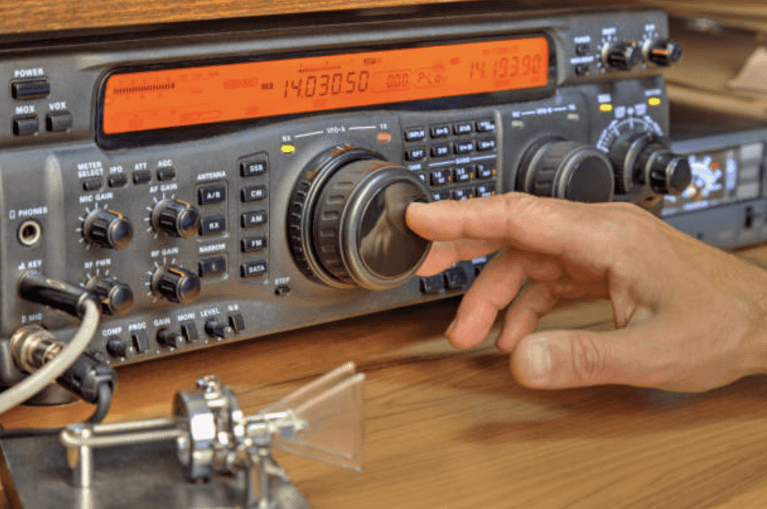
Amateur (ham) radio is a licensed communication system allowing operators to transmit voice or digital signals across:
- Local VHF/UHF bands
- Regional HF bands
- International frequencies
Operators use:
- Handheld radios
- Mobile units
- Base stations
- Portable field antennas
Unlike consumer walkie-talkies, licensed ham radio allows broader transmission power, frequency access, and structured emergency networks.
It is both a technical discipline and a communication culture.

Relevance for Diving Operations
While underwater communication relies on line signals, slates, or specialised acoustic systems, surface coordination often determines mission success.
Ham radio supports:
- Vessel-to-shore communication
- Remote site logistics
- Expedition coordination
- Weather monitoring
- Emergency response liaison
In disaster or field conditions where mobile networks collapse, RF networks often remain active.
Amateur operators frequently form volunteer emergency communication networks.
Structured communication protocols enhance clarity and reduce misunderstanding.
Discipline in Communication
Ham radio is not casual chatter.
Effective communication requires:
- Clear call signs
- Structured message format
- Signal confirmation
- Minimal unnecessary transmission
- Accurate logging
Brevity prevents frequency congestion.
Clarity prevents error.
Communication under stress demands simplicity.
Structured radio discipline parallels structured dive procedures — both reduce ambiguity.

Understanding Frequency and Propagation
Effective radio operation requires understanding:
- Frequency selection
- Line-of-sight limitations
- Antenna orientation
- Atmospheric propagation effects
HF signals can travel thousands of kilometres by bouncing off the ionosphere. VHF and UHF signals are primarily line-of-sight but provide excellent clarity locally.
Choosing the correct frequency band depends on:
- Terrain
- Distance
- Time of day
- Atmospheric conditions
Technical literacy enhances reliability.
Emergency Preparedness and ICS Integration
Ham radio aligns well with structured command systems such as Incident Command System (ICS).
In emergency scenarios, amateur radio operators can:
- Relay status updates
- Coordinate evacuation support
- Maintain communication with command centres
- Operate independent communication hubs
Communication breakdown often amplifies crisis severity.
Redundant communication preserves coordination.
At N9BO℠, we integrate communication resilience into broader safety and operational training frameworks.
Why Licensing Matters
Amateur radio operation requires:
- Passing a regulatory examination
- Understanding legal frequency use
- Following national communication regulations
Licensing ensures:
- Responsible frequency management
- Knowledge of interference protocols
- Ethical communication standards
Operating without understanding regulations risks interference with critical systems.
Professionalism includes compliance.
From Hobby to Operational Asset
Ham radio is often viewed as a hobbyist pursuit.
In operational contexts, it becomes a strategic asset.
Expeditions, offshore operations, research teams, and emergency responders benefit from:
- Independent communication channels
- Technical troubleshooting capability
- Field-deployable equipment
Resilience is built before it is needed.
Communication redundancy reduces dependency on single-point failure systems.
Communications as a Safety Layer
In diving and field operations, risk management is layered:
- Equipment redundancy
- Gas redundancy
- Team redundancy
- Communication redundancy
When digital systems fail, analogue systems sustain continuity.
At N9BO℠, we believe professional operations extend beyond underwater competence. Communications planning is as critical as dive planning.
Signal clarity often determines operational clarity.

Strengthen Your Operational Communications Capability
Reliable communication is a core safety layer in expedition and field environments. Contact N9BO℠ to explore structured communication and resilience workshops.
From the N9BO℠ Knowledge Base