Bailout Is Not a Backup — It Is the Plan
In open circuit diving, gas supply is visible, tangible, and constantly monitored through pressure gauges. In CCR diving, the primary breathing gas is recycled within a loop, and oxygen is injected to maintain a target partial pressure. This increases efficiency — but it also means the diver is relying on electronics, sensors, and scrubber chemistry.
When something fails, it rarely announces itself dramatically. It begins with subtle anomalies: sensor disagreement, unexpected PPO₂ fluctuations, erratic handset readings.
At that moment, the only safe assumption is that the loop cannot be trusted.
Bailout gas becomes the diver’s only guaranteed life support.
This is why bailout planning must be conservative, pre-calculated, and rehearsed before entering the water.
Understanding Failure Modes
CCR systems can fail in predictable ways:
- Oxygen solenoid malfunction
- Sensor drift or calibration error
- Loop flooding
- Scrubber breakthrough
- Electronics failure
- Hyperoxia or hypoxia events
The diver must be trained to recognise early indicators and respond immediately.
The most dangerous mistake is delay — continuing to troubleshoot while depth, decompression obligation, or overhead constraints increase risk.
A disciplined CCR diver switches to bailout decisively, then manages the ascent according to pre-established planning.
There is no improvisation at 60 metres with decompression pending.

Gas Calculations: Planning for the Worst Day
Bailout planning must assume:
- Maximum anticipated depth
- Highest realistic breathing rate (stress-adjusted)
- Potential team assistance
- Delayed ascent scenarios
In technical environments, bailout may require multiple stage cylinders or team gas sharing strategies.
The calculation is not based on ideal breathing rates. It is based on worst-case consumption.
At N9BO℠, bailout planning exercises are conducted using elevated stress assumptions rather than optimistic ones. This approach builds margin into the system and reinforces conservative decision-making.
Redundancy only works if it is adequate.
The Psychology of Bailout Hesitation
One of the most overlooked risks in CCR diving is psychological reluctance to bail out.
Divers invest time, money, and ego into mastering rebreathers. Switching to open circuit can feel like an admission of failure — especially if the dive was proceeding smoothly until a minor anomaly appeared.
This mindset is dangerous.
Bailout is not failure. It is system management.
Professional CCR divers treat bailout as routine. The plan is written assuming it may be required. If it is not, that is a bonus — not the objective.
Training must remove emotional attachment from the decision.
Team Dynamics and Shared Responsibility
In advanced technical environments, bailout planning is not individual. It is integrated into team strategy.
Questions must be answered before descent:
- Who carries what gas?
- What is the minimum gas requirement per diver?
- Is there shared bailout planning?
- How will communication be handled in a failure?
Each diver must understand not only their own bailout profile but that of the team.
Redundancy scales when coordination exists. Without coordination, redundancy becomes fragmented.
Transition Drills: The Skill That Buys Time
Knowing bailout gas calculations is theoretical. Executing the switch calmly is practical.
CCR divers must be proficient in:
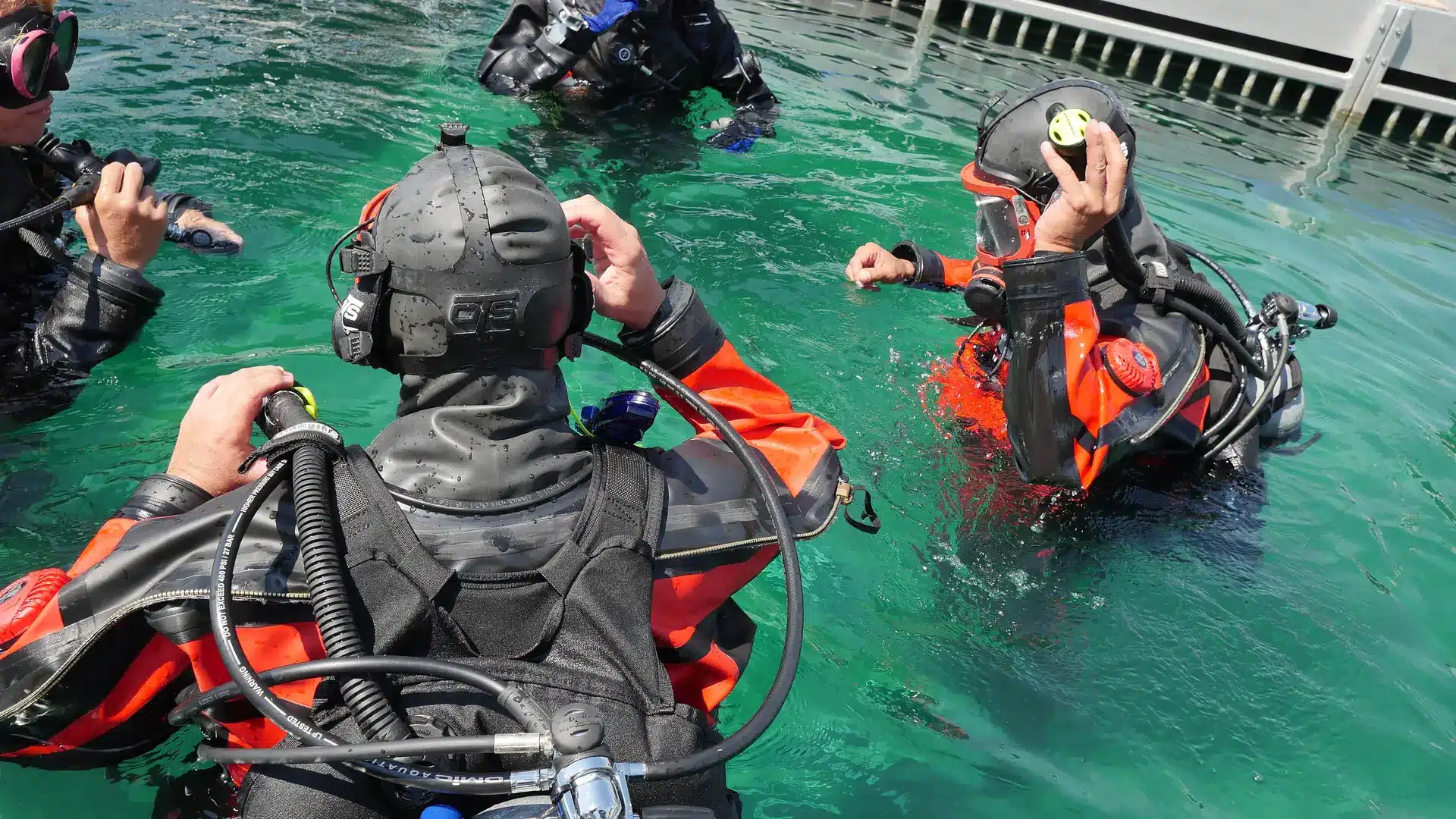
- Immediate switch to open circuit regulator
- Loop isolation
- Buoyancy stabilisation during transition
- Monitoring ascent gas switches
This cannot be improvised.
Transition drills must be rehearsed until they become procedural reflexes. When stress spikes, motor skills degrade. Only trained repetition maintains control.
At N9BO℠, bailout drills are integrated progressively into workload scenarios rather than practiced in isolation. This ensures the skill remains functional under pressure.
When Redundancy Is Your Only Option
A rebreather offers elegance, silence, and extended duration. But none of these matter if the diver cannot abandon the loop instantly and safely.
Bailout planning is not an accessory to CCR diving — it is the safety net that makes CCR viable.
The most experienced rebreather divers share a common trait: they assume failure is possible and plan accordingly.
They do not rely on hope. They rely on preparation.
Redundancy is not about carrying more equipment. It is about carrying enough margin to survive the unexpected.
In CCR diving, discipline preserves capability.
Ready to Approach CCR the Professional Way?
Bailout planning defines safe rebreather diving. Contact N9BO℠ to discuss structured CCR training and readiness assessment.
From the N9BO℠ Knowledge Base