Technology Is Reliable — Humans Are Variable
Modern CCR units are sophisticated life-support systems. They include multiple oxygen sensors, electronic controllers, redundant displays, and increasingly refined design architecture.
From a purely mechanical standpoint, failure rates are low when units are assembled and maintained correctly.
Yet incident reports repeatedly show a different pattern:
Divers ignoring sensor disagreement.
Divers continuing dives despite warning signs.
Divers delaying bailout to “confirm” a problem.
The equipment often functions exactly as designed. It is the interpretation — or dismissal — of data that creates risk.
Human factors, not hardware, are the dominant variable.
The Illusion of Familiarity
One of the most powerful cognitive biases in rebreather diving is familiarity.
After dozens of uneventful dives, the unit feels predictable. Displays look stable. Setpoints behave normally. The diver begins to assume that stability equals safety.
This is the moment discipline begins to erode.
Sensor checks become quick glances rather than deliberate cross-checks. Pre-breathe procedures shorten. Calibration routines become “close enough.”
Complacency does not feel reckless. It feels efficient.
But CCR diving punishes drift from procedure. The margin for error is narrow, particularly with hypoxia or hyperoxia risks.
Routine must remain routine — regardless of experience level.
Task Loading and Cognitive Saturation
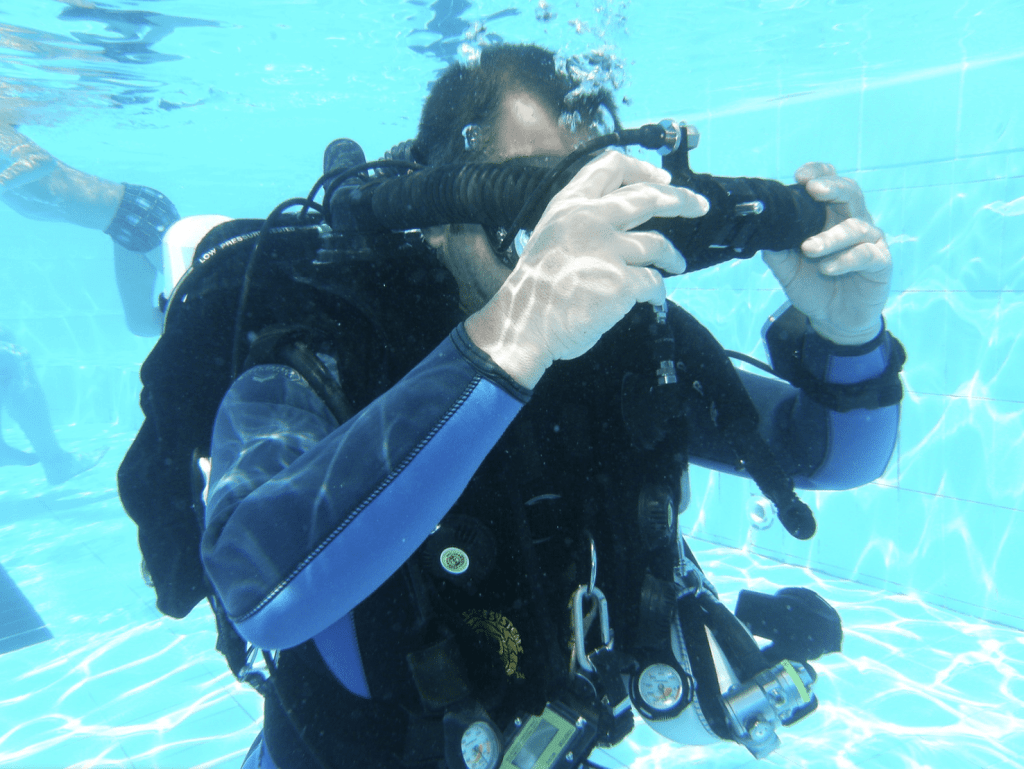
Rebreather diving increases task load compared to open circuit. The diver must manage:
- PPO₂ monitoring
- Setpoint changes
- Loop volume
- Depth transitions
- Decompression obligations
- Bailout readiness
Add environmental complexity — current, overhead environment, low visibility — and cognitive bandwidth becomes strained.
When bandwidth shrinks, perception narrows. The diver focuses on one problem and misses others. This is how minor anomalies escalate.
Human performance research consistently shows that multitasking degrades decision quality. Underwater, that degradation can become critical.
This is why structured training emphasises:
- Slow, deliberate procedures
- Clear prioritisation
- Simplified decision trees
At N9BO℠, we reinforce that rebreather mastery is not about handling more variables. It is about reducing unnecessary complexity.
Overconfidence and the “It’s Probably Fine” Trap
Many CCR incidents begin with a small deviation:
- Slightly elevated PPO₂
- Minor sensor discrepancy
- Small delay in solenoid firing
Instead of bailing out immediately, the diver rationalises:
“It’s probably just a transient glitch.”
“I’ll monitor it a bit longer.”
“It’s been fine all day.”
This is not recklessness. It is optimism bias.
Humans are wired to assume continuity. If the system has been stable, we expect it to remain stable. But life-support systems require conservative interpretation, not hopeful interpretation.
Professional CCR discipline means treating uncertainty as unacceptable — not waiting for confirmation of failure.
Procedural Discipline as a Performance Tool
In high-reliability industries — aviation, nuclear operations, surgical practice — strict procedural discipline reduces variability.
Rebreather diving operates within similar constraints. Oxygen exposure limits are unforgiving. Hypoxia can be silent. Hyperoxia can be sudden.
Procedures exist to compensate for human inconsistency.
Checklists, cross-checks, and verification rituals may feel repetitive. They are not about memory. They are about error prevention.
The most competent CCR divers often appear methodical rather than dramatic. They move slowly. They confirm steps. They resist improvisation.
This calm discipline is not personality — it is trained behaviour.
Stress Amplifies Weaknesses
When stress rises — due to depth, cold, equipment anomaly, or environmental challenge — cognitive clarity drops.
Fine motor skills degrade. Tunnel vision increases. Decision speed accelerates while quality declines.
If foundational discipline has not been established during training, stress will expose that gap immediately.
This is why stress exposure training is essential in CCR progression. Controlled, supervised complexity builds resilience.
Calm under stress is not natural. It is practiced.
Why Discipline Outweighs Technology
Rebreathers represent advanced engineering. But engineering alone cannot create safety.
The diver must:
- Maintain vigilance
- Respect procedure
- Recognise bias
- Act conservatively
- Accept bailout as normal
Technology expands capability. Discipline protects survivability.
When discipline erodes, even the most advanced unit becomes vulnerable to human error.
The most capable CCR divers are not those with the most hours. They are those whose procedural discipline remains intact dive after dive.
In rebreather diving, human factors determine outcome long before hardware does.

Want to Strengthen Your CCR Decision-Making Skills?
Rebreather safety depends as much on human performance as equipment. Contact N9BO℠ to explore structured CCR progression and performance-based training.
From the N9BO℠ Knowledge Base