The False Comfort of “Having a Backup”
Many divers feel safer simply knowing that a backup system exists. This sense of security can be misleading.
Redundancy does not work automatically. A backup that cannot be accessed quickly, identified correctly, or operated under stress may be worse than no backup at all. Technical diving training treats redundancy as a system that must be tested, rehearsed, and integrated—not merely carried.
Why Redundancy Fails Under Stress
Under stress, fine motor skills degrade and cognitive bandwidth shrinks. Backup systems that require complex manipulation or decision-making often fail precisely when needed.
Examples include:
- Poorly routed backup regulators
- Valves that are difficult to reach
- Ambiguous switch procedures
Advanced technical diving progression emphasises that redundancy must remain usable under worst-case conditions.
More Equipment ≠ More Safety
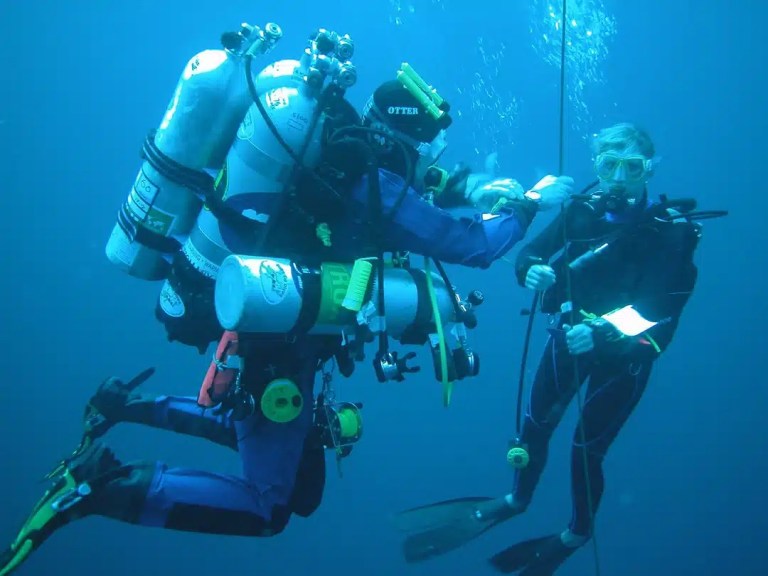
Adding equipment increases task loading, drag, and failure points. Each additional component must be monitored, maintained, and managed.
When redundancy is added without integration, complexity increases faster than safety. Technical diving training focuses on appropriate redundancy, not maximal redundancy.

Redundancy Must Be Independent
True redundancy requires independence. Backups that share common failure points—gas sources, regulators, power supplies—do not protect against systemic failure.
Advanced technical diving progression trains divers to analyse dependencies and design systems that fail gracefully rather than catastrophically.
Procedural Redundancy Matters Too
Redundancy is not only physical. Procedural redundancy—clear abort criteria, shared decision-making, rehearsed responses—often provides greater safety than extra hardware.
Technical diving training teaches that equipment redundancy without procedural clarity is incomplete protection.
Why Familiarity Breeds Overconfidence in Backups
Divers who have “never needed” their backups may underestimate the difficulty of deploying them under stress.
Backup systems must be practised regularly. Advanced technical diving progression requires divers to demonstrate smooth, unhesitating deployment before advancing.
Instructor Perspective: Stress-Testing Redundancy
Instructors deliberately stress backup systems during training. Valves are shut, failures are simulated, and divers must respond without warning.
At N9BO℠, redundancy is evaluated not by possession, but by performance under pressure.
Redundancy and Team Awareness
In team diving, redundancy must be visible and predictable to teammates. A backup only helps if others understand how it will be used.
Technical diving training emphasises standardised configurations so redundancy supports team response rather than confusion.
Professional Parallels
In engineering and aviation, poorly designed redundancy has caused major accidents by introducing complexity without clarity.
Technical diving adopts these lessons. Redundancy must simplify outcomes—not complicate them.
Designing Redundancy Deliberately
Effective redundancy is:
- Simple
- Accessible
- Rehearsed
- Independent
- Communicated
Advanced technical diving progression teaches divers to evaluate redundancy as part of a system, not an afterthought.
The Bottom Line
Backups are not magic.
They only work if you can use them.
In technical diving, redundancy must be designed, practised, and integrated deliberately. The safest divers are those who trust systems they have tested—not equipment they hope will work.
At N9BO℠, redundancy is engineered, not assumed.
Unsure How to Build Smart Redundancy?
Redundancy must reduce risk—not add complexity and new failure points. Contact us to discuss equipment choices and configuration that support safety.
From the N9BO℠ Knowledge Base