Why Trimix Exists
As depth increases, so do physiological challenges:
- Nitrogen narcosis impairs cognitive function
- Oxygen partial pressure rises toward toxicity thresholds
- Gas density increases breathing effort
- Decompression obligation expands
Trimix — a blend of oxygen, nitrogen, and helium — mitigates narcosis by replacing a portion of nitrogen with helium.
Helium’s low narcotic effect preserves mental clarity.
However, clarity does not eliminate risk. It only preserves decision-making capability.
Narcotic Depth and Cognitive Degradation
Nitrogen narcosis affects divers differently, but common effects include:
- Delayed reaction time
- Poor judgment
- Tunnel vision
- Euphoria or anxiety
At depth, even small cognitive delays compound.
Trimix reduces narcotic load, allowing divers to maintain:
- Procedural memory
- Clear communication
- Structured problem-solving
Depth tolerance is not bravado. It is cognitive management.
Oxygen Toxicity Awareness
As depth increases, oxygen partial pressure rises.
Exceeding safe limits risks:
- Central nervous system (CNS) oxygen toxicity
- Convulsions underwater
Trimix blends reduce oxygen percentage to maintain safe partial pressure at target depth.
Gas selection must match dive profile precisely.
Planning errors at depth have limited margin.
Professional Trimix diving requires precision.

Gas Planning at Advanced Depth
Advanced Trimix dives involve:
- Bottom mix
- Travel gases
- Decompression gases
Divers must calculate:
- Gas consumption at depth
- Stress-adjusted breathing rate
- Bailout requirements
- Worst-case decompression scenario
Gas is no longer a simple calculation.
It becomes a layered system.
Redundancy must be realistic, not symbolic.
Decompression Is the Real Challenge
Depth is rarely the most demanding part of a Trimix dive.
Decompression often defines the dive duration.
Long staged ascents require:
- Thermal management
- Stable buoyancy
- Mental endurance
- Gas-switch discipline
Decompression stops demand patience.
Rushing shallow stops undermines planning.
Advanced divers treat decompression as active management, not passive waiting.
Gas Density and Work of Breathing
At extreme depth, gas density increases.
High-density gas:
- Raises breathing resistance
- Increases CO₂ retention risk
- Elevates fatigue
Helium reduces density and improves breathing efficiency.
Gas density planning becomes critical in deep dives.
Human physiology sets practical depth limits.
Team Coordination at Depth
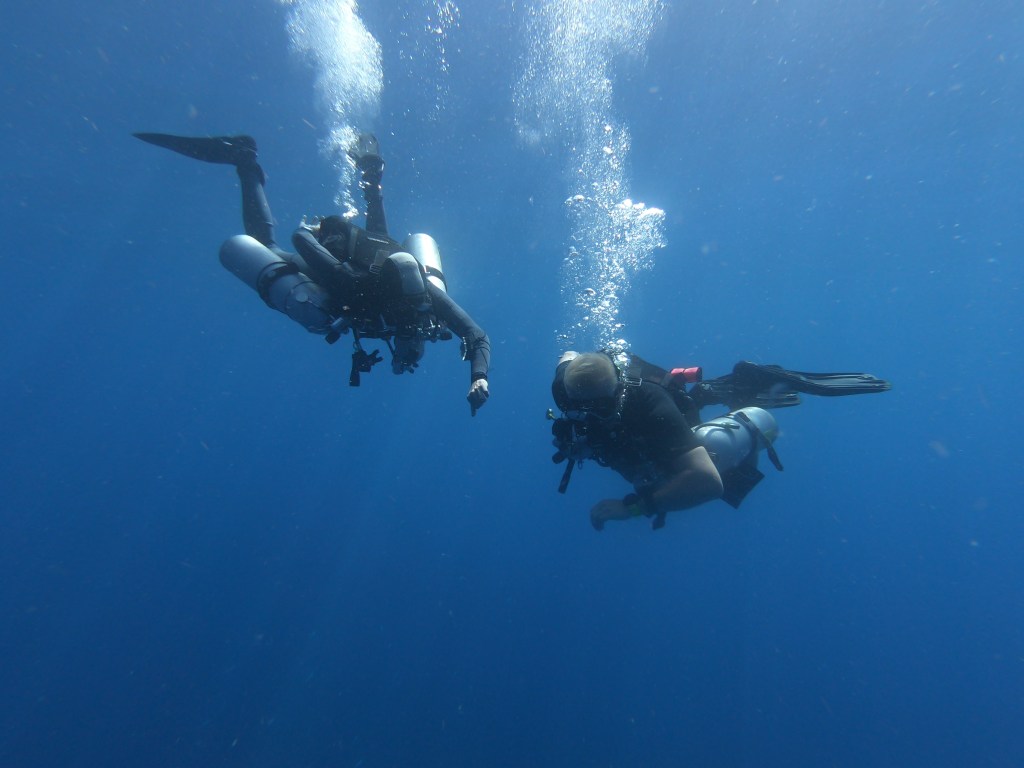
Advanced Trimix diving requires strong team discipline.
Teams must:
- Synchronise descent rates
- Confirm gas switches verbally or visually
- Monitor each other for narcosis signs
- Share bailout gas if required
At depth, small mistakes magnify.
Communication must remain structured.
Professional discipline overrides ego.
Psychological Stability Under Pressure
Depth amplifies environmental pressure and psychological load.
Divers must manage:
- Cold
- Darkness
- Equipment complexity
- Extended bottom time
Trimix preserves cognitive clarity, but stress still accumulates.
Training introduces controlled exposure to maintain composure.
Calm behaviour reduces gas consumption and preserves clarity.
When Advanced Trimix Is Appropriate
Advanced Trimix diving is suitable for:
- Deep wreck exploration
- Expedition-level cave dives
- Research missions at extended depth
It is not a shortcut to “going deeper.”
Depth should serve purpose — not identity.
At N9BO℠, we emphasise structured progression toward Trimix competency. Advanced gas blends are tools, not status symbols.
Professional depth management requires humility and discipline.
Considering Advanced Trimix Progression?
Depth demands structured gas planning, decompression discipline, and cognitive clarity. Contact N9BO℠ to discuss Trimix readiness and training pathways.
From the N9BO℠ Knowledge Base