Purpose of Emergency Care Training
Emergency care training is designed to provide non-medical responders with the knowledge and practical skills required to manage medical emergencies in the first minutes after an incident occurs.
This includes:
- Primary assessment and scene management
- Cardiopulmonary resuscitation (CPR)
- Automated External Defibrillator (AED) use
- First aid for injury and illness
The objective is not to replace professional medical treatment, but to stabilise the casualty and preserve life until advanced care becomes available.
In many emergencies, immediate intervention determines outcome. Delayed response significantly reduces survival probability, particularly in cardiac arrest and airway compromise situations.
At N9BO℠, we treat emergency care training as a core operational capability, not an optional qualification.
Understanding the Chain of Survival
The course reinforces the concept of the Chain of Survival, where early intervention increases the likelihood of survival and recovery.
The key stages include:
- Early recognition of the emergency
- Immediate activation of emergency medical services
- Early CPR
- Rapid defibrillation using an AED
- Transfer to advanced medical care
Each stage supports the next. Failure at any point weakens the entire response system.
The course teaches responders to act decisively while maintaining control and safety throughout the incident.
At N9BO℠, we emphasise that survival depends on structured action rather than hesitation.
Primary Assessment and Scene Safety
Every emergency response begins with scene assessment. Responders must ensure that the environment is safe before approaching the casualty.
Hazards may include:
- Traffic or moving equipment
- Electrical hazards
- Fire or unstable structures
- Biological contamination
Once the scene is secure, responders conduct a primary assessment to evaluate:
- Responsiveness
- Airway status
- Breathing
- Circulation
This structured approach ensures that life-threatening problems are identified quickly and managed in the correct order.
At N9BO℠, we emphasise that responder safety is always the first priority.
CPR and Cardiac Arrest Management
Cardiac arrest occurs when the heart stops effectively circulating blood. Without immediate intervention, oxygen delivery to the brain and vital organs rapidly ceases.
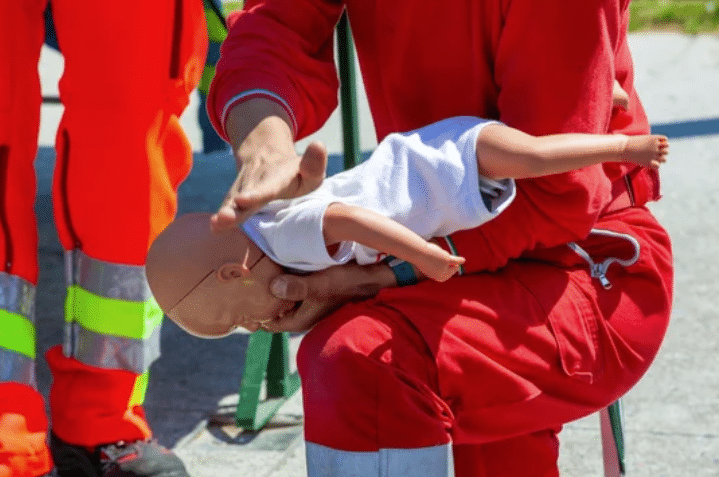
The course teaches high-quality CPR techniques for both adults and children, including:
- Chest compressions at the correct depth and rate
- Effective rescue breaths
- Minimising interruptions during CPR
Although the principles remain the same, child CPR procedures are adapted to reflect anatomical and physiological differences.
The objective of CPR is not to restart the heart directly, but to maintain blood circulation until defibrillation or advanced care can restore effective cardiac function.
At N9BO℠, we emphasise consistency and quality of compressions as critical survival factors.
AED Use and Defibrillation
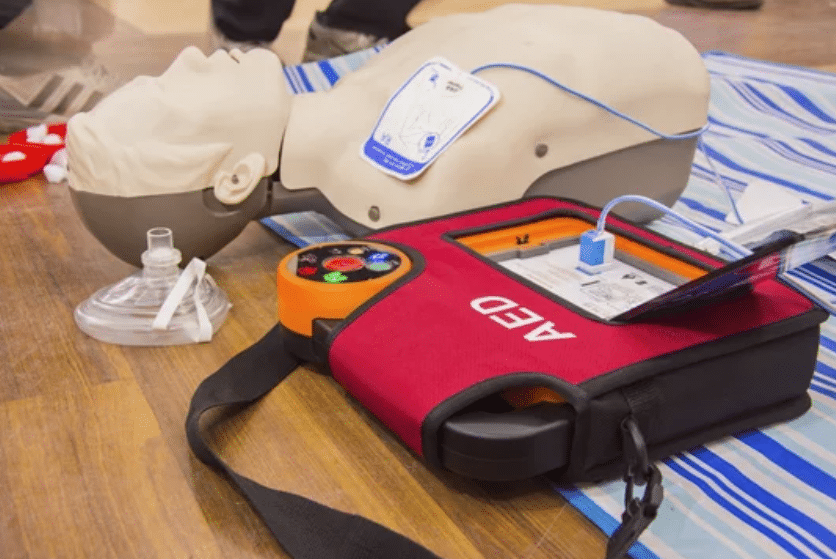
Automated External Defibrillators (AEDs) are designed to analyse heart rhythm and deliver an electrical shock when appropriate.
The course teaches responders how to:
- Prepare and operate the AED
- Apply pads correctly
- Follow voice prompts safely
- Coordinate CPR with defibrillation
AEDs significantly improve survival rates in sudden cardiac arrest when used early. The combination of immediate CPR and rapid defibrillation provides the highest chance of successful resuscitation.
The course also addresses differences between adult and child AED use, including pad placement and paediatric settings where available.
At N9BO℠, we treat AED competency as an essential component of emergency response capability.
First Aid for Injury and Illness
The course develops first aid skills for a range of medical and trauma emergencies affecting both adults and children.
These may include:
- Severe bleeding
- Shock
- Burns
- Fractures and sprains
- Allergic reactions
- Heat-related illness
- Seizures and diabetic emergencies
Responders are trained to assess the casualty systematically, prioritise interventions, and monitor condition changes until professional assistance arrives.
The emphasis is on controlled, structured response rather than improvisation.
At N9BO℠, we emphasise that first aid is a decision-making process as much as a practical skill set.

Differences Between Adult and Child Response
Children are not simply smaller adults. Their physiology, airway structure, and response to injury differ significantly.
The course addresses these differences by adapting:
- Compression depth and technique
- Rescue breathing procedures
- Airway management considerations
- Recognition of distress and deterioration
Responders must also adapt communication and emotional management when dealing with children and family members during emergencies.
This requires both technical competence and composure under stress.
At N9BO℠, we emphasise that effective paediatric response requires precision and calm decision-making.
Scenario-Based Training and Practical Skills
Emergency care training is heavily practical. Students must demonstrate skills through realistic scenarios designed to simulate actual emergencies.
Training includes:
- Single-rescuer and team CPR
- AED deployment drills
- Casualty assessment exercises
- First aid response scenarios
These exercises reinforce coordination, communication, and procedural sequencing under time pressure.
Repetition is essential. In real emergencies, responders rely on trained behaviour rather than conscious recall.
At N9BO℠, we prioritise repeatable performance and operational confidence.
Operational Relevance Across Industries
Emergency care capability is relevant far beyond diving environments. These skills apply across workplaces, travel, offshore operations, remote environments, education, and community settings.
For dive professionals and operational teams, CPR and first aid training form part of broader emergency response planning and risk management systems.
The ability to provide immediate care improves overall operational resilience and strengthens team preparedness.
At N9BO℠, we integrate emergency care training into wider safety and readiness programmes.
Operational Mindset
The Adult and Child Emergency Care course reinforces that effective emergency response depends on preparation, structure, and immediate action.
Responders must remain calm, follow procedures, and prioritise interventions correctly. Panic, hesitation, and improvisation reduce effectiveness and increase risk.
The goal is not perfection. The goal is controlled intervention that preserves life until advanced medical care becomes available.
At N9BO℠, we approach emergency care as a core operational capability built on discipline, repetition, and confidence under pressure.
In emergencies, the first responder often becomes the deciding factor between deterioration and survival.
Respond with Confidence When Seconds Matter
Contact N9BO℠ to integrate Adult and Child Emergency Care: First Aid, CPR & AED training into your operational readiness programme, building practical life-saving capability for real-world emergencies.
From the N9BO℠ Knowledge Base