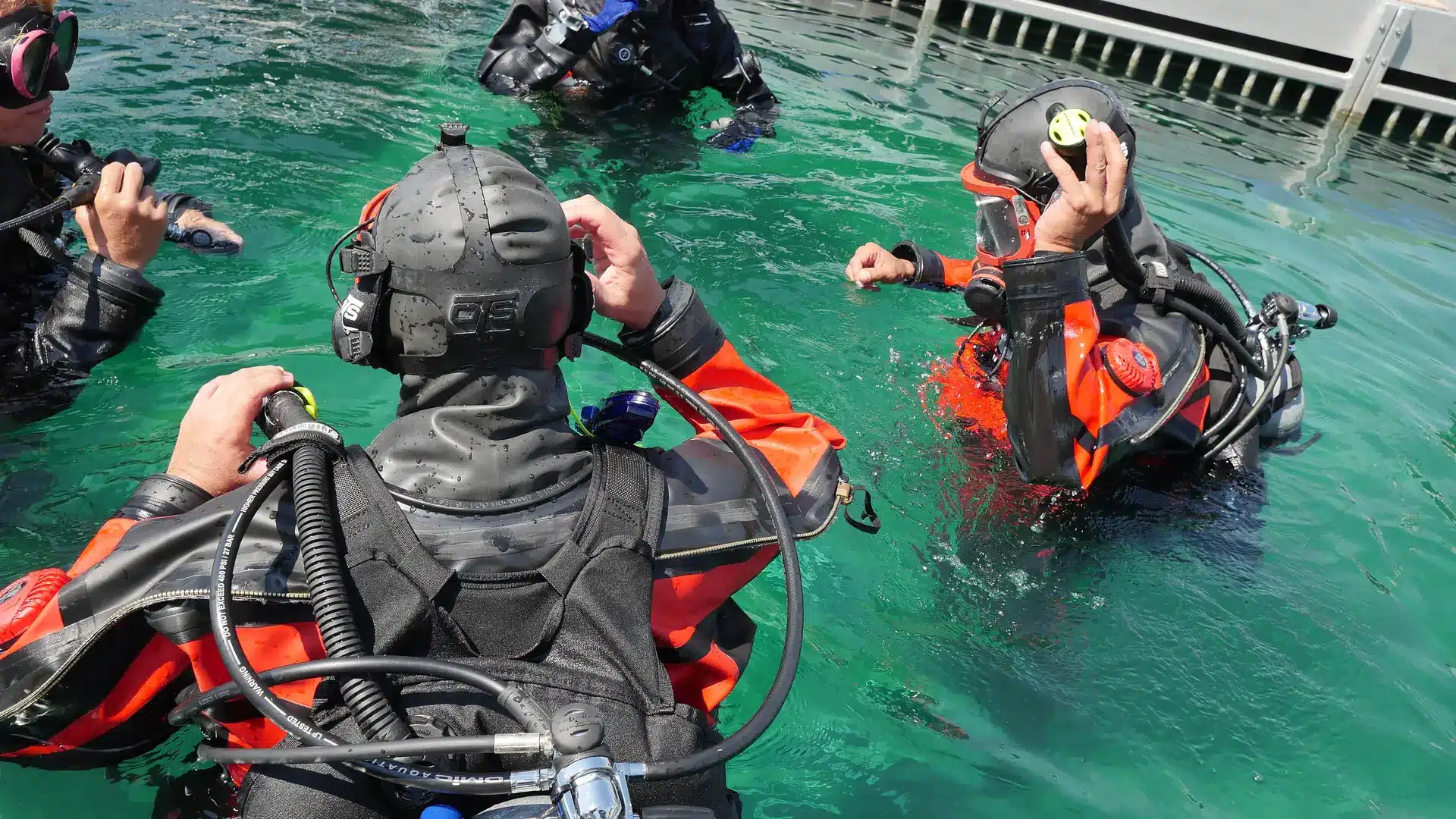
What Defines SAR in Public Safety Diving
Search and Rescue (SAR) diving involves:
- Locating missing persons.
- Recovering submerged vehicles.
- Responding to flood incidents.
- Supporting disaster recovery.
- Conducting evidence-related searches.
- Assisting law enforcement and emergency services.
Unlike recreational diving:
SAR is mission-driven.
There is:
- Time pressure.
- Public scrutiny.
- Family involvement.
- Inter-agency coordination.
- Environmental unpredictability.
Structure protects both divers and mission integrity.
Urgency vs Procedure
One of the greatest risks in SAR operations is emotional urgency.
Families wait.
Media observes.
Command pressures.
Time feels critical.
But uncontrolled urgency leads to:
- Poor gas planning.
- Surface miscommunication.
- Improvised search patterns.
- Diver overexertion.
- Reduced safety margin.
Professional SAR divers operate with ‘controlled urgency’. Speed without structure increases incident probability.
The Role of Incident Command
Effective SAR operations integrate:
- Incident Command System (ICS).
- Defined chain of command.
- Clear operational objectives.
- Surface coordination.
- Medical standby.
- Logistical oversight.
The diver is one component of a larger operational framework.
Without command structure, confusion multiplies. ICS provides clarity.
Search Patterns and Systematic Coverage
Professional SAR divers deploy structured search methods, including:
- Jackstay search.
- Circular search.
- Arc search.
- Grid search.
- Shoreline sweep.
- Tethered patterns.
Each pattern depends on:
- Visibility.
- Current.
- Bottom composition.
- Area size.
- Objective priority.
Improvised searching wastes time and gas.
Systematic coverage increases the probability of detection.
Environmental Challenges in SAR
Public safety diving environments are often:
- Zero visibility.
- High contamination risk.
- Current-driven.
- Cold water.
- Debris-laden.
- Psychologically stressful.
Divers may encounter:
- Entanglement hazards.
- Sharp metal.
- Fuel leaks.
- Biohazards.
- Structural instability.
- Risk mitigation must remain:
- Primary.
Rescuers must not become victims.

Gas Discipline Under Stress
SAR divers frequently operate in shallow but complex environments. Thus, gas management remains essential.
- Stress increases:
- Respiratory rate.
- CO₂ retention risk.
- Decision fatigue.
Professional teams implement:
- Conservative turn pressures.
- Strict dive duration limits.
- Surface interval enforcement.
- Redundant systems.
Emotional intensity must not override gas discipline.
Tender and Surface Support Roles
The tender in SAR operations is critical.
Surface personnel manage:
- Line tension.
- Communication.
- Time tracking.
- Gas monitoring.
- Emergency readiness.
The diver may have limited visibility and orientation.
The tender provides stability. Team integration prevents isolation.
Psychological Load in SAR
SAR diving often involves:
- Human remains.
- Traumatic scenes.
- Family presence.
- High emotional weight.
Divers must:
- Remain composed.
- Operate procedurally.
- Separate emotion from execution.
Post-operation debrief and psychological support are essential.
Professional resilience protects long-term performance.
Equipment Considerations
SAR operations may utilise:
- Full-face masks.
- Surface-supplied systems.
- Tethered lines.
- Cutting tools.
- Lift bags.
- Underwater communication systems.
- Dry suits for contamination protection.
Equipment selection reflects operational complexity.
Configuration must support mobility and safety.

Rescue vs Recovery
SAR missions may transition from:
- Rescue (life-saving priority)
To:
- Recovery (asset or remains retrieval).
The operational tone shifts. Procedure remains disciplined. Clear mission definition prevents confusion.
Training Requirements
Professional SAR divers require:
- Structured ERDI training.
- Scenario-based drills.
- Surface coordination practice.
- Stress exposure simulation.
- Incident command integration.
Skill must be:
- Rehearsed.
- Under controlled training conditions.
Operational Discipline at N9BO℠
At N9BO℠, SAR training emphasises:
- Structure over speed.
- Systematic search methodology.
- Gas discipline.
- Tender integration.
- Command coordination.
- Psychological resilience.
We train teams to:
- Think clearly under pressure.
- Because uncontrolled urgency creates secondary casualties.
Common Failures in SAR Operations
Operational reviews often identify:
- Poor communication.
- Inadequate search pattern selection.
- Failure to respect gas limits.
- Unclear command hierarchy.
- Inconsistent documentation.
Each error compounds. Structure prevents escalation.
Professional Mindset
SAR divers must accept:
- They cannot control the outcome.
- They can only control:
- Procedure.
Professionalism means:
- Following protocol.
- Protecting team safety.
- Executing search systematically.
- Maintaining emotional discipline.
Final Perspective
Search and Rescue diving is not heroic improvisation. It is structured execution under pressure.
Successful SAR operations depend on:
- Command clarity.
- Team cohesion.
- Gas discipline.
- Search methodology.
- Emotional control.
In public safety diving, procedure protects life. Even when time feels urgent.

Building or Strengthening Your SAR Diving Team?
Contact N9BO℠ to discuss structured ERDI Search and Rescue training aligned with professional public safety standards.
From the N9BO℠ Knowledge Base