Why Valve Drills Are So Often Misunderstood
Valve drills are one of the most recognisable components of technical diving training. They are also one of the most frequently misinterpreted. Videos, social media clips, and informal discussions often portray valve drills as demonstrations of dexterity or speed—how quickly a diver can reach back, manipulate valves, and return to position.
This framing misses the point entirely.
Valve drills exist to teach failure recognition, prioritisation, and controlled response. Speed is a secondary outcome that may develop with experience, but it is never the primary objective. This distinction is made explicit in technical diving training, yet it is often lost outside formal instructional contexts.
What Valve Drills Are Actually Training For
At a fundamental level, valve drills simulate gas delivery failures. These failures can include:
- Free-flowing regulators
- Burst hoses
- Manifold leaks
- Isolation failures
The drill teaches divers to:
- Recognise the failure
- Stabilise buoyancy and position
- Isolate the problem
- Preserve breathable gas
- Communicate clearly with the team
Each of these steps is far more important than how quickly a valve is turned. TDI technical diving courses structure valve drills to reinforce this sequence rather than encourage rushed responses.
Stability Before Action
One of the first corrections instructors make during valve drills is slowing the diver down. Many candidates instinctively rush to “fix” the problem, sacrificing buoyancy, trim, and awareness in the process.
In technical environments, instability creates secondary problems. Depth excursions affect decompression obligations. Poor trim interferes with access and visibility. Loss of awareness compromises team coordination.
This is why advanced technical diving progression insists that divers stabilise before acting. A calm pause often prevents escalation and preserves options.
Why Speed Is a Dangerous Obsession
Speed-focused valve drills create several risks:
- Incomplete isolation of the failure
- Accidental shutdown of functioning valves
- Loss of situational awareness
- Increased breathing rate due to stress
A fast but sloppy drill is worse than a slow, precise one. Real failures rarely reward haste; they reward clarity.
Professional technical divers understand that time spent stabilising is time well invested.

Valve Drills and Cognitive Load
Valve drills are not purely mechanical tasks. They are cognitive exercises performed under simulated stress. The diver must:
- Interpret sensory input (sound, bubbles, resistance)
- Recall procedural sequence
- Maintain awareness of depth and gas
- Communicate with teammates
This multi-layered demand is why valve drills are so revealing during technical diving training. Weaknesses in task integration become immediately apparent.
Equipment Familiarity and Configuration Consistency
Effective valve drills require intimate familiarity with one’s equipment. Valve placement, hose routing, and manifold orientation must be consistent and predictable.
Frequent configuration changes undermine procedural memory. This is why TDI technical diving courses emphasise standardisation during early training. Consistency reduces hesitation and error under stress.
Valve drills are not the place to “experiment” with new setups.
Team Awareness During Valve Drills
Valve drills are often performed while teammates observe. This is intentional. Team members learn to recognise:
- Signs of distress
- Loss of control
- Incorrect shutdown sequences
They also practise positioning and readiness to assist if the drill escalates. Advanced technical diving progression reinforces that valve failures are team events, not private challenges.
When Valve Drills Go Wrong
Instructors frequently see valve drills fail not because candidates cannot reach their valves, but because they:
- Rush without stabilising
- Fixate on one valve and ignore the system
- Stop communicating
- Forget to monitor depth and time
These failures are instructive. They reveal how a diver is likely to behave during a real incident. Technical training uses these moments diagnostically rather than punitively.

Valve Drills in Real-World Context
In actual dives, valve failures rarely occur in isolation. They may coincide with:
- Reduced visibility
- Current
- Task load
- Narcosis
- Fatigue
This reality is why advanced technical diving progression integrates valve drills with other tasks rather than practising them in isolation forever. The goal is adaptability, not choreography.
Mastery Looks Boring—and That’s the Point
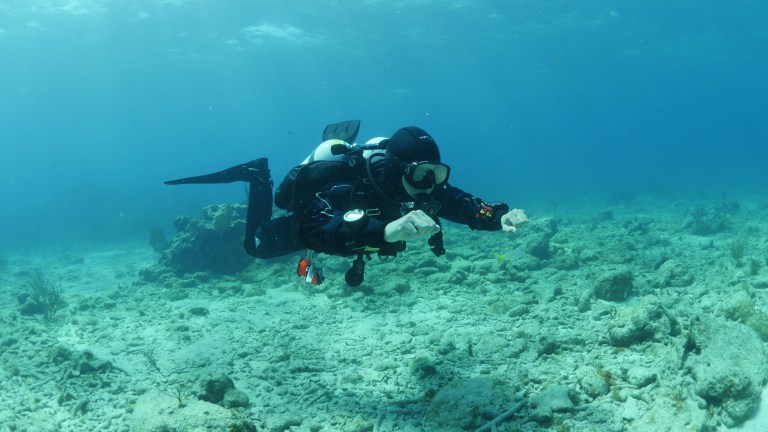
Well-executed valve drills are unremarkable. The diver remains stable. Movements are deliberate. Communication continues. Nothing dramatic happens.
This “boring” appearance is the hallmark of competence.
At N9BO℠, valve drills are taught as risk-management rehearsals, not demonstrations. Divers are evaluated on composure, control, and clarity—not theatrics.
The Takeaway
Valve drills are not about speed.
They are about discipline.
They exist to ensure that when gas delivery fails—as it eventually will—the diver responds with calm precision rather than panic. This capability defines technical competence far more than depth records or equipment lists.
In tactical training, a mantra famously used by US Navy SEALs is “Slow is smooth and smooth is fast“. In technical diving, smooth is safe.
Fast is optional.

Want to Train Valve Drills the Right Way?
Valve drills are about control and accuracy, not speed. Contact us to discuss proper skill development and performance standards.
From the N9BO℠ Knowledge Base