Understanding PADI Distinctive Specialities
A PADI Distinctive Speciality is a course created by an individual instructor or training organisation, then reviewed and approved by PADI. Unlike standard PADI courses, which follow globally fixed curricula, distinctive specialities allow adaptation to specific operational needs, environments, or areas of expertise.
This flexibility allows training to integrate real-world operational requirements, external standards, and advanced methodologies while remaining within the PADI quality assurance framework. The structure remains controlled, but the delivery can be tailored to reflect actual field conditions.
In the case of Tec Rescue [Distinctive], the programme expands traditional rescue training into the technical domain, aligning procedures with the realities of decompression diving, complex equipment, and team-based operations.
At N9BO℠, we use distinctive specialities to bridge training systems and deliver operationally relevant capability.
Purpose of the PADI Tec Rescue Course
The Tec Rescue course is designed to expand rescue skills beyond recreational scenarios and apply them to technical diving operations. While traditional rescue training focuses on immediate response and rapid ascent, technical diving introduces constraints that require a different approach.
Divers must manage emergencies while maintaining decompression obligations, handling complex equipment, and coordinating within a team. This changes both the nature of the problem and the structure of the response.
The course develops the ability to plan, organise, and execute rescue procedures within this environment, ensuring that divers can respond effectively without creating additional risk.
At N9BO℠, we treat technical rescue as a controlled process where response must align with operational constraints.
Risk Management as the Foundation
Risk management is central to technical rescue. Emergencies are rarely isolated events; they are often the result of unmanaged hazards or compounding factors.
Divers are trained to identify threats early, assess vulnerability, and understand the potential impact of failure. This includes recognising environmental risks, equipment limitations, and human factors before the dive begins.
Planning becomes the first stage of rescue. A well-structured dive plan includes contingency procedures, emergency roles, and clear decision points.
This proactive approach reduces the likelihood of incidents and improves response capability when they occur.
At N9BO℠, we emphasise that effective rescue begins with effective risk control.
Identifying Emergencies Underwater
In technical diving, emergencies are not always obvious. Early signs may be subtle, requiring continuous observation and situational awareness.
Divers must monitor team members for changes in behaviour, buoyancy, communication, or equipment handling. Environmental changes can also indicate developing risk.
Maintaining composure is critical. Panic reduces the ability to assess and respond effectively.
Recognition is the first step. A delayed response increases complexity and reduces available options.
At N9BO℠, we train divers to detect problems early and act before they escalate.

Structured Emergency Response
Technical rescue requires a systematic approach. Once an issue is identified, the diver must establish communication, assess the situation, and initiate the appropriate response.
Procedures must follow a defined sequence. This ensures that critical steps are not missed and that the response remains controlled.
The diver must manage gas supply, buoyancy, and team positioning while considering decompression obligations. In non-life-threatening situations, ascent must remain controlled and aligned with the dive plan.
This balance between immediate response and long-term safety defines technical rescue.
At N9BO℠, we emphasise that structured response replaces improvisation.
Managing an Unconscious Technical Diver
One of the most complex scenarios addressed in the course is the recovery of an unresponsive diver. Unlike recreational diving, ascent must be controlled to minimise further injury and manage decompression constraints.
The rescuer must stabilise the diver, control buoyancy, and manage ascent rate while maintaining awareness of gas supply and team positioning. This process requires both technical skill and situational control.
At the surface, the operation continues. Equipment may need to be removed, and the diver must be transferred safely while initiating emergency care.
This requires coordination between underwater and surface teams, as well as clear communication throughout the process.
At N9BO℠, we treat unconscious diver recovery as a coordinated operation rather than a single action.
Decompression Illness and In-Water Considerations
Technical rescue training includes recognition and management of decompression-related injuries. Divers must understand the different types of decompression sickness and their operational implications.
Response begins with early recognition and continues with controlled action, including ascent management, oxygen administration, and coordination with medical support.
In certain environments, in-water recompression may be considered, but only within strict procedural frameworks and appropriate training.
The diver must balance immediate intervention with the risks associated with further exposure.
At N9BO℠, we emphasise that decompression illness management requires both knowledge and disciplined execution.
Team Diving and Communication
Technical rescue is inherently team-based. Divers must operate within a coordinated system where each member understands their role and responsibilities.
Communication must be clear, consistent, and agreed upon before the dive. Signals, procedures, and response protocols must be standardised to avoid confusion during an emergency.
During an incident, the team must function as a single unit. Individual actions must align with the overall plan.
This coordination reduces variability and ensures that the response remains controlled under pressure.
At N9BO℠, we treat team alignment as a primary control measure in emergency situations.

Training Structure and Scenario-Based Learning
The Tec Rescue [Distinctive] course combines knowledge development with scenario-based training across multiple open water dives.
Training is conducted in controlled environments, typically at shallow depths, allowing divers to focus on procedure and coordination rather than exposure. This ensures that skills are developed without unnecessary risk.
Scenarios include missing diver searches, unconscious diver recovery, gas emergencies, and surface response procedures. Each scenario is designed to reinforce decision-making and procedural execution.
Repetition is used to build confidence and ensure that responses become consistent and reliable.
At N9BO℠, we emphasise realistic training that reflects operational conditions.
Position Within the Technical Pathway
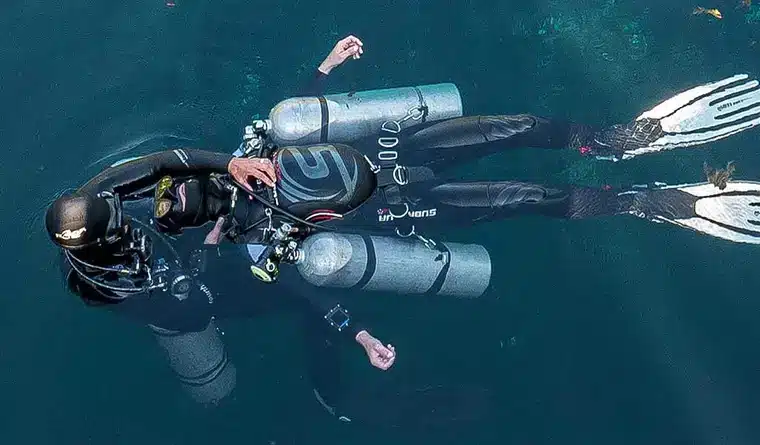
The Tec Rescue [Distinctive] course complements advanced technical training by adding a critical layer of emergency preparedness. It does not extend depth or gas capability, but strengthens the diver’s ability to manage incidents within those limits.
It integrates with programmes such as emergency oxygen provision, medical response training, and public safety diving, forming part of a broader operational capability.
For technical divers, it provides the tools to manage team incidents. For professionals, it enhances readiness in complex environments.
At N9BO℠, we position technical rescue as an essential component of advanced diving.
Operational Mindset
The Tec Rescue course reinforces that technical diving requires preparation for failure, not just success. Emergencies must be anticipated, planned for, and managed within a structured framework.
Every dive must include contingency planning, defined roles, and clear procedures. Response must be controlled and deliberate.
At N9BO℠, we approach technical rescue as part of a broader operational system. Risk management, team coordination, and procedural discipline must align to ensure an effective response.
In technical diving, safety is defined by the ability to manage incidents when they occur.

Train for the Emergency Before It Happens
Contact N9BO℠ to integrate PADI Tec Rescue [Distinctive] training into your technical development, ensuring you are prepared to manage emergencies in complex diving environments.
From the N9BO℠ Knowledge Base