Understanding PADI Distinctive Specialities
A PADI Distinctive Speciality is a course created by an instructor or training organisation and formally approved by PADI. Unlike standardised courses, distinctive specialities allow adaptation to specific operational requirements, environments, and instructor expertise.
This framework allows training to integrate real-world procedures, advanced techniques, and cross-discipline standards while remaining within PADI’s quality assurance system. The structure is controlled, but the content can be tailored to reflect actual field conditions.
In the case of Tec Advanced Wreck [Distinctive], the course expands beyond recreational wreck diving and aligns training with technical, overhead, and penetration diving protocols.
At N9BO℠, we use distinctive specialities to bridge training systems and deliver operationally relevant capability.
Purpose of the Tec Advanced Wreck Course
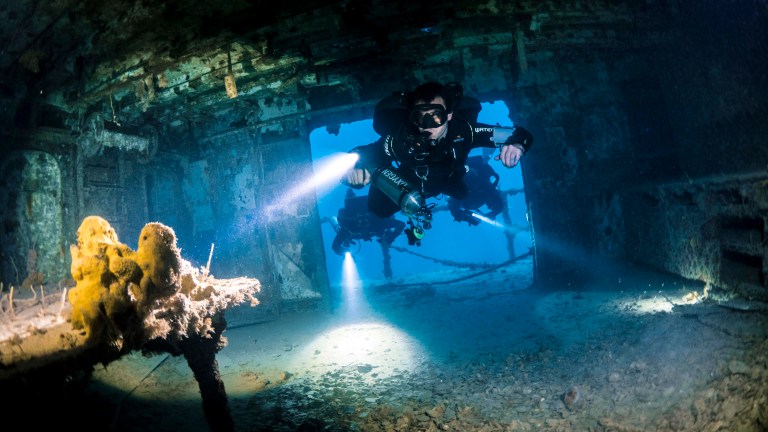
The Tec Advanced Wreck course is designed to train divers to safely plan and execute penetration dives inside wrecks. Unlike external wreck exploration, this environment introduces overhead constraints, limited visibility, and complex navigation.
The course emphasises advanced dive planning, execution of penetration techniques, and management of hazards specific to wreck environments.
Divers are trained to operate within defined limits, including a maximum depth of 50 metres and penetration governed by structured gas management protocols.
The objective is not exploration alone. It is controlled penetration within a defined safety framework.
At N9BO℠, we position wreck penetration as a discipline that requires structure, not curiosity.
Overhead Environment and Operational Constraints
Wreck penetration introduces an overhead environment where direct ascent is not possible. This fundamentally changes how dives are planned and executed.
Divers must manage:
- Navigation without direct visual reference to the exit
- Limited or zero visibility conditions
- Physical restrictions within the structure
These constraints require the use of guidelines, strict gas management, and continuous awareness of position relative to the exit.
Every action must support a safe return path. There is no tolerance for deviation or disorientation.
At N9BO℠, we emphasise that overhead environments remove options and therefore demand control.
Gas Management and the Rule of Thirds
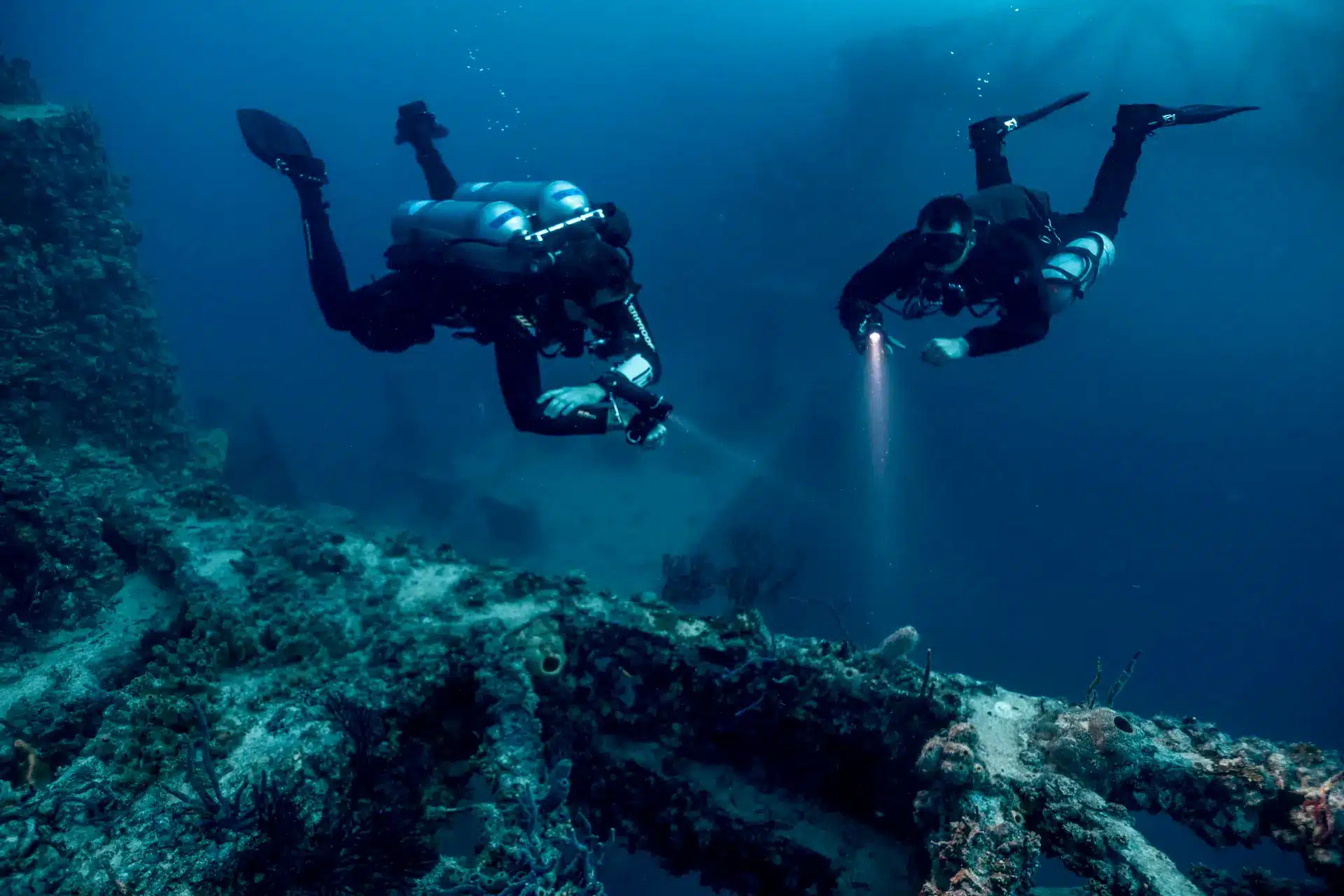
Gas management in wreck penetration follows strict protocols. The most commonly applied is the Rule of Thirds, where one third of the gas supply is used for entry, one third for exit, and one third reserved for emergencies.
This ensures that divers always maintain sufficient gas to exit the wreck, even under failure conditions or when assisting a team member.
Gas matching between team members is also critical. Divers must plan based on the lowest available gas volume within the team.
This approach reduces variability and ensures that all team members remain within safe operational limits.
At N9BO℠, we treat gas planning as the primary safety control in penetration diving.
Guideline Use and Navigation Control
Guidelines are the central navigation tool in wreck penetration. They provide a continuous physical reference from the entry point to the deepest point of penetration.
Divers are trained to deploy, secure, and follow guidelines using reels and spools. Proper line placement, tension, and marking are essential to avoid confusion or entanglement.
The guideline is more than a navigation aid. It is the primary safety system in low visibility or zero-visibility conditions.
Loss of the line represents a critical emergency, which is why drills and procedures are built around maintaining and recovering line contact.
At N9BO℠, we emphasise that the guideline is the lifeline in overhead environments.
Skill Development and Penetration Techniques
The course develops a range of specialised skills required for penetration diving. These include propulsion techniques designed to minimise silt disturbance, as well as buoyancy and trim control to maintain stability in confined spaces.
Divers are trained to:
- Maintain neutral buoyancy and precise body positioning
- Use propulsion techniques that reduce environmental impact
- Navigate using both visual and tactile references
These skills are not isolated. They must be integrated into a controlled system where movement, awareness, and task execution remain aligned.
At N9BO℠, we emphasise that penetration skills must be repeatable and controlled under all conditions.
Hazard Management and Problem Solving
Wreck environments present multiple hazards, including entanglement, disorientation, structural instability, and equipment failure. Divers must be prepared to identify and manage these risks in real time.
The course introduces structured problem-solving procedures. Divers are trained to recognise issues early, stabilise the situation, and apply controlled responses.
Typical scenarios include lost line, lost diver, light failure, and gas supply issues. Each requires a specific and rehearsed response.
The objective is not to eliminate risk, but to manage it effectively within defined procedures.
At N9BO℠, we train divers to operate within controlled frameworks that support consistent decision-making.
Training Structure and Dive Progression
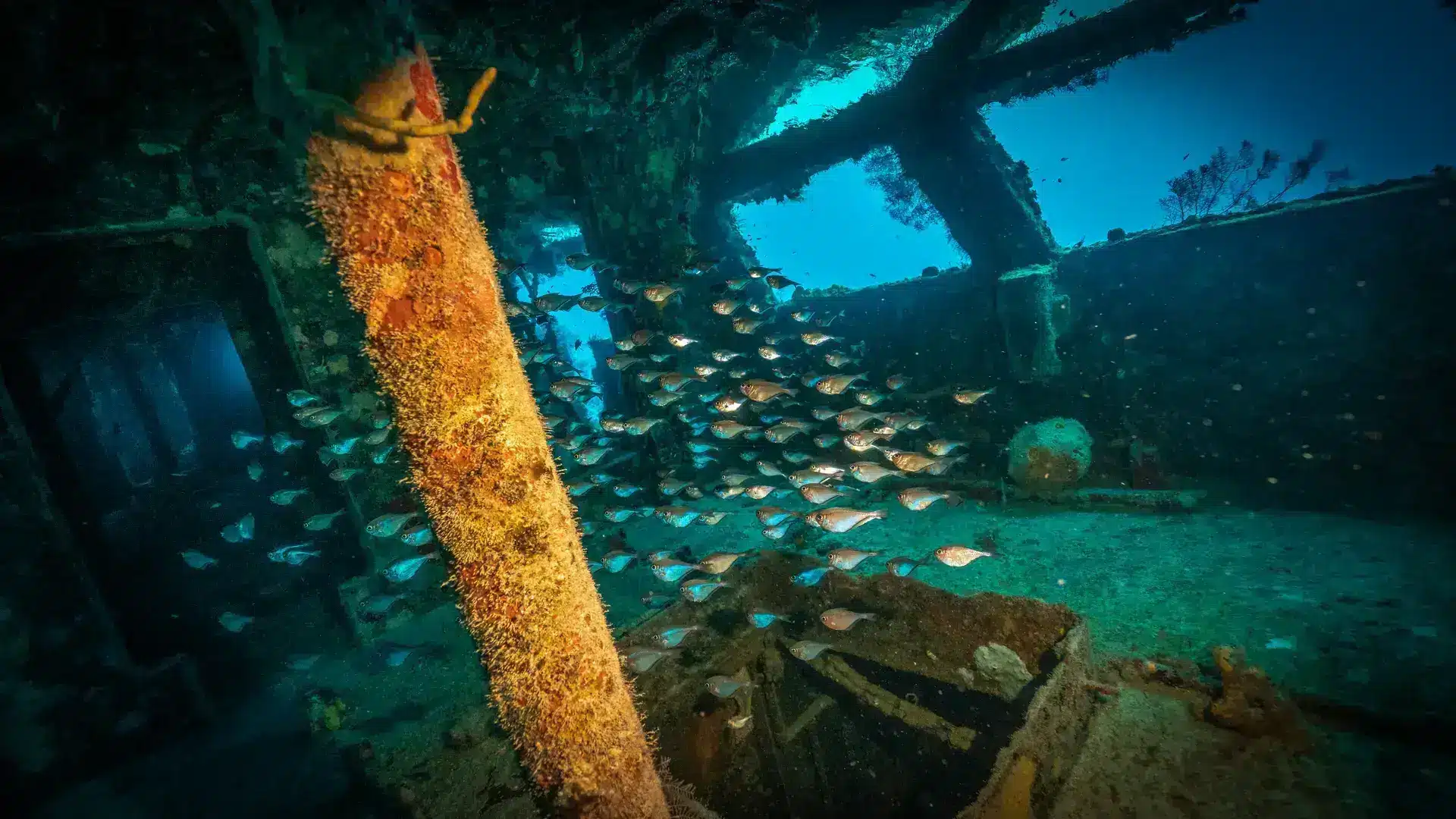
The course includes knowledge development, land drills, and six wreck penetration dives conducted in sequence.
Training progresses from basic guideline deployment and navigation to more complex scenarios involving zero visibility, gas sharing, and emergency procedures.
Dives are structured to build capability progressively. Each dive introduces additional complexity while reinforcing previous skills.
The maximum depth is 50 metres, and penetration distances are controlled within defined limits.
This progression ensures that divers develop both technical skills and operational awareness.
At N9BO℠, we emphasise structured progression to build reliable performance.
Team Coordination and Communication
Wreck penetration is inherently team-based. Divers must operate within a coordinated system where communication is clear and consistent.
Communication methods include hand signals, light signals, and touch contact when visibility is reduced. These methods must be standardised and understood by all team members.
Pre-dive briefings are critical. The team must agree on roles, procedures, and contingency plans before entering the wreck.
During the dive, alignment must be maintained at all times. Individual deviation introduces risk to the entire team.
At N9BO℠, we treat team coordination as a primary safety mechanism.
Position Within the Technical Pathway
The Tec Advanced Wreck course sits within the advanced technical and overhead environment training pathway. It builds on prior wreck and technical certifications and prepares divers for more complex environments such as cave or advanced penetration diving.
Prerequisites typically include Tec 50 or equivalent and prior wreck diving certification, reflecting the level of skill required.
This course does not extend depth beyond 50 metres, but significantly increases environmental complexity and operational demand.
At N9BO℠, we position advanced wreck as a transition into full overhead environment discipline.
Operational Mindset
The Tec Advanced Wreck course reinforces that penetration diving is defined by discipline, not exploration. Every dive must be planned, executed, and monitored within a structured framework.
The diver must maintain continuous awareness of gas, position, and team status. Procedures must be followed precisely, and contingency plans must be ready at all times.
At N9BO℠, we approach wreck penetration as a controlled operation. Equipment, gas, and procedures must align to manage the constraints of the environment.
In overhead diving, safety is not created by skill alone, but by the system in which that skill is applied.
Enter the Wreck with Control, Not Only Curiosity
Contact N9BO℠ to integrate PADI Tec Advanced Wreck training into your technical development, building the discipline, precision, and awareness required for safe wreck penetration diving.
From the N9BO℠ Knowledge Base