Understanding PADI Distinctive Specialities
A PADI Distinctive Speciality is a course created by an instructor or training organisation and formally approved by PADI. Unlike standard PADI courses, which follow globally fixed curricula, distinctive specialities allow adaptation to specific operational needs, environments, and instructor expertise.
This flexibility allows integration of real-world procedures, local regulations, and industry standards into a structured training framework. The course remains within PADI’s quality assurance system while reflecting actual operational requirements.
In the case of the Air Compressor Operator course, the programme is designed to address a critical operational function that is not covered in standard recreational training, ensuring that gas production is managed safely and professionally.
At N9BO℠, we use distinctive specialities to align training with real operational demands.
Purpose of the Air Compressor Operator Course
The Air Compressor Operator course is designed to train both divers and non-diving personnel in the safe operation of compressor systems used to fill scuba cylinders. It focuses on understanding compressor mechanics, air quality, and operational procedures rather than diving performance.
The objective is to ensure that compressed air used for breathing meets required standards and is produced consistently under controlled conditions. This includes both technical understanding and practical execution.
The course emphasises that gas quality is not assumed. It must be produced, verified, and documented as part of a structured process.
At N9BO℠, we treat compressor operation as a critical upstream control that defines dive safety before entering the water.
Understanding Compressor Systems
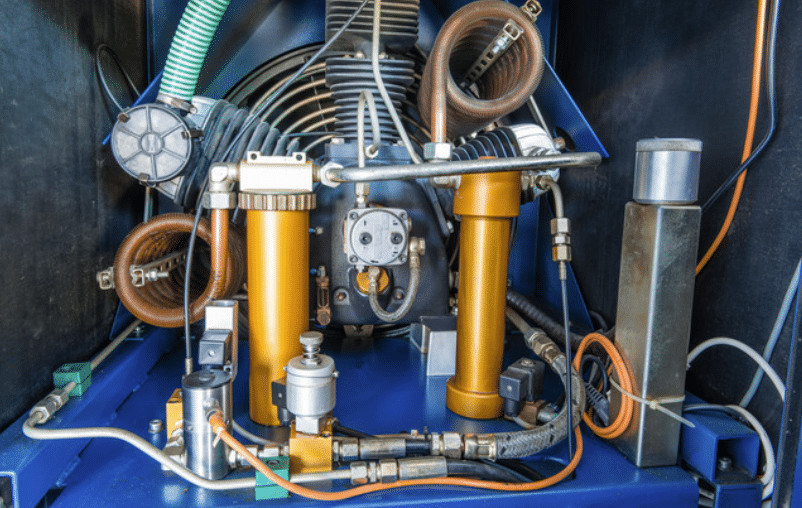
A dive compressor is a high-pressure system designed to compress atmospheric air to pressures typically between 200 and 300 bar for storage in scuba cylinders.
This process involves multiple stages of compression, cooling, and filtration to ensure that the final gas is suitable for breathing. Compressors may be powered by electric motors or combustion engines and can be either stationary or portable depending on operational needs.
Not all compressors are suitable for diving. Only systems designed for breathing air, with proper filtration and maintenance, can be used safely.
Understanding how these systems function is essential. The operator must know how air is compressed, filtered, and stored, as well as how each component contributes to final gas quality.
At N9BO℠, we emphasise that compressor knowledge is operational knowledge, not theoretical background.
Breathing Air Quality and Contamination Control
Air quality is one of the most critical elements of compressor operation. Compressed air must meet breathing-grade standards, ensuring that it is free from harmful contaminants.
Common risks include carbon monoxide, carbon dioxide, oil vapours, and water contamination. These contaminants can enter the system through poor intake placement, inadequate filtration, or lack of maintenance.
The course teaches how to control these risks through:
- Proper placement of air intake
- Use and maintenance of filtration systems
- Regular monitoring of air quality
The operator must understand that contamination is often invisible. It must be prevented through system control rather than detected after the fact.
At N9BO℠, we treat air quality as a non-negotiable safety requirement.
Gas Laws and Compression Principles
Operating a compressor requires an understanding of basic gas physics. Key laws such as Charles’ Law, Gay-Lussac’s Law, and Avogadro’s Law directly affect how gases behave during compression and storage.
These principles explain how temperature, pressure, and volume interact during the filling process. For example, heat generated during compression increases pressure, which must be managed to avoid overfilling or equipment stress.
Understanding these relationships allows the operator to control the filling process more precisely and avoid unsafe conditions.
At N9BO℠, we emphasise that gas physics is not academic—it directly affects operational safety.
Operational Procedures and Cylinder Filling
The course provides structured procedures for filling cylinders safely. This includes pre-operational checks, correct connection of cylinders, controlled filling rates, and post-fill verification.
Before filling, the operator must confirm that cylinders are within testing requirements and free from damage. During filling, pressure must be increased gradually to control heat and ensure accuracy.
Cooling methods, such as water baths, may be used to manage temperature and reduce stress on the cylinder.
The process does not end when the cylinder is full. Post-operational checks and documentation ensure traceability and accountability.
At N9BO℠, we treat cylinder filling as a controlled procedure, not a routine task.
Maintenance and System Reliability
Compressor reliability depends on regular maintenance and inspection. The course teaches how to conduct both pre-operational and post-operational checks to ensure system integrity.
Key elements include:
- Monitoring oil levels and mechanical components
- Inspecting hoses, valves, and fittings
- Draining condensation from tanks
- Maintaining filtration systems
Operators must also maintain a compressor log, recording usage, maintenance, and any anomalies.
This ensures that potential issues are identified early and that the system remains within safe operating parameters.
At N9BO℠, we emphasise that maintenance is a continuous process, not a periodic task.
Safety Systems and Risk Management
Operating a high-pressure compressor introduces significant risk if not managed correctly. The course introduces safety systems designed to prevent accidents and protect both operators and equipment.
These include pressure relief valves, burst disks, fill whip restraints, and emergency shutdown systems.
Personal protective equipment is also required, including hearing protection and appropriate clothing during operation.
Operators must follow structured procedures and adhere to local regulations governing high-pressure systems.
At N9BO℠, we treat compressor safety as a disciplined operational process.
Training Structure and Practical Application
The course combines knowledge development with practical training. Students must complete theory components before progressing to hands-on compressor operation.
Practical training includes multiple cylinder fills, system checks, and maintenance procedures. Students must demonstrate consistent and repeatable performance to meet certification requirements.
The programme can typically be completed within one day, but performance standards must still be met.
Training is performance-based. Certification is earned through demonstrated competence rather than attendance.
At N9BO℠, we align training with operational expectations, ensuring real-world capability.
Position Within the Diving Pathway
The Air Compressor Operator course sits alongside diving training rather than within it. It supports all levels of diving by ensuring that the gas used is safe and reliable.
It is particularly relevant for dive professionals, technicians, and anyone involved in dive centre operations.
The course also supports progression into related areas such as gas blending and equipment maintenance.
At N9BO℠, we position compressor operation as a core operational capability within dive operations.
Operational Mindset
The Air Compressor Operator course reinforces a critical principle: diving safety begins before the dive.
Gas quality defines the conditions under which the diver operates. If the gas is compromised, no level of skill can compensate.
The operator must approach compressor use with precision, discipline, and accountability. Every step, from intake placement to final fill, must be controlled.
At N9BO℠, we treat compressor operation as part of a larger safety system. It ensures that every dive begins with reliable, verified conditions.
In diving operations, control starts at the compressor—not at depth.
Control the Air Before the Dive Begins
Contact N9BO℠ to integrate PADI Air Compressor Operator training into your operations, ensuring safe, reliable gas production and full control over your diving environment.
From the N9BO℠ Knowledge Base