Beyond the Daylight Zone
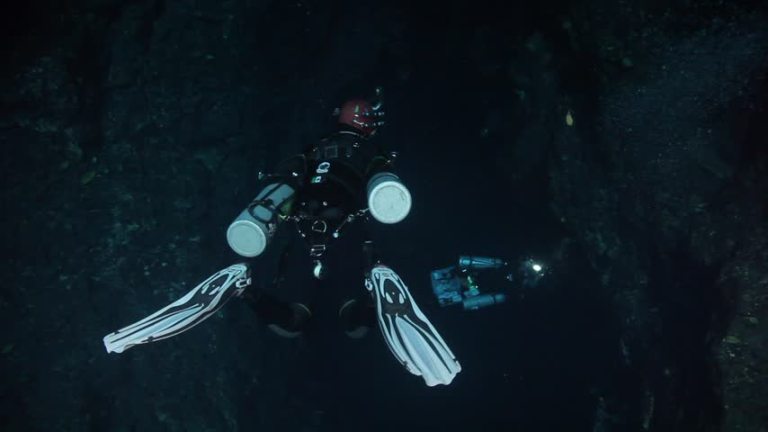
Cavern diving introduces overhead principles while maintaining visible exit references. Introductory cave training expands line navigation and gas planning but typically restricts complexity.
Full cave training removes visual exit cues entirely.
Divers must rely on:
- Continuous guideline contact
- Structured navigation protocols
- Pre-planned gas limits
- Team coordination
There is no natural light. There is no direct ascent. There is only the plan.
The difference is psychological as much as technical. Full cave divers operate in environments where mistakes do not surface — they compound.
Line Drills: Precision Before Penetration
The guideline is the cave diver’s exit map.
Full cave training reinforces:
- Primary reel deployment
- Gap jumps
- T-intersection navigation
- Marking protocols
- Cookie and directional marker use
Every tie-off must be secure. Every intersection must be marked with clarity.
Line discipline is not about decoration — it is about unambiguous exit strategy.
A single incorrect marker placement can create confusion in zero visibility. Precision eliminates doubt.
At N9BO℠, line drills are repeated until they become automatic. In overhead environments, procedural clarity replaces guesswork.
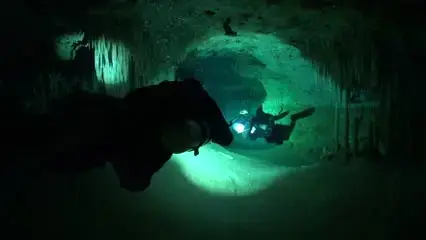
Gas Planning in Complex Cave Systems
Gas planning in caves goes beyond the basic rule of thirds.
Divers must consider:
- Penetration distance
- Depth variation
- Potential restriction negotiation
- Stress-adjusted breathing rates
- Team consumption profiles
Cave environments can extend horizontally for significant distances. Return travel may require more effort than entry due to current, restriction, or navigation complexity.
Conservative gas planning preserves margin.
Gas is not consumed according to plan — it is consumed according to reality. Planning must anticipate deviation.
Zero-Visibility Exit Drills
Full cave training deliberately introduces zero-visibility scenarios.
Lights are extinguished. Masks may be partially obscured. Silt is simulated.
The objective is not discomfort — it is competence.
Divers must:
- Maintain contact with the line
- Stabilise buoyancy
- Communicate through touch contact
- Control breathing
- Exit calmly
Panic is the real hazard. The environment does not create panic — uncertainty does.
Zero-visibility drills build familiarity with uncertainty.
Calm response replaces fear when training is structured properly.
Failure Management in Overhead Environments
Equipment failures in caves require immediate, controlled response.
Training includes:
- Light failure protocols
- Regulator shutdowns
- Gas sharing in restriction
- Lost line drills
- Lost buddy procedures
Each drill reinforces a single principle: stop, stabilise, solve, exit.
Rushing escalates problems. Discipline resolves them.
Failure is assumed possible. Training ensures it is survivable.
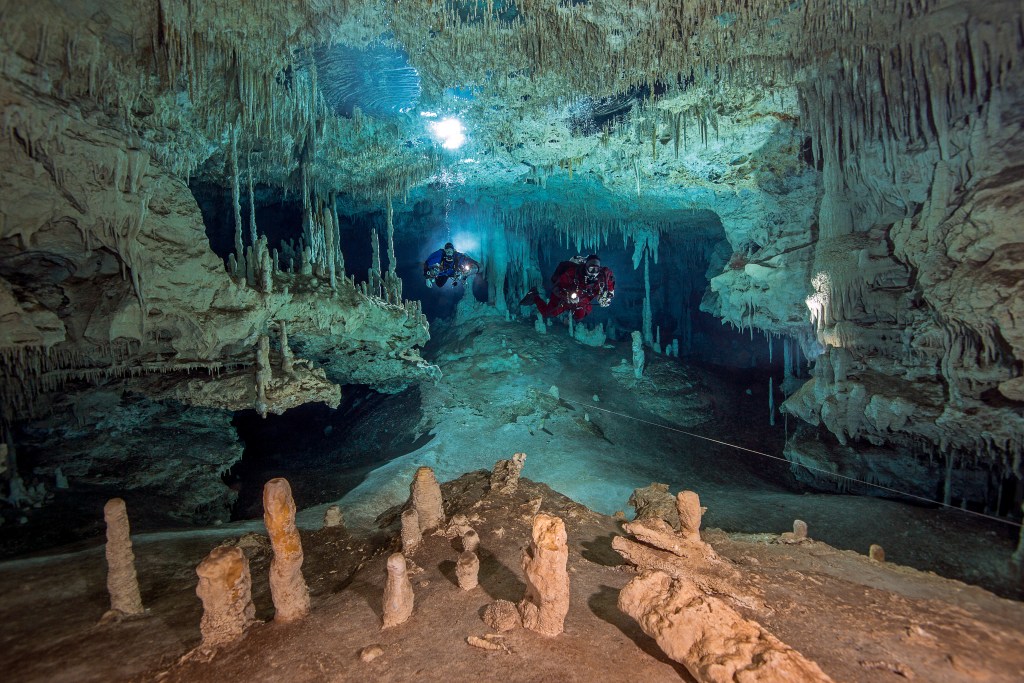
Navigation Complexity and Cognitive Control
Full cave divers must navigate:
- Complex line networks
- Multiple intersections
- Loops and circuits
- Directional ambiguity
Navigation errors in caves can be fatal.
Structured thinking reduces this risk:
- Mark clearly
- Confirm direction
- Communicate before movement
- Reconfirm gas status frequently
The environment rewards those who slow down.
At N9BO℠, we emphasise that cave diving is not about exploration ego — it is about disciplined navigation under constraint.
Psychological Stability in Confined Space
Caves challenge human instincts.
Darkness, confined passages, and distance from the surface can elevate stress responses. Elevated stress increases breathing rate and reduces cognitive clarity.
Full cave training builds familiarity through repetition.
Exposure to controlled stress creates resilience. Familiarity with darkness reduces anxiety. Structured procedure replaces improvisation.
Confidence in cave diving does not come from depth or distance. It comes from repetition of fundamentals until they remain stable under pressure.
Why Full Cave Training Is Progressive
Full cave certification is not a badge of bravery.
It is a confirmation of:
- Gas discipline
- Line mastery
- Failure response competence
- Zero-visibility control
- Team awareness
Progression must be gradual. Distance increases only when skill consistency is demonstrated.
The objective is not penetration length — it is exit certainty.
In cave diving, survival depends on one thing: knowing how to leave.
Structured training builds that certainty.
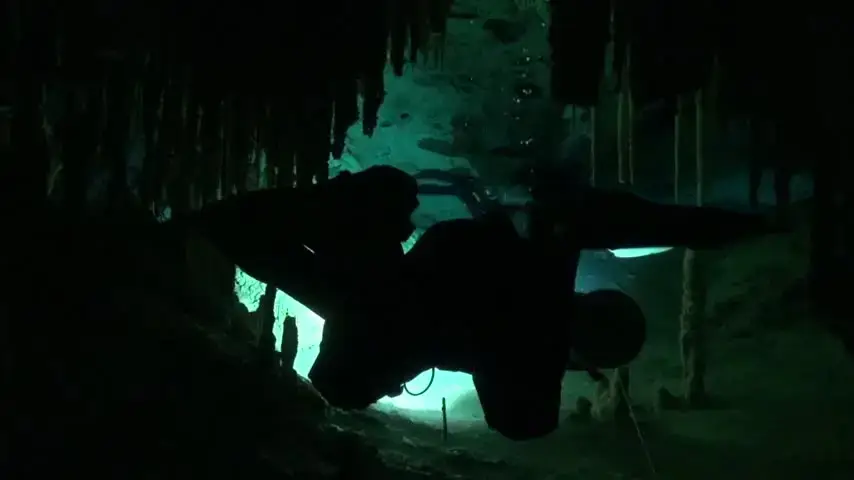
Considering Full Cave Training?
Cave diving requires disciplined gas planning, line mastery, and zero-visibility competence. Contact N9BO℠ to discuss structured cave progression pathways.
From the N9BO℠ Knowledge Base