Fear vs Biological Reality
The “big three” designation is largely media-driven.
The species include:
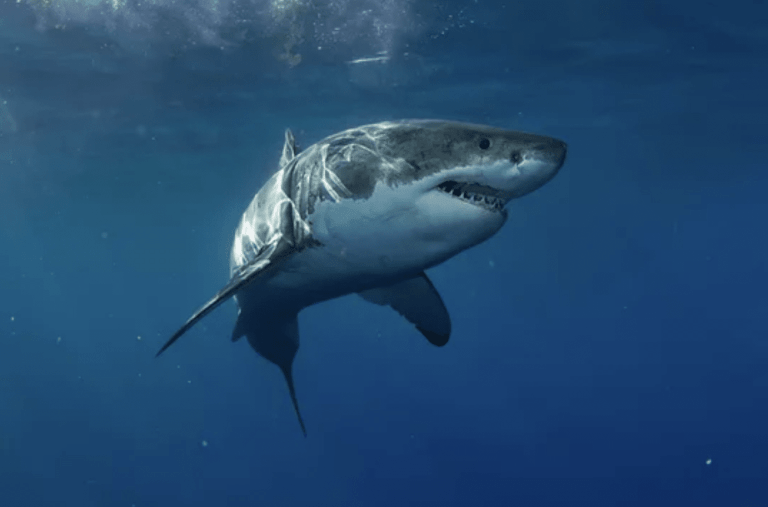
- Great White Shark (Carcharodon carcharias)
- Bull Shark (Carcharhinus leucas)
- Tiger Shark (Galeocerdo cuvier)
They share size, power, and ecological dominance — but their behaviour differs significantly.
Globally, shark incidents remain statistically rare relative to water exposure.
Perception is amplified by visibility.
Understanding behavioural patterns shifts response from fear to structured awareness.
Great White Sharks: Investigative Precision
Great whites are primarily found in temperate waters and often associated with seal colonies.
Their behaviour is characterised by:
- Ambush hunting strategy
- Investigative passes
- Acute sensory systems (electroreception, lateral line)
Most diver encounters involve curiosity rather than aggression.
Body language indicators include:
- Arched back
- Lowered pectoral fins
- Rapid tail movement
Understanding these signals improves situational awareness.
Professional divers maintain:
- Vertical posture
- Calm movement
- Visual tracking
Control reduces escalation.

Bull Sharks: Adaptable and Territorial
Bull sharks inhabit coastal and estuarine waters.
Their ability to tolerate freshwater increases proximity to human populations.
Behavioural traits include:
- Assertive investigative patterns
- Activity in low visibility environments
- Higher territoriality in certain regions
Risk often correlates with:
- Turbid water
- Spearfishing activity
- Feeding events
Environmental context influences behaviour more than inherent aggression.
Divers must assess surroundings before entry.
Tiger Sharks: Curious Opportunists
Tiger sharks occupy tropical and subtropical waters.
They are known for:
- Slow, sweeping approaches
- Close investigative passes
- Wide-ranging dietary habits
Tiger sharks often display prolonged curiosity.
Maintaining:
- Eye contact
- Controlled posture
- Stable buoyancy
signals awareness.
Fleeing behaviour may increase investigative intensity.
Professional composure matters.

Why Incidents Occur
Common contributing factors include:
- Low visibility
- Surface splashing
- Erratic movement
- Prey confusion
- Human-provoked interaction
Many incidents involve mistaken identity.
Divers differ from typical prey, but behavioural cues still matter.
Understanding environmental triggers reduces risk.
Diving Protocol Around Large Sharks
Professional divers follow structured conduct:
- Maintain group cohesion
- Avoid isolated positioning
- Minimise reflective equipment
- Avoid chasing or blocking movement
- Ascend slowly and deliberately
Surface behaviour is equally important.
Avoid excessive splashing or chaotic exit attempts.
Predictability reduces misinterpretation.
Ecological Importance of Apex Predators
Apex predators regulate marine ecosystems.
Sharks influence:
- Prey population balance
- Reef resilience
- Biodiversity stability
Declines in shark populations disrupt marine systems.
Divers who understand ecological context often become conservation advocates.
Fear undermines preservation.
Knowledge supports it.
Respect Over Sensationalism
Sharks are not villains — they are evolved predators.
Divers entering their habitat assume shared space.
Professional awareness requires:
- Environmental literacy
- Behavioural understanding
- Calm response
At N9BO℠, we emphasise that structured awareness improves both safety and ecological respect. Diving culture must prioritise knowledge over sensationalism.
Apex predators deserve understanding — not mythology.

Want to Strengthen Environmental Awareness Underwater?
Knowledge reduces fear and increases safety around large marine life. Contact N9BO℠ to explore advanced environmental and situational awareness training.
From the N9BO℠ Knowledge Base