Helicopter Ditching Is Rare — and Absolutely Unforgiving
Helicopter incidents offshore are statistically uncommon.
When they occur, survival depends almost entirely on training and behaviour in the first seconds, not strength, fitness, or luck. Water, inversion, darkness, and panic combine instantly.
HUET Is About Psychology, Not Swimming
Many assume HUET is a swimming or breath-hold exercise.
It is not.
HUET focuses on:
- Orientation under inversion
- Controlled breathing under stress
- Procedural sequencing
- Muscle memory when vision fails
The body can swim — the mind must remain functional.
Why ERDI HUET Is Different
ERDI HUET is grounded in emergency response doctrine.
It integrates:
- Public safety methodology
- Incident stress exposure
- Procedural discipline
- Accountability and debrief
This moves training beyond mechanical drills into true survival preparation.

Instructor Perspective: Panic Is Predictable
Instructors consistently observe the same pattern:
- Disorientation
- Breath-holding
- Grabbing the wrong reference
- Premature release
At N9BO℠, training deliberately slows the process, reinforcing pause–orient–act under controlled stress.
The Importance of Reference Discipline
HUET survival depends on maintaining a physical reference.
Training emphasises:
- Door and frame contact
- Hand positioning
- Deliberate movement sequencing
Letting go too early is one of the most common fatal errors.
Egress With Equipment and Constraints
Real-world egress is rarely clean.
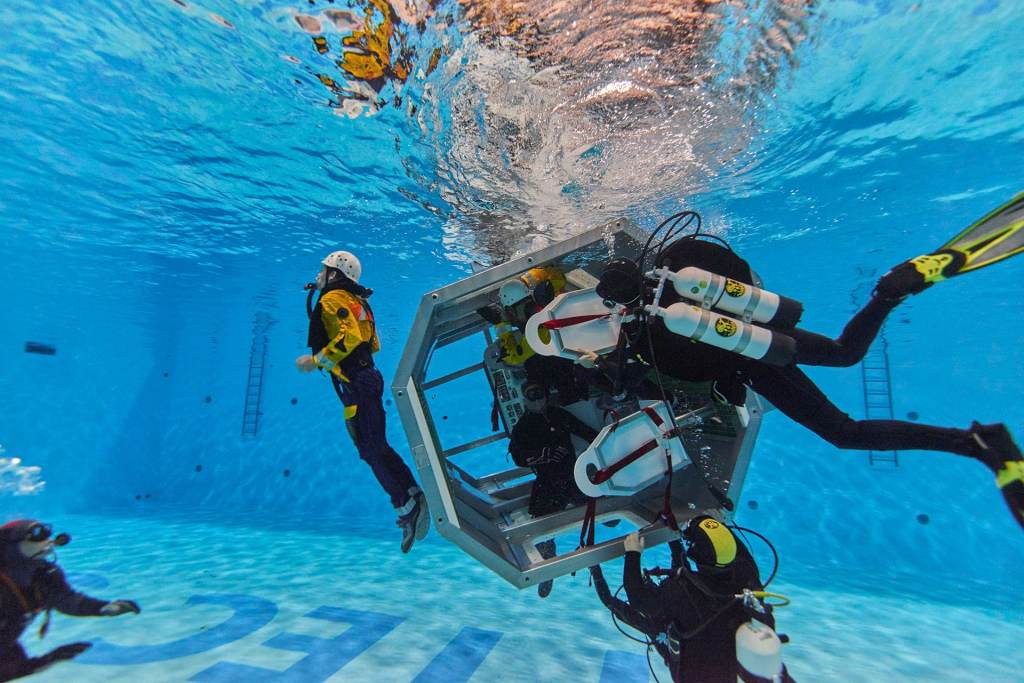
ERDI HUET includes scenarios with:
- Restricted exits
- Simulated debris
- Seatbelts and harnesses
- Low or zero visibility
Realism builds resilience.
Cold Shock and Breath Control
Cold water shock can destroy breath control instantly.
Professional HUET training teaches participants to regain breathing rhythm before attempting movement—a critical survival skill.

Team Awareness and Exit Order
HUET is not always a solo event.
Training reinforces:
- Exit sequencing
- Avoiding entanglement
- Maintaining spatial awareness
Poor coordination increases fatalities.
Transferable Survival Skills
HUET training builds capabilities applicable beyond aviation:
- Vehicle submersion
- Capsized vessels
- Flooded compartments
The principles remain the same.
Professional Parallels
Military aircrew, SAR teams, and offshore operators all rely on HUET for one reason: it works under stress.
The Bottom Line
In a helicopter ditching, instinct kills.
Training saves.
ERDI HUET training at N9BO℠ builds procedural calm in the most hostile orientation imaginable—preparing professionals to survive the moment when everything else fails.
Preparing Teams for Offshore or Aviation Emergencies?
HUET training builds the skills and mindset required to survive underwater egress scenarios. Contact us to discuss ERDI and offshore survival training programmes.
From the N9BO℠ Knowledge Base