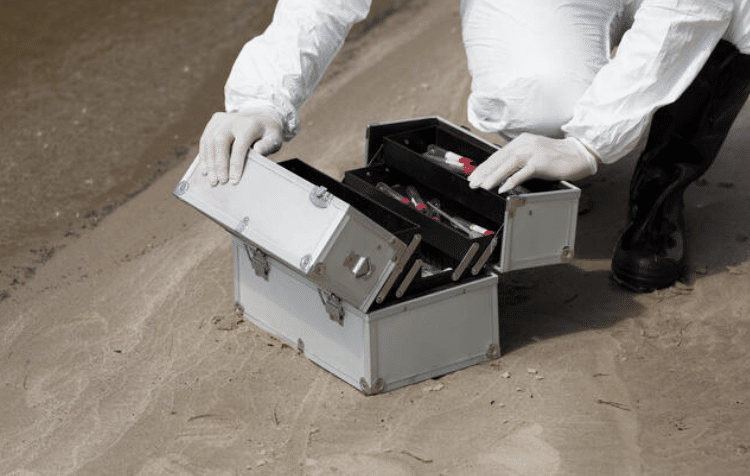
From Recovery to Evidence Control
In public safety diving, the transition from underwater recovery to surface handling is critical. Errors at this stage can compromise evidence, regardless of how well the recovery was conducted.
Once evidence is brought to the surface, it enters a controlled process. This process ensures that:
- The item remains uncontaminated
- Its condition is preserved
- Its origin and handling are fully documented
This is not a continuation of the dive—it is the beginning of an evidence management procedure.
At N9BO℠, we emphasise that recovery without control has limited value. Evidence integrity is determined at the surface.
Initial Surface Reception Procedures
The moment evidence reaches the surface, control must be established immediately. Unstructured handling introduces contamination and breaks chain of custody.
Key initial actions include:
- Assigning a designated evidence handler
- Preventing unnecessary contact or handling
- Maintaining the item in its recovered state
The recovery team must avoid the instinct to inspect or manipulate the item. Curiosity or informal examination can alter or damage evidence.
Surface personnel must be prepared in advance, with roles clearly defined before recovery begins.
At N9BO℠, we treat surface reception as a controlled handover, not an informal process.
Preservation of Evidence Condition
Preserving the original condition of evidence is essential. Waterborne items may contain trace evidence such as biological material, fibres, or residues that can be easily lost or altered.
Improper handling can result in:
- Loss of trace material
- Introduction of external contaminants
- Degradation due to exposure or drying
In some cases, items must remain wet to preserve evidence. In others, controlled drying may be required.
Preservation methods must be aligned with investigative requirements. This often involves coordination with forensic specialists.
At N9BO℠, we emphasise that preservation decisions must be deliberate and informed, not improvised.

Chain of Custody and Documentation
Chain of custody is the documented history of evidence from recovery to analysis. Any break or inconsistency in this chain reduces evidentiary value.
Documentation must include:
- Time and location of recovery
- Identity of personnel involved
- Description and condition of the item
- Transfer records between handlers
This documentation must be continuous and accurate. Gaps or errors introduce uncertainty.
Handling must be limited to authorised personnel only. Each transfer must be recorded and justified.
At N9BO℠, we treat documentation as part of the evidence itself—without it, the item loses context and value.
Contamination Control Measures
Contamination is a primary risk during surface handling. Evidence can be compromised by contact with equipment, personnel, or the environment.
Control measures include:
- Use of gloves and protective equipment
- Isolating evidence from non-essential personnel
- Using clean, designated surfaces for handling
Cross-contamination between items must also be prevented. Each item should be handled and packaged separately.
Surface environments are often uncontrolled compared to laboratory settings. This increases the importance of discipline and procedure.
At N9BO℠, contamination control is enforced through strict handling protocols.
Packaging and Transport Procedures
Proper packaging ensures that evidence remains secure during transport. Incorrect packaging can result in damage, contamination, or loss.
Considerations include:
- Selecting appropriate containers based on evidence type
- Ensuring containers are clean and labelled correctly
- Maintaining environmental conditions where required
Packaging must protect the item without altering its condition. For example, sealing wet items in airtight containers may accelerate degradation.
Transport must also be controlled. Evidence should be transferred directly to the appropriate authority or facility without unnecessary delay.
At N9BO℠, packaging and transport are treated as extensions of the evidence handling process.
Coordination with Investigative Authorities
Public safety diving operations often support law enforcement or investigative agencies. Coordination is essential to ensure that evidence handling aligns with legal and procedural requirements.
This includes:
- Following agency-specific protocols
- Ensuring proper handover procedures
- Maintaining communication with investigative personnel
Diving teams must understand their role within the broader investigation. Misalignment between recovery and investigation reduces effectiveness.
At N9BO℠, we integrate operational procedures with investigative requirements to ensure consistency.

Protect Evidence Integrity from Surface to Court
Contact N9BO℠ to integrate structured evidence handling procedures into your public safety dive operations, ensuring compliance, reliability, and admissibility.
Designated roles may include:
- Evidence handler
- Documentation officer
- Scene supervisor
Each role carries specific responsibilities. Overlapping roles or unclear responsibilities increase the likelihood of error.
Training must cover both procedural knowledge and practical application.
At N9BO℠, we ensure that roles are defined and personnel are trained before operations begin.
Common Failures in Surface Handling
Most evidence handling failures occur at the surface, not during recovery. These failures are typically procedural rather than technical.
Common issues include:
- Uncontrolled handling by multiple personnel
- Incomplete or inaccurate documentation
- Improper packaging
- Delayed transfer to authorities
These failures compromise evidence even when recovery is successful.
At N9BO℠, we address these risks through structured procedures and operational discipline.
Operational Mindset
Evidence handling is a controlled process that begins at the moment of recovery and continues through every stage of transfer and analysis.
The surface phase is critical. It is where evidence is either preserved or compromised.
At N9BO℠, we emphasise that discipline, documentation, and control define success. Recovery is only the first step—what follows determines the outcome.
In public safety diving, the value of evidence is not defined by its discovery, but by how it is handled.
Stay Ready for Every Callout
Contact N9BO℠ to integrate structured readiness programmes into your public safety dive team, ensuring consistent performance and rapid, effective response.
From the N9BO℠ Knowledge Base