What Citizen Science Actually Means
Citizen science refers to structured data collection performed by non-academic participants under defined research protocols.
In marine environments, divers contribute by:
- Recording species presence
- Monitoring coral health
- Documenting invasive species
- Reporting unusual behaviour patterns
- Photographing reef conditions
When properly coordinated, this information strengthens large-scale environmental datasets.
But casual observation is not the same as scientific contribution.
For citizen science to be valuable, it must be:
- Repeatable
- Standardised
- Geographically traceable
- Methodologically consistent
Professional diving discipline becomes an asset.
Why Divers Are Uniquely Positioned
Divers access environments that remain difficult for researchers to monitor continuously.
Frequent site visitation allows divers to detect:
- Early bleaching indicators
- Shifts in species distribution
- Changes in reef structure
- Emergence of invasive organisms
Long-term familiarity with a site increases observational sensitivity.
Professional divers operating consistently within a region can provide longitudinal insight that occasional surveys may miss.
Data Quality vs Observation Bias
The greatest challenge in citizen science is accuracy.
Untrained participants may:
- Misidentify species
- Overestimate abundance
- Record incomplete data
- Influence habitat through poor buoyancy control
This reduces scientific reliability.
Structured training addresses these limitations.
Divers must learn:
- Species identification fundamentals
- Standardised counting methods
- Accurate depth and location recording
- Consistent photographic angles
At N9BO℠, we emphasise that precision underwater is not only a safety skill — it supports environmental contribution.
The Importance of Standardisation
Scientific studies depend on comparability.
If one diver surveys a transect at 12 metres and another at 18 metres without recording depth precisely, the data becomes distorted.
Standardisation includes:
- Defined survey depth ranges
- Measured transect lengths
- Pre-agreed recording intervals
- Calibrated equipment
Citizen science becomes powerful when divers adhere to repeatable frameworks.
Consistency transforms observation into evidence.
Environmental Discipline as a Scientific Requirement
Data collection must not harm the environment being studied.
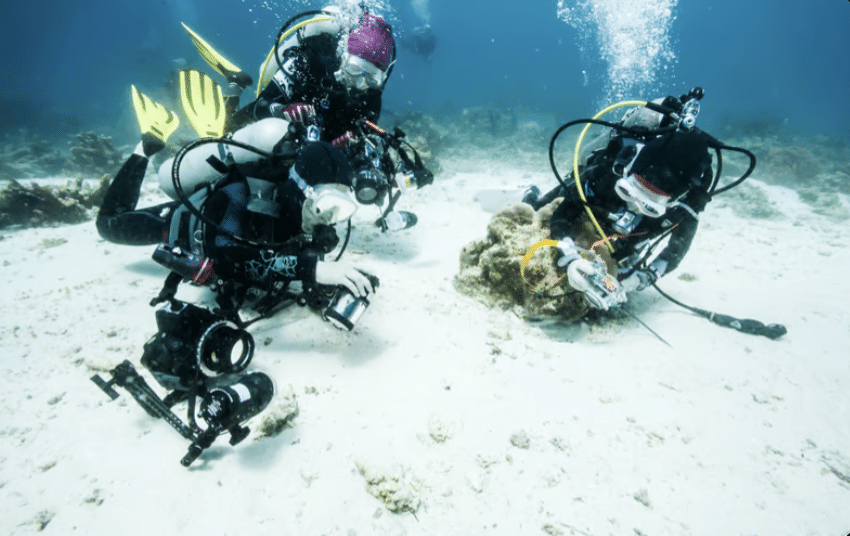
Poor buoyancy control, excessive finning, or contact with fragile coral compromises both habitat integrity and data validity.
Professional diving behaviour includes:
- Neutral buoyancy
- Controlled propulsion
- Streamlined equipment
- Minimal disturbance
Environmental responsibility strengthens research credibility.
Technology Enhancing Participation
Modern tools expand citizen science capability:
- Underwater cameras for photogrammetry
- GPS-enabled surface tracking
- Digital logging applications
- Temperature and depth data recorders
These tools allow divers to document:
- Reef structure changes
- Species migration
- Environmental anomalies
However, technology does not replace methodology.
Structured use remains essential.

Building a Culture of Informed Divers
Citizen science participation strengthens diving culture by shifting perspective from consumption to contribution.
Divers who understand ecosystem fragility often:
- Improve buoyancy discipline
- Avoid reef contact
- Educate peers
- Support conservation initiatives
Knowledge fosters responsibility.
Environmental literacy elevates professionalism.
From Recreational Participation to Professional Contribution
While citizen science often begins at recreational levels, professional divers can expand impact through:
- Structured survey leadership
- Collaboration with research institutions
- Mentoring less experienced divers
- Standardising local monitoring practices
At N9BO℠, we encourage divers to view competence as a platform for contribution. Diving skill creates access; discipline creates value.
The ocean benefits when trained divers apply structure to observation.
When Observation Supports Preservation
Marine ecosystems face increasing stress from climate change, pollution, and overfishing.
Reliable data supports:
- Reef protection policies
- Marine park designations
- Restoration initiatives
- Species conservation programmes
Divers operating with awareness and structure become part of the solution.
Citizen science is not activism. It is disciplined participation.
Professional standards underwater translate into credible data above the surface.
Interested in Contributing to Marine Research?
Structured diving skills can support real conservation efforts. Contact N9BO℠ to explore environmentally responsible diving and research-oriented training.
From the N9BO℠ Knowledge Base