Conservation Is a Behavioural Problem First
Marine degradation is rarely caused by malice.
It results from ignorance, detachment, and lack of connection. Education changes behaviour long before enforcement ever can, especially when introduced early in life.
Why Children Are the Key Audience
Children form value systems early.
When they learn:
- How marine ecosystems function
- Why biodiversity matters
- How human actions affect oceans
They carry these principles forward naturally. Conservation becomes instinctive rather than imposed.
Education Is Not Simplification
Teaching children about the ocean does not mean oversimplifying reality.
Well-designed programmes introduce:
- Food webs and ecosystems
- Human impact and responsibility
- Cause-and-effect relationships
This builds understanding without fear or guilt.

Instructor Perspective: Teaching Respect Before Skill
At N9BO℠, education precedes activity.
Before teaching diving, instructors emphasise:
- Respect for marine life
- Neutral buoyancy as conservation
- Observation without interference
These principles are foundational, not optional.
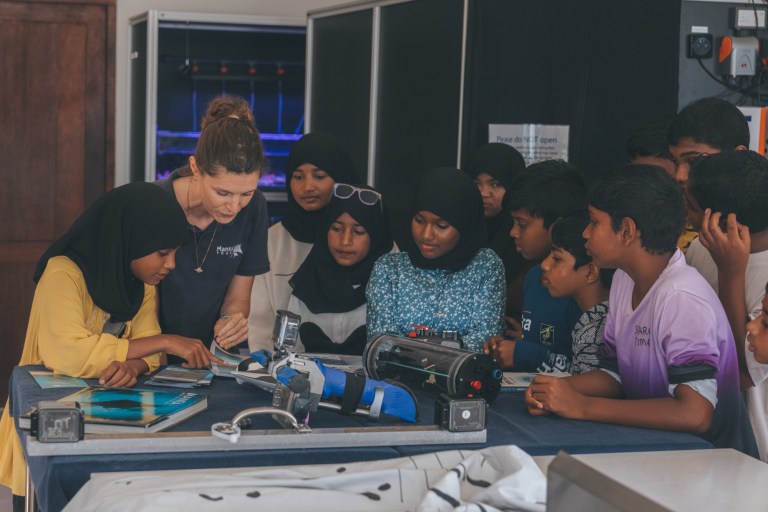
Programmes Like Scubility and Adaptive Education
Inclusive programmes demonstrate that the ocean belongs to everyone.
Teaching children—able-bodied or disabled—fosters empathy, patience, and environmental awareness. Adaptive education reinforces conservation as a shared responsibility.
Linking Fun With Responsibility
Curiosity drives learning.
Interactive experiences, storytelling, and exploration create emotional connections. When children enjoy learning about the ocean, they want to protect it.
From Education to Advocacy
Children educated about marine life often become advocates:
- Encouraging family behaviour change
- Supporting conservation initiatives
- Asking critical questions
Education scales impact far beyond the classroom.

Professional Responsibility of Dive Organisations
Dive professionals are uniquely positioned:
- They operate in marine environments
- They witness change firsthand
- They hold public trust
Engaging in education is part of ethical operation—not marketing.
Long-Term Impact Over Immediate Results
Conservation outcomes are measured in decades.
Education invests in future decision-makers, voters, and leaders. This is slow work—but it is the most effective.
Professional Parallels
Environmental education is foundational in national parks, research institutions, and conservation NGOs.
Diving organisations share this responsibility where oceans are concerned.
The Bottom Line
Protecting the ocean begins with understanding it.
By educating children early, we build a generation that values marine life not as a resource—but as a shared inheritance. At N9BO℠, education and conservation are inseparable.

Interested in Youth or Conservation Diving Programmes?
Early education builds lifelong respect for the ocean and safer future divers. Contact us to learn about education and conservation-focused training initiatives.
From the N9BO℠ Knowledge Base